High-Speed Data Acquisition: B&K Precision Launches Portable Dual-Slot System
The new compact DAS1820 data acquisition system features a plug-and-play dual-slot chassis with up to eight channels, 1 MSa/s sampling, 16-bit resolution, and a 12-inch HD touchscreen display.
The landscape of data acquisition often requires a balance between high-speed sampling and the number of available input channels. B&K Precision has released the DAS1820, a portable data acquisition recorder that addresses these requirements by providing two module slots supporting up to eight isolated universal analog channels and a high sampling rate in a single instrument. This expansion of the company’s recorder line emphasizes versatility in both field and laboratory environments.
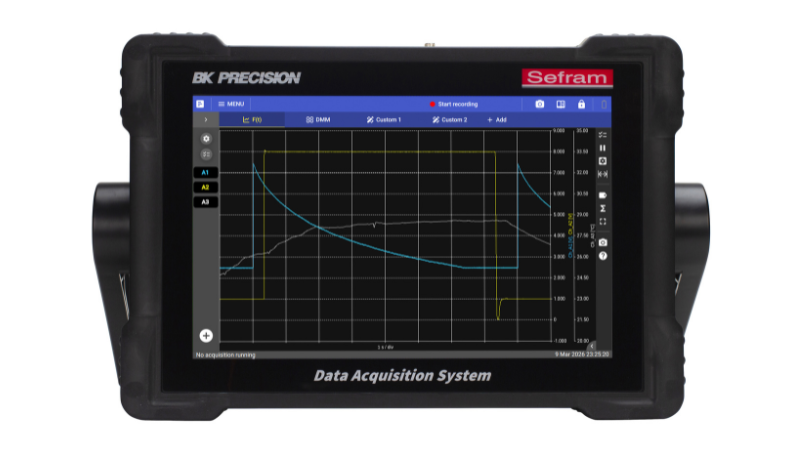
B&K Precision’s DAS1820 portable data acquisition recorder. Image used courtesy of B&K Precision
High-Speed Data Acquisition
The DAS1820 data acquisition system is built around two plug-and-play slots that support up to eight isolated universal analog input channels. Each channel supports simultaneous sampling at 1 MSa/s with 16-bit resolution. This high-speed performance is paired with a 100 kHz bandwidth, enabling the capture of rapid transients and high-frequency signals. The isolation of these channels is a critical design feature, as it enables the measurement of various signal types and potentials without the risk of ground loops or input interference.
In terms of voltage handling, the unit can accept inputs up to ±1500 V DC or 1000 Vrms when equipped with the high-voltage (HVM) module. Beyond standard voltage measurements, the recorder is equipped to handle current, frequency, and temperature via thermocouples or PT100 sensors. It also supports strain gauges and counters, making it a multifunctional tool for complex electromechanical testing and diagnostics.
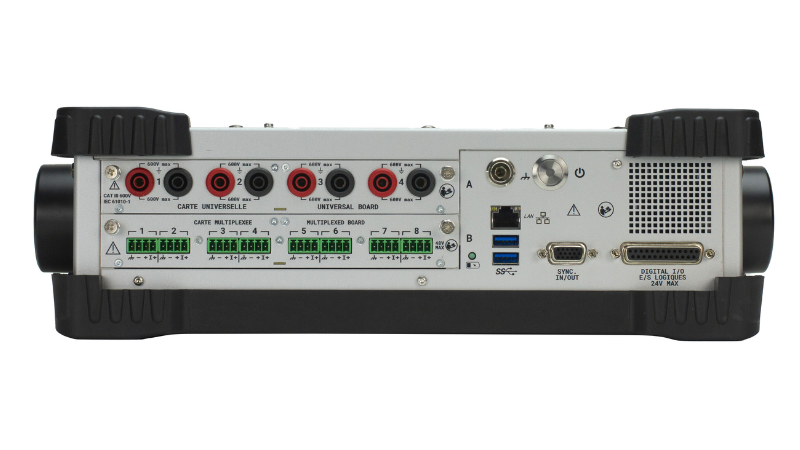
The DAS1820 features a plug-and-play design that enables users to switch out module slots to meet specific application needs. Image used courtesy of B&K Precision
Digital Integration and Data Management
Complementing the analog inputs is a suite of digital I/O capabilities. The instrument features 16 digital inputs and four outputs. These outputs can operate as TTL-level triggers or alarms, facilitating synchronization with external hardware or triggering based on specific signal conditions. For data storage, the device includes an internal 500 GB SSD. This high-capacity drive enables continuous high-speed recording for extended periods, ensuring data retention during long monitoring sessions.
The user interface is centered on a 12-inch full HD touchscreen, intended to provide a clear visualization of multiple waveforms and analytical results simultaneously. For external monitoring or presentations, an HDMI output is included. Connectivity options are further bolstered by USB and Ethernet ports, along with Wi-Fi for remote data access and control. Configuration and data management can be further handled via B&K Precision’s DASpro software.
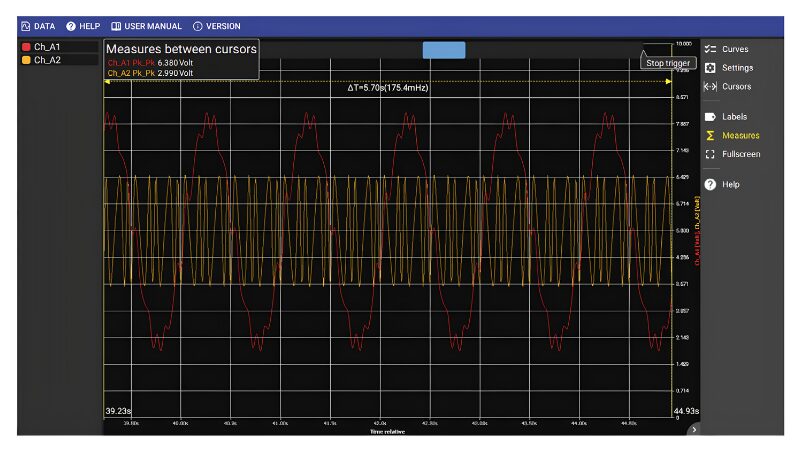
The DAS1820 comes with license-free DASpro software, allowing users to transfer ASAM MDF4 files to a PC for advanced data visualization and comprehensive post-analysis. Image used courtesy of B&K Precision
Display and Field Portability
The DAS1820 is designed for portability, featuring an internal battery that provides up to four hours of operation. This makes it suitable for applications where AC power may be unavailable or unreliable. Additionally, the instrument includes integrated power analysis functions for calculating parameters in single-phase and three-phase systems. This function enables engineers to perform sophisticated power-quality assessments directly on the device, without requiring immediate post-processing on a separate computer.
The DAS1820 integrates high-speed simultaneous sampling across up to eight isolated channels (or 16 multiplexed channels) with a comprehensive digital interface and large-scale internal storage. These features make it an effective tool for a variety of engineering tasks, including industrial maintenance, power grid monitoring, and R&D testing. It is also well-suited for automotive testing and aerospace applications where multiple high-speed sensors must be logged simultaneously in a mobile form factor.