
Ezurio Adds Edge AI and USB to Its BL54L Bluetooth LE Modules
Built on Nordic's newest SoCs, a trio of pre-certified products offers extra memory and I/O, an optional on-chip neural accelerator, and a pluggable dongle-style variant.
Ezurio has widened its BL54L family of Bluetooth LE modules with the BL54LM20 Series, a trio of products built around Nordic Semiconductor’s new nRF54LM20A and nRF54LM20B SoCs. The lineup comprises two modules, the BL54LM20A and BL54LM20B, plus a BL54LM20B USB-C Adapter. Compared with earlier BL54L parts, the series adds USB, more memory, a larger I/O set, and, for the first time in the family, module-level edge AI.
Two Modules, One Footprint
Both modules pair a 128 MHz Arm Cortex-M33 application processor with a 128 MHz RISC-V coprocessor, backed by 2 MB of non-volatile memory and 512 KB of RAM. Radio support spans Bluetooth LE Core 6.x, 802.15.4 for Thread and Matter, and NFC, all packed into an 11 × 8 × 1.8 mm outline. Ezurio lists an operating range of -40°C to +85°C, a maximum transmit power of +8 dBm, and a receive sensitivity of -95.5 dBm. Antenna choices are an integrated chip antenna or an MHF4 connector.
The larger GPIO count is the headline change for the BL54LM20A. Ezurio points to designs with more sensors and peripherals, richer human-interface hardware, and gateway- or controller-style products. The RISC-V coprocessor handles high-speed peripherals, while the low-leakage set includes timers, ADC, PWM, QDEC, and I2S. On the security front, the parts offer Secure Boot, Secure Firmware Update, and Secure Storage, and they are described as designed for PSA Certified level 3. Nordic’s nRF Connect SDK, Zephyr RTOS, and Ezurio’s Canvas software suite support firmware development.
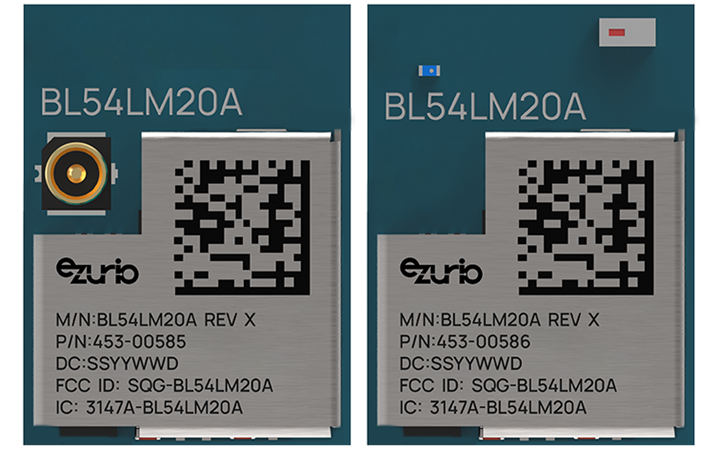
The BL54LM20A, shown here with an MHF4 connector (left) and a chip antenna (right), shares the same footprint as the BL54LM20B. Image used courtesy of Ezurio
Adding an NPU
The BL54LM20B carries the same feature set with one addition: Nordic’s integrated Axon NPU. According to Ezurio, the accelerator delivers up to 15x faster inferencing than running the same workload on the CPU alone, while improving power efficiency for always-on machine-learning tasks. Inference happens locally and offline, so no cloud connection is needed. Developers can also lean on Nordic’s Edge AI Lab and pre-trained Neuton models to speed up building and deploying on-device models.
Because the two modules share a footprint, RF design, and certification, a project can start on the BL54LM20A and later migrate to the BL54LM20B without a board respin or a new certification cycle. That arrangement lets the AI decision wait until it is actually needed.
The USB-C Adapter and Availability
The BL54LM20B USB-C Adapter tucks the BL54LM20B module into a compact, pluggable enclosure aimed at gateways, PCs, and internal development and production rigs. Per its product page, the adapter measures 26 × 15 × 6 mm, works in hosted or hostless setups, and supports Windows, macOS, and Linux. Two variants exist: a standard version and one with an added 8 MB of NOR flash, which enables dual-bank firmware update staging, data logging, and extra configuration storage without a host.
Beta samples are scheduled to ship in October, while development kit guides, datasheets, and schematics are available now. Ezurio’s product pages currently carry an early-preview label, and pricing has not yet been listed.
In short, the BL54LM20 Series hands Bluetooth LE designers more elbow room, with extra memory, extra pins, and USB, plus an optional route to on-device machine learning that skips the board redesign. Ezurio is targeting predictive maintenance sensors, wearable and portable medical devices, factory automation and robotics, asset tracking, and smart building hardware. It is a tidy setup for anyone curious about pushing a little intelligence out to the edge of a low-power wireless node.


