
GPX10 Pro AI Processor Delivers Always-On Edge AI Below 100µW
Ambient Scientific's MCU integrates 10 MX8 AI cores, Cortex-M4F, 2MB SRAM, and sensor interfaces for ultra-low-power vision, voice, and sensing applications.
GPX10 Pro AI native processor
Ambient Scientific GPX10 Pro is a processor/microcontroller for always-on embedded AI applications on power-strapped edge devices. It can run years of always-on AI on a single coin-cell battery, consuming less than <100μW. The SoC is equipped with 10 MX8 software-programmable AI cores based on the company’s DigAn silicon architecture technology, ultra-low power ADC, 8-bit DVP camera interface, 2048KB SRAM, support for a variety of peripherals, and an Arm Cortex-M4F core for non-AI workloads.
The AI processing is carried out by two groups of five MX8 AI cores each, with separate power domains. One set is in an always-on block that enables ultra-low power sensor interfacing and fusion. For example, when performing always-on keyword spotting the chip consumes less than 100µW. The 10 MX8 cores can perform up to 2,560 multiply-accumulate (MAC) operations per cycle with total peak AI throughput of 512 GOPs. The GPX10 Pro additionally includes an Arm® Cortex®-M4F CPU core for legacy control functions. Integrated analog features include an ultra-low power ADC, enhanced I2S logic and interfaces to up to eight concurrently operating analog and 20 digital sensors. The GPX10 Pro AI MCU also supports 8-bit, 16-bit and 32-bit operations for flexible precision and power saving. The GPX10 Pro accelerates common edge AI functions like voice recognition, keyword spotting, low frequency computer vision and intelligent sensing significantly faster and with substantially less computational power than today’s MCUs, NPUs or GPUs.
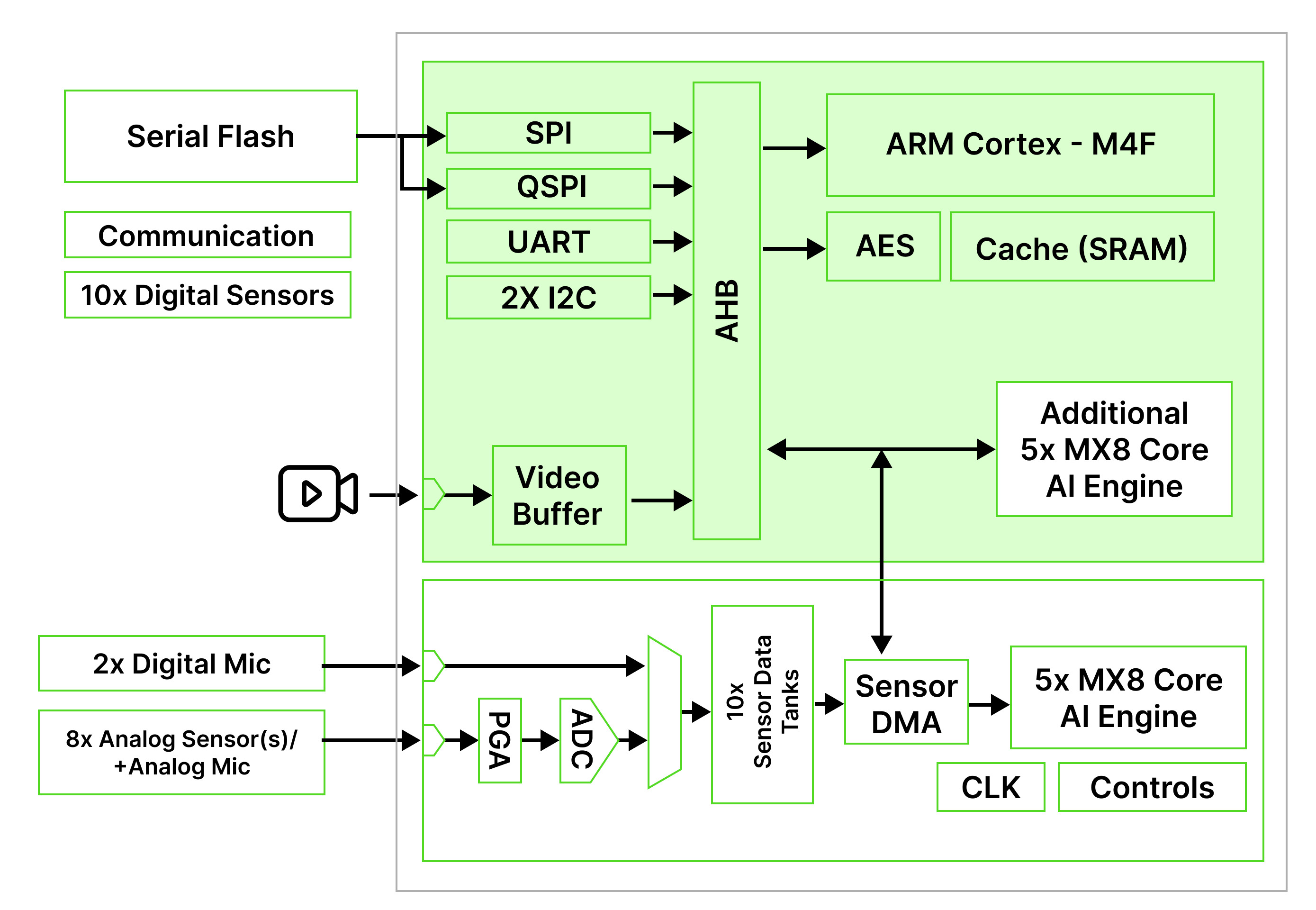
GPX10 Pro block diagram
Ambient Scientific GPX10 Pro MCU Specifications:
- High-Performance AI Processing Architecture:
- Processor Core: Integrated Arm Cortex-M4F MCU core operating from 100 KHz to 100 MHz for flexible performance scaling and ultra-low-power operation.
- AI Acceleration Engine: Features 10 programmable MX8 AI cores optimized for energy-efficient deep learning and always-on edge AI applications.
- DigAn AI Engine Architecture: Advanced AI processing framework that dynamically enables cores to operate as master or slave nodes based on workload requirements.
- AI Compute Performance: Delivers up to 2,560 MAC operations per clock cycle (256 MACs per core per cycle) and peak performance of 512 GOPS at 100 MHz.
- Energy Efficiency: Achieves more than 7 TOPS/W AI processing efficiency for battery-powered edge applications.
- Neural Network Support: Compatible with standard AI models including CNN, RNN, LSTM, and FCN, along with custom-designed neural networks.
- Precision Flexibility: Supports multiple data and weight formats ranging from 4-bit to 32-bit resolution.
- Memory and Storage:
- System SRAM: Integrated 2MB on-chip SRAM for AI workloads and real-time processing.
- Retention Memory: Includes 64KB Always-On retention SRAM for low-power data storage during sleep modes.
- External Storage Support: Interfaces with external SPI/QSPI Flash memory for firmware and model storage.
- AI Vision and Sensor Processing:
- Camera Interface: Supports an 8-bit DVP camera interface with a dedicated 32KB auto-streaming video buffer for low-frequency image classification applications.
- Camera Control: Includes I²C interface for camera configuration and management.
- Sensor Fusion Capability: Enables simultaneous connection of up to 10 analog and digital sensors for multi-sensor AI applications
- Audio Processing: Supports up to 4 analog microphones and 2 digital I²S microphones with 16-bit audio processing capability.
- Always-On AI and Signal Processing:
- FFT Accelerator: Integrated 256-point FFT engine within the Always-On domain for real-time signal analysis and edge processing.
- Ultra-Low-Power AI Operation: Designed for continuous AI inference with power consumption below 100 µW.
- Battery Longevity: Enables years of always-on AI operation from a single coin-cell battery.
- Energy Harvesting Support: Enables charger-less AI solutions by harvesting power from sources such as kinetic and RF energy.
- Connectivity and Peripheral Interfaces:
- GPIO: 16 configurable GPIO pins with 4 interrupt inputs.
- Communication Interfaces:
- 1× I²C Slave
- 1× I²C Master
- 2× SPI
- 2× UART
- Analog Interfaces and Data Acquisition:
- Integrated ADC: Multi-channel ultra-low-power 16-bit ADC with 14-bit ENOB performance.
- Analog Sensor Support:
- Supports up to 8 analog sensors
- Consumes less than 5 µW at 20K samples/s
- Less than 20 µW at 1M samples/s
- Security Features: Hardware Security: Integrated AES-128 encryption engine for secure data processing and protected AI applications.
- Advanced Low-Power Architecture:
- Power Optimization: Uses an advanced clock management system including:
- Low-Power Oscillator (LPO)
- External Clock Source
- Phase-Locked Loop (PLL)
- Ultra-Low Power Consumption: Optimized for always-on edge intelligence with power consumption below 100 µW.
- Power Optimization: Uses an advanced clock management system including:
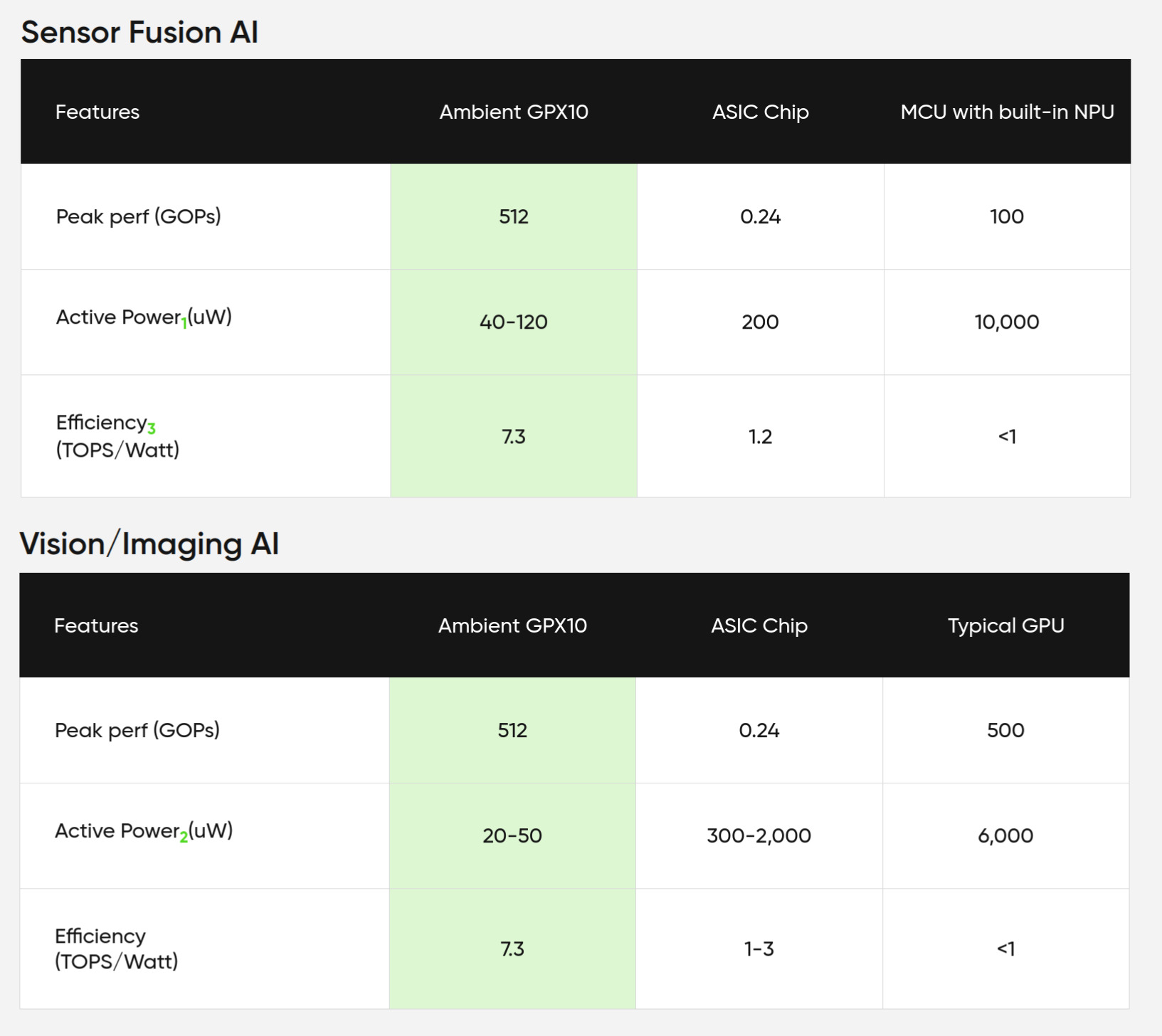
Ambient GPX10 Pro vs ASIC vs MCU with NPU
The company offers an SDK that includes:
- Supported AI/ML Frameworks: Keras, Tensorflow, ONNX
- Compiler Toolchains: ONNX Runtime, MX8 Runtime, ONNX-MLIR
- Ambient Libraries: MX8 Math Libraries (Arithmetic Logic, Compare, etc) and MX8 AI Libraries (Convolution, Recurrent, etc.)
- System Software: Peripheral drivers, system interface, emulation support
- The operating systems that are supported are listed as “Windows” and “RTOS”.
Ambient Scientific also provides certain performance metrics for Sensor Fusion AI and Vision AI workloads, comparing the 512 GOPS GPX10 with a dedicated ASIC chip and a general MCU with an integrated NPU. Note this is for the earlier GPX10, not the new GPX10 Pro, but the ten MX8 cores look to be the same, and the Pro model mainly has extra memory (2048 KB vs 256 KB) and various improvements.
There’s not much publicly available information at this point and the user will be required to request the SDK on the product page for access.
Images used courtesy of Ambient Scientific


