
Grinn Delivers High-Performance Edge AI in Tiny 25 x 25 mm System-on-Module
The Grinn AstraSOM-261x is an Edge AI SoM built on the Synaptics Astra SL2610 processor, packing a 1 TOPs NPU and advanced graphics into an ultra-compact industrial-grade footprint.
Edge AI hardware keeps trending smaller, but fitting a capable processor, NPU, memory, power management, and a broad set of I/O onto a module small enough for genuinely space-constrained applications remains a real design challenge. Poland-based embedded systems company Grinn is taking a run at that problem with the AstraSOM-261x, a new System on Module (SoM) it claims is the world’s smallest based on the Synaptics Astra SL2610 processor family.
At 25 mm x 25 mm and built on an LGA178 footprint, the module is aimed at industrial, medical, and consumer applications where board real estate is limited but AI inference, connectivity, and reliability all still matter.
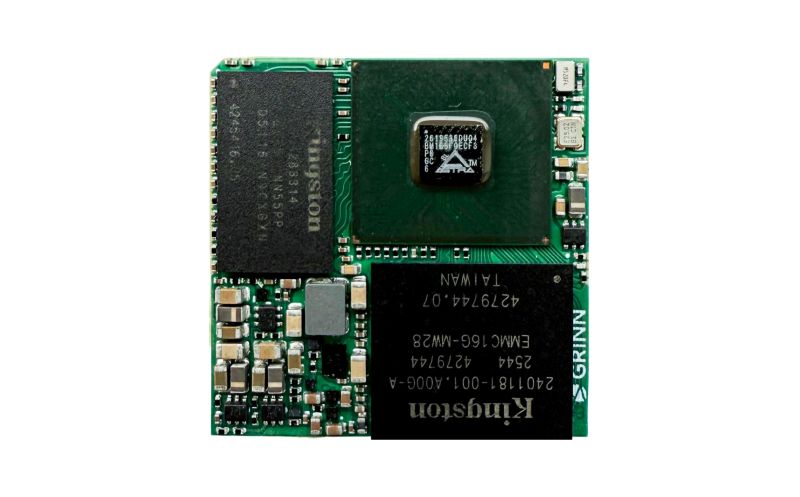
Grinn’s AstraSOM-261x SoM comes in a compact 25 mm x 25 mm form factor. Image used courtesy of Grinn
A Look at the Grinn AstraSOM-261x
The Synaptics Astra SL2610 product line sits at the center of the new Grinn AstraSOM-261x SoM design. The processor is part of the Synaptics’ Torq Edge AI platform, which combines a heterogeneous CPU configuration — single or dual Arm Cortex-A55 cores alongside a Cortex-M52 — with a dedicated 1 TOPs NPU for AI inference workloads. Graphics are handled by a Mali-G31 GPU, which supports Full HD at 60 fps with OpenGL ES 3.2 and Vulkan 1.3.
A notable feature of the Torq platform is its use of Google Research’s Coral NPU. The NPU uses an open-source IREE/MLIR compiler and runtime, which gives developers direct access to a standard toolchain rather than a proprietary one. This is a noticeable and meaningful difference for teams that want portability and long-term maintainability in their inference pipeline.
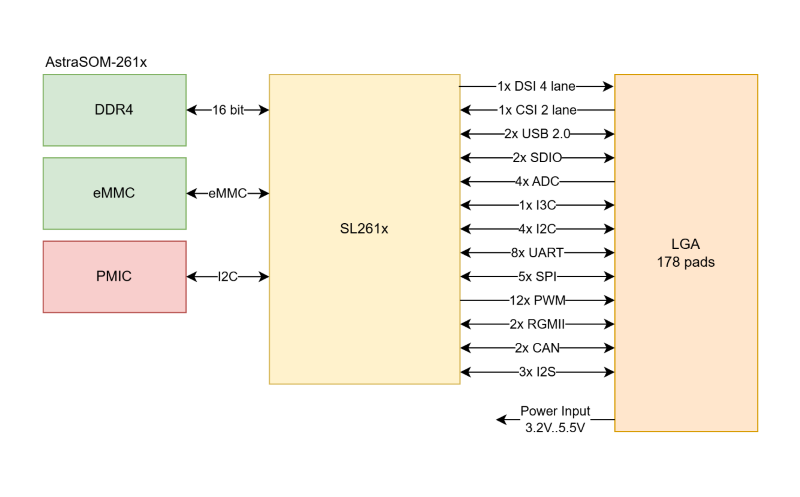
Block diagram of the AstraSOM-261x. Image used courtesy of Grinn
I/O, Power, and Industrial Credentials
Despite its footprint, the AstraSOM-261x doesn’t cut the peripheral list short. The module exposes MIPI-CSI and DSI interfaces, dual Ethernet with TSN and IEEE 1588 support, USB 2.0, CAN-FD, and high-speed serial interfaces. Grinn says all GPIOs are available to developers through the LGA178 connector, which matters for carrier board designers who need maximum flexibility without routing around hidden limitations.
Power input is a single 4.5 V to 5.5 V DC rail, and the module can supply power directly to external components, which helps keep carrier board complexity down. Built-in low-power modes are included for battery-operated use cases. The operating temperature range runs from -40°C to 85°C, which puts it in legitimate industrial territory rather than the extended consumer range that sometimes gets relabeled as industrial.
Security is handled through PSA Level 3 Root of Trust, Secure Boot, and on-chip crypto engines, a combination that addresses both hardware attestation and data integrity for connected deployments.
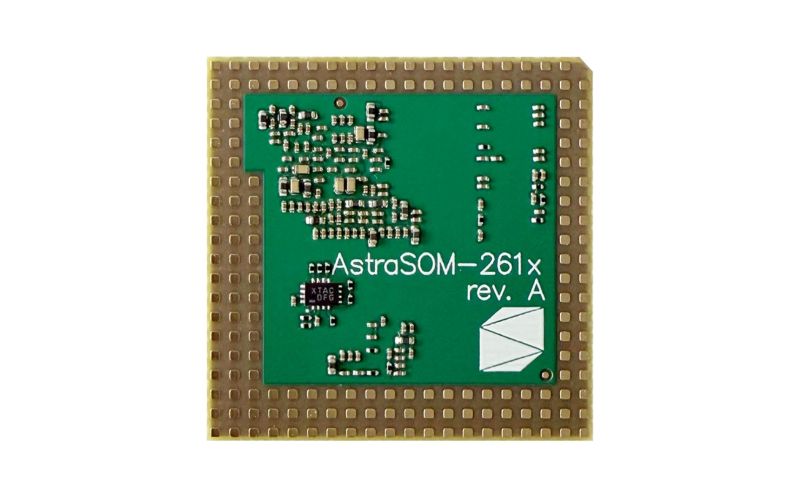
Back view of the Grinn AstraSOM-261x. Image used courtesy of Grinn
Next-Generation Smart Devices
Grinn is also shipping a companion industrial single board computer (SBC) designed around the AstraSOM-261x. The board is intended to serve as a development platform and a direct path to production: teams prototype with the SBC, then design their own carrier board using the same module without swapping out the core compute element. That continuity between development and production hardware tends to reduce integration surprises and shorten the gap between first prototype and manufacturable design.
The AstraSOM-261x is the latest collaboration between Grinn and Synaptics, who have previously worked together on the larger AstraSOM-1680 platform. Where that module targets higher-compute applications, the 261x is positioned for designs where size is the binding constraint and a 1 TOPs inference budget is sufficient for the task at hand, covering a wide range of on-device classification, detection, and sensor-fusion workloads in smart industrial, consumer, and medical devices.


