
Hirose’s GT37 Connector Brings Shielded Gigabit Ethernet to Vehicles
A compact wire-to-board design targets EMI-prone cabin wiring and aims to simplify harness assembly for next-generation ADAS and connected-vehicle systems.
Modern vehicles have become rolling data networks, and the harnesses tying together cameras, radar modules, and driver-assistance computers must keep pace with that shift. Hirose has introduced the GT37 Series, a shielded wire-to-board connector engineered for automotive Ethernet links that run to the 1000BASE-T1 standard.
As electronic control units, sensors, displays, and ADAS features proliferate throughout a vehicle, electromagnetic interference becomes harder to ignore. The GT37 Series meets that pressure with a fully shielded structure designed to maintain signal integrity even in electrically noisy cabin and underhood environments. Supporting Gigabit-rate transmission over a single twisted pair, the connector lets automotive Ethernet carry bandwidth-hungry traffic without the bulk of multi-pair cabling, trimming harness volume.
Guarding the Signal Path
Impedance matching at the stripped-cable section preserves transmission performance right through the termination point, a detail that matters when Gigabit Ethernet has little margin for reflection or loss. A dual-lock mechanism adds a tactile click when the connector fully mates, giving assemblers a physical cue that the joint is secure rather than leaving that judgment to feel alone. Rated for 1 A at 30 V AC and built to operate between -40°C and 105°C, the GT37 Series is sized around a two-position interface measuring 8.6 mm wide by 10.6 mm high, a footprint designed to conserve PCB real estate in already-crowded module enclosures.
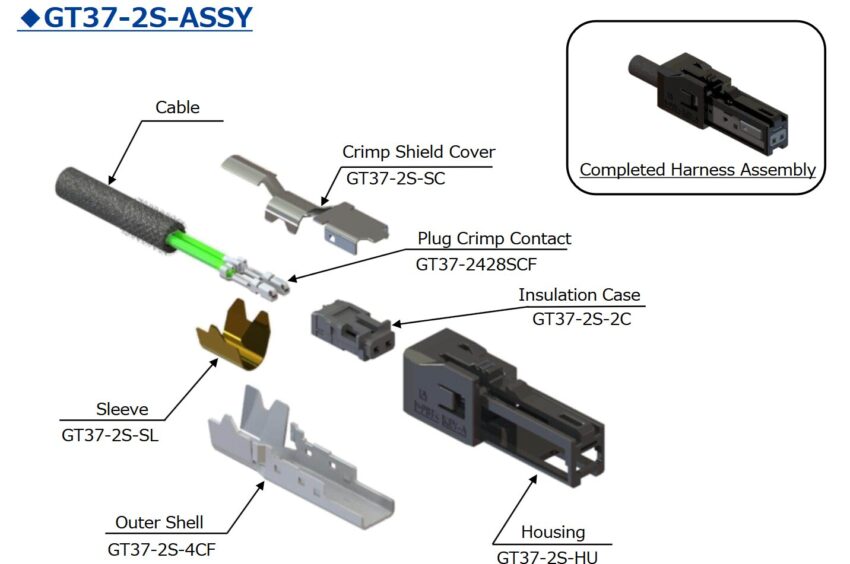
A look inside the GT37 Series plug assembly, including the crimp shield cover and sleeve that replace traditional copper tape. Image used courtesy of Hirose
Trimming Steps on the Harness Floor
Hirose designed the connector’s cable strip length around hand-crimping, so harness assemblers can reach consistent terminations without extra prep work. The inner cable sheath never needs to be cut during assembly, which removes a step that would otherwise slow the line. A sleeve component also replaces the copper tape traditionally applied during shield termination, reducing both material count and handling time. None of this requires dedicated processing equipment: the GT37 Series works with standard automotive harnesses and conventional manual or automated assembly lines.
Pete Lais, Assistant Vice President of Product Management for Hirose Electric Americas, framed the connector against the backdrop of vehicle electrification and autonomous driving, noting that the growing number of cameras, sensors, displays, and control units is pushing data volumes beyond what conventional CAN and LIN networks can carry. Automotive Ethernet, in his view, supplies the scalable backbone that ADAS, automated-driving, and connected-vehicle systems now require, with the GT37 Series contributing shielding, compact packaging, and streamlined harness assembly toward that goal.
For engineers laying out next-generation vehicle architectures, the GT37 Series looks like a practical answer to a familiar tension: bandwidth keeps climbing while board space and assembly time keep shrinking. With shielded 1000BASE-T1 support and a simplified crimping process, the connector fits naturally into displays, cameras, LiDAR units, and other high-speed links that automotive designers are racing to wire up. It’s the kind of unglamorous hardware that could quietly make ADAS and connected-vehicle rollouts a little easier to build.


