
IBM’s New Mainframe Chip Runs Arm and IBM Z Instructions Natively
A 2-nanometer processor core natively runs Arm and IBM Z instructions, allowing Arm-native Linux to operate alongside z/OS on the same system.
At Hot Chips 2026, IBM introduced its first dual-architecture processor for future IBM Z and LinuxONE systems, designed to let enterprises run Arm-native applications directly alongside existing mainframe workloads. The announcement marks the first hardware outcome of the IBM and Arm collaboration formed in April 2026 and addresses a specific engineering challenge: how to provide access to the Arm software ecosystem without requiring data centers to sacrifice the reliability that makes IBM Z and LinuxONE attractive to regulated industries.
One Core, Two Instruction Sets
Rather than pairing separate Arm and IBM cores on a single die, IBM engineered each core to execute Arm and IBM Z, or Arm and LinuxONE, instructions concurrently, prioritizing the established performance, security, encryption, and availability characteristics of whichever platform is active. That native execution model differs from typical heterogeneous computing designs, which usually rely on discrete co-processors or accelerator tiles dedicated to a secondary instruction set. Built on a 2-nanometer node, the chip packs 11 high-performance cores clocked above 5.7 GHz, along with AI inference accelerators aimed at in-transaction fraud detection, an on-chip data processing unit for I/O acceleration, and an enlarged cache hierarchy suited to enterprise workloads. Systems built around the processor retain IBM Z and LinuxONE’s established scaling ceiling of hundreds of cores and tens of terabytes of memory.
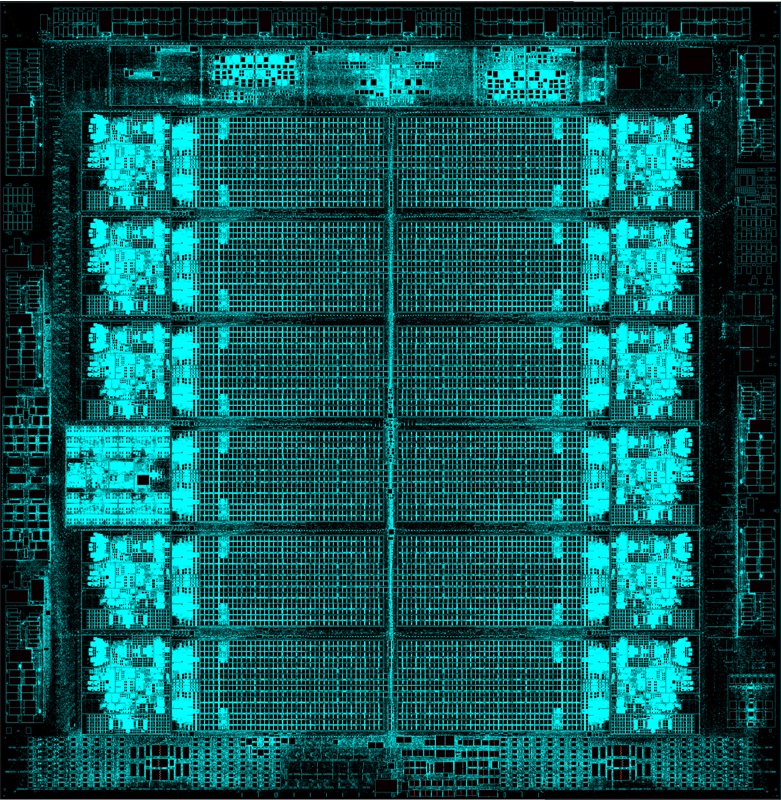
The chip’s floorplan reveals its symmetric core layout, with I/O and cache structures arranged around a central spine. Image used courtesy of IBM
Extending an Ecosystem Rather Than Replacing One
The Arm software base spans more than 22 million developers and a growing set of cloud-native and AI applications. IBM is positioning the new processor as a bridge that carries that ecosystem into transaction-heavy, data-intensive environments without displacing z/OS or existing Linux workloads already running there. Arm has framed the move as part of a broader industry shift toward Arm-based infrastructure among major cloud and AI providers, with the IBM Z and LinuxONE integration extending that trend into mission-critical, highly regulated environments such as financial services and healthcare. IBM has also opened a registration channel for independent software vendors, open-source maintainers, and systems integrators seeking testing and validation opportunities as the platform matures.
The dual-architecture processor remains a design under development rather than a shipping product, with IBM and Arm describing the milestone as an architectural direction rather than a delivery date. Still, the approach outlines a fairly unusual path for coexisting instruction sets on a single core, and it points toward future IBM Z and LinuxONE deployments that can host Arm-native fraud detection models, cloud-native middleware, and AI inference pipelines alongside the transaction processing these systems have handled for decades. Engineers watching the mainframe space have good reason to keep an eye on how this native dual-instruction execution performs once early silicon reaches customers.


