
Business Bytes: Industry Giants Recalibrate AI and Networking Strategies
Tesla partners with Samsung for AI chip manufacturing, Intel spins off its networking business, and chiplet development heats up as two Asian semiconductor firms collaborate.
Tesla and Samsung Forge AI Chip Partnership
Tesla has reportedly signed a substantial $16.5 billion, multi-year deal with Samsung to manufacture its next-generation AI chips. This agreement, which runs through 2033, positions Samsung as the primary foundry partner for Tesla’s upcoming AI6 chips. These custom-designed semiconductors are intended to power a wide range of Tesla’s technologies, including its autonomous vehicles, humanoid robots, and expanding AI infrastructure. The partnership represents a significant strategic shift for Tesla, which had previously invested heavily in its in-house Dojo supercomputer and custom chip development. Instead of full vertical integration, Tesla is now opting to outsource manufacturing to a specialized, high-volume foundry partner.

Tesla uses a versatile, scaling chip to power a variety of products, from self-driving vehicles to AI training centers. Image courtesy of Adobe Stock
Production of the AI6 chips is slated to take place at Samsung’s new facility in Taylor, Texas. This domestic manufacturing location is a notable detail, as it aligns with U.S. government efforts to increase domestic chip production and reduce reliance on overseas suppliers. The project has also received significant funding from the CHIPS Act, underscoring its strategic importance.
From Samsung’s perspective, the deal provides a major customer for its new foundry, which reportedly had struggled to secure clients. The collaboration is expected to leverage Samsung’s advanced 2nm Gate-All-Around (GAA) process technology, which is critical for delivering the computational power and energy efficiency required for AI workloads. By offloading the manufacturing complexities to Samsung, Tesla can focus its resources on its core competencies of chip design and software development for its AI applications. This move could also help Tesla mitigate supply chain risks and ensure a more predictable supply of its custom silicon for years to come.
Intel Spins Off Its Network and Edge Group
In a separate but equally significant industry development, Intel has announced plans to spin off its Network and Edge Group (NEX) into a standalone business. This strategic move, spearheaded by CEO Lip-Bu Tan, is part of a broader effort to streamline Intel’s operations and sharpen its focus on its core businesses: PC and data center chips. While the NEX division generated $5.8 billion in revenue in 2024, its operational model was deemed to be a poor fit for Intel’s primary strategy. The new, independent company will focus exclusively on delivering silicon solutions for communications, enterprise networking, and Ethernet connectivity.
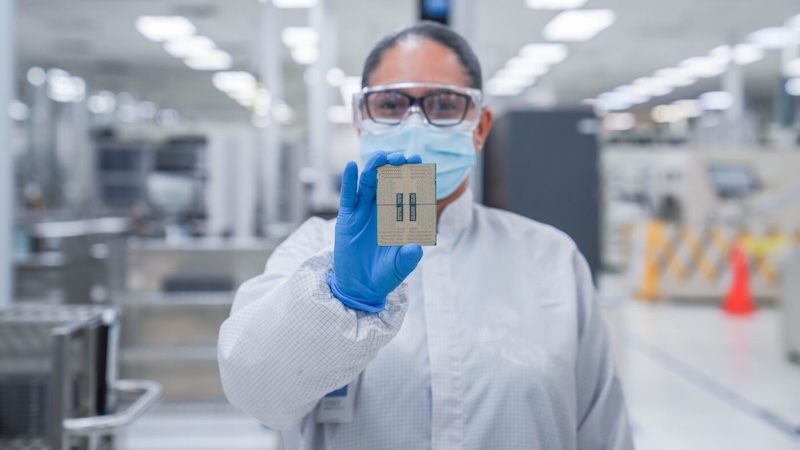
The industry giant plans to spin off a portion of its silicon-making portfolio and seek outside investors to build the brand. Image used courtesy of Intel
Intel intends to remain an “anchor investor” in the new entity, allowing it to benefit from future growth while enabling the spun-off company to operate with greater agility and focus. This is a similar strategy to Intel’s recent divestiture of its majority stake in the Altera programmable chip business. The spin-off is a clear signal that Intel is strategically divesting non-core assets to reallocate resources toward high-growth areas, particularly in AI and advanced semiconductor manufacturing. The move also reduces Intel’s direct competition with companies like NVIDIA’s Mellanox, Marvell, and Broadcom in the communications chip market.
For engineers, the creation of a focused networking company could lead to more specialized and innovative products, as the new entity will be able to make its own investment and product roadmap decisions without being constrained by the broader corporate strategy of a large conglomerate.
Collaborative Chiplet Development for Next-Gen AI
The semiconductor industry’s focus on specialization and collaboration is further exemplified by a new partnership between CoAsia SEMI and South Korean AI semiconductor company Rebellions. The two companies have teamed up to co-develop a next-generation AI chiplet based on Rebellions’ REBEL architecture.
This collaboration highlights the growing importance of the chiplet ecosystem, which enables the creation of complex, high-performance systems by integrating multiple specialized dies in a single package. The partnership leverages CoAsia SEMI’s expertise in 2.5D silicon interposer technology and advanced packaging, combining it with Rebellions’ fabless design capabilities.
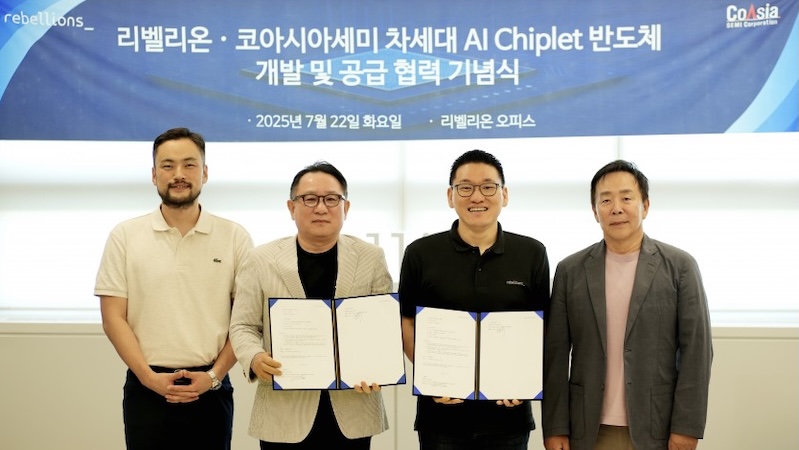
Rebellions and CoAsia SEMi have been collaborating since April, initially working together to research and develop multi-petaflop PIM chiplets. Image courtesy of CoAsia SEMI
This chiplet-based design approach offers several technical advantages over conventional monolithic single-die System-on-Chip (SoC) architectures. It provides superior design flexibility, better yield, and optimized power and performance. The joint project aims to integrate I/O dies and HBM3E memory into the REBEL chiplet, creating a more powerful and efficient solution for data center and high-performance computing (HPC) applications. The companies aim to complete development and verification by the end of 2026, with a clear roadmap toward mass production for global AI data centers.
By bringing together fabless design, packaging, assembly, and IP from various partners, this collaboration illustrates how companies are forming comprehensive value chains to compete in the rapidly evolving AI semiconductor market, where no single company can master every aspect of the design and manufacturing process.


