
indie’s iND881 Brings Edge AI to Automotive and Robotic Cameras
The iND881 SoC pairs a low-latency ISP with an NPU and DSP for smart-camera perception in vehicles and humanoid robots.
indie Semiconductor has announced the iND881, a next-generation edge AI system-on-chip designed to bring intelligent perception to smart cameras in automotive and robotic platforms. Built on the foundation of indie’s existing iND880 camera video processor, the new device integrates an AI compute engine with the company’s established multi-camera image signal processor, a combination that positions it squarely at the intersection of vision processing and edge machine inference.
Heterogeneous Compute Architecture
The iND881’s architecture revolves around three distinct compute elements working in concert. A Neural Processing Unit delivers 2 TOPS at 1 GHz on the flagship iND88140 variant, accelerating inference workloads with support for unstructured sparsity to reduce memory bandwidth and power draw. A floating-point VLIW SIMD DSP rated at 500 GOPS handles classical signal processing tasks: filtering, transforms, and other deterministic operations that don’t demand neural acceleration. Rounding out the compute subsystem is a quad-core ARM Cortex-A53 application processor capable of running up to 1 GHz, with support for a full Linux-based OS as well as legacy codebases.
The ISP itself is no afterthought. Capable of processing up to 700 MP/s with sub-1 ms latency, it supports simultaneous multi-camera input streams across a 144 dB HDR 24-bit pipeline. Indie’s proprietary sixth-generation eWARP geometric processor handles lens distortion correction for ultra-wide fields of view exceeding 200 degrees, with a typical latency of just one-sixth of a frame. Video output options include MIPI D-PHY at 10 Gbps or MIPI C-PHY at 17.1 Gbps, while the onboard H.264 encoder supports up to 8MP at 60 fps.
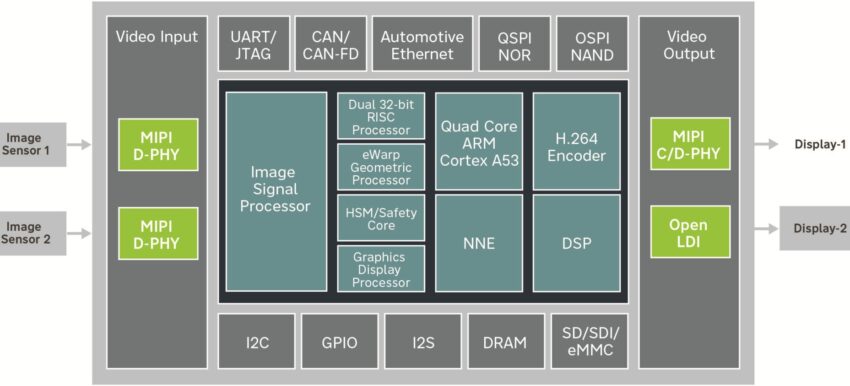
The iND881’s heterogeneous compute blocks — including the NPU, DSP, and quad-core Cortex-A53 — sit downstream of a dual-input MIPI D-PHY front end feeding the ISP. Image used courtesy of indie
Sensor Fusion and Security
Beyond standard RGB camera input, the iND881 supports a wide range of sensor modalities—IR, thermal, time-of-flight, radar, and LiDAR—enabling multimodal sensor fusion on a single chip. This breadth of input support is particularly relevant for autonomous mobile robots and humanoid platforms, where perception reliability across varying lighting and environmental conditions is non-negotiable.
Security receives dedicated silicon in the form of a hardware security module featuring a dual-core lockstep RISC processor. The HSM supports secure boot, asymmetric and symmetric cryptographic functions, a true random number generator, and signature verification on video input streams. For automotive deployments, the iND881 meets ASIL-B requirements per ISO 26262 and is automotive-qualified to AEC-Q100 Grade 2. A unified SDK, covering code libraries, APIs, compiler toolchain, debugger, and reference camera tuning, carries over from the iND880 platform, easing the migration path for existing customers.
Applications and Availability
The iND881 can be paired with emotion3D’s production-validated driver and occupant monitoring perception stack, a software layer that indie acquired alongside emotion3D in 2025, to form a fully integrated hardware-software solution. This pairing targets DMS/OMS deployments in passenger vehicles, though the platform is equally applicable to smart eMirrors with blind-spot detection and parking assistance systems. The iND88120 variant, with 1 TOPS of NPU performance and a dual-core A53, offers a lower-power option for cost-sensitive designs.
The iND881 is now sampling and is slated for demonstrations at AutoSens and InCabin USA 2026. For engineers working on perception systems in vehicles, humanoid robots, or industrial automation, the combination of heterogeneous compute, multi-modal sensor support, and an established software ecosystem makes the iND881 worth a close look.


