
Meet the Arduino VENTUNO Q: A “Dual-Brain” Architecture on a Single Board
The new board pairs a Dragonwing IQ8 series processor with an STM32H5 microcontroller, targeting edge AI, robotics, and motion control applications.
Announced ahead of Embedded World 2026, the Arduino VENTUNO Q is a new single-board computer designed around a dual-processor architecture aimed squarely at edge AI, robotics, and real-time actuation. The board combines a Qualcomm Dragonwing IQ8 series processor with a dedicated STM32H5 microcontroller, with one handling AI inference and the other handling low-latency physical control.
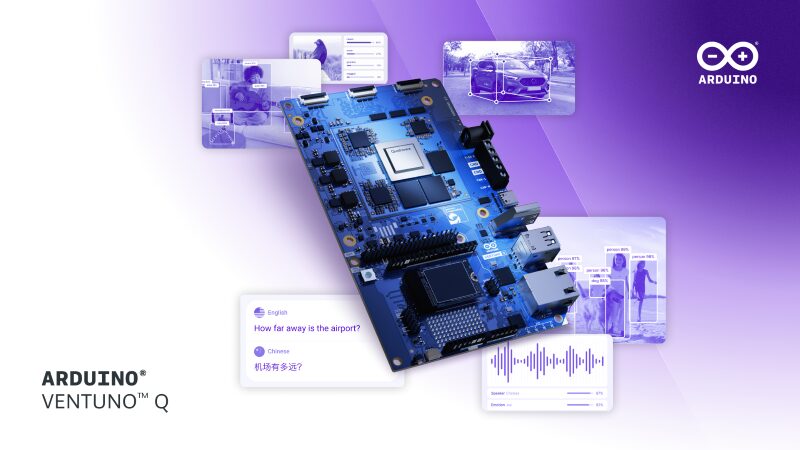
The Arduino VENTUNO Q features a Qualcomm Dragonwing IQ8 series processor and an STM32H5 microcontroller. Image used courtesy of Qualcomm Technologies
The Arduino VENTUNO Q
The core idea behind VENTUNO Q’s hardware design is to separate compute-intensive AI workloads from deterministic real-time tasks. The Qualcomm Dragonwing IQ8 series processor features an NPU capable of up to 40 dense TOPS, running Linux Ubuntu or Debian with upstream support. The STM32H5 microcontroller, meanwhile, runs the Arduino Core on Zephyr OS and handles timing-sensitive tasks such as motor control and actuation — work that doesn’t mix well with a general-purpose OS.
Supporting both processors are 16 GB of RAM and 64 GB of expandable onboard storage, giving the board enough headroom to run concurrent inference tasks and local AI models without reaching for the cloud.
The Arduino VENTUNO Q includes 16 GB RAM and 64 GB expandable storage. Video used courtesy of Arduino
Connectivity and I/O
On the hardware side, VENTUNO Q covers a broad range of connectivity and interface options. Wireless connectivity includes WiFi 6 and Bluetooth 5.3. Wired options include 2.5 Gb Ethernet and high-speed connectors for multiple MIPI-CSI cameras, which the board can process simultaneously using AI.
For physical control applications, the board exposes native CAN-FD, PWM, and high-speed GPIO — I/Os suited to industrial and robotics use cases. ROS 2-ready workflows are built directly into the platform, and the board accepts Arduino UNO shields and carriers, Arduino Modulino nodes, Qwiic sensors, and Raspberry Pi Hats.
Software and AI Tooling
Development on VENTUNO Q runs through the Arduino App Lab environment, which provides a unified interface for Arduino sketches, Python scripts, and AI workflows. The platform ships with access to a set of ready-to-use AI models via Qualcomm AI Hub, covering local LLMs, VLMs, ASR, TTS, gesture recognition, pose estimation, and object tracking — all capable of running fully offline.
For custom model development, Arduino App Lab is now integrated with Edge Impulse Studio, with additional AI framework support planned. The board can be used as a standalone single-board computer with a display, keyboard, and mouse, or connected to a desktop or laptop for remote development.

The Arduino VENTUNO Q is purpose-built for AI-powered systems, robotics and actuation, edge AI vision, and more. Image used courtesy of Arduino
AI, Robotics, Motion Control, and More
Arduino positions VENTUNO Q for a range of edge AI scenarios. On the robotics side, the combination of real-time motor control and vision processing makes it applicable to pick-and-place arms, autonomous navigation using Visual SLAM, and service robots. For AI-powered systems, the offline LLM and ASR/TTS capabilities point toward voice interfaces, smart kiosks, and interactive installations that don’t require a network connection. The board also targets industrial-edge vision use cases, such as quality inspection systems that use local VLMs to identify defects.
In education and research, the unified development environment and broad hardware compatibility lower the barrier to experimenting with computer vision, generative AI, and embedded robotics.
Accessible Edge AI
Arduino VENTUNO Q is scheduled for availability in Q2 2026 through the Arduino Store and a network of distributors, including DigiKey, Farnell, Macfos, Mouser, and RS. The name “Ventuno” — Italian for twenty-one — marks Arduino’s 21st anniversary as a company, and the board’s naming continues the UNO family’s lineage while stepping up its capabilities.


