
Melexis Introduces 22-Bit Resolution Encoder for Rotary and Linear Motion
The new dual-input MLX90520 offers 22-bit inductive position sensing with sub-microsecond latency, targeting robotics and industrial applications with 20 mm to 200 mm diameter joints.
Melexis has introduced the MLX90520, a dual-channel inductive position encoder delivering 22-bit resolution for rotary and linear motion sensing applications. The device addresses position feedback requirements in robotics, construction equipment, and agricultural machinery, where joint diameters range from 20 mm to 200 mm and linear travel extends up to 400 mm.
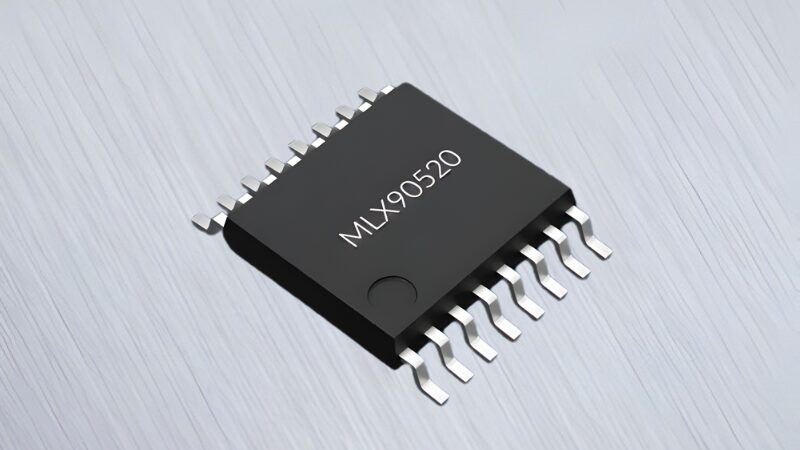
Melexis’ new 22-bit dual-input inductive encoder for absolute rotary and linear motion sensing. Image used courtesy of Melexis
The MLX90520 Dual-Input Inductive Position Sensor
The MLX90520 inductive encoder integrates two independent inductive-sensing channels, each comprising a transmit-coil oscillator and a three-phase receiver. An on-chip LC oscillator operating between 2.0 MHz and 5.0 MHz drives the transmit coil, which inductively couples to receiver coils through a patterned PCB target. The device achieves a maximum accuracy of ±0.36 degrees electrical per channel, with RMS noise ranging from 0.025 to 0.100 degrees electrical, depending on the loop filter bandwidth settings.
Digital signal processing includes automatic gain control across five gain settings, 16-point angular linearization per channel, and phase-tracking loops with configurable bandwidth. The architecture supports electrical angular speeds up to 240,000 e-rpm at the default 20 MHz application clock, with proportional scaling at reduced clock frequencies. Delay compensation circuitry maintains latency within ±1 μs by utilizing calculated speed and acceleration values to correct for system propagation delays.
The MLX90520 features 22-bit resolution for high-precision sensing. Video used courtesy of Melexis
Vernier Angle Calculation and System Integration
The device implements Vernier angle calculation between its two channels to enable absolute position sensing across extended mechanical ranges. Programmable Vernier divider ratios support various pole-pair combinations, with the high-resolution mode outputting a 22-bit absolute position value comprising a 6-bit sector counter and a 16-bit fine angle.
The encoder supports both SPI and SSI output protocols, with SPI offering frame rates up to 10 MHz and SSI providing conventional or frame-read modes. For multi-sensor systems, the Super Frame Read function enables TDMA operation with synchronized data capture across multiple devices sharing a common MISO bus. The 3 mm total assembly height, including IC, PCB, and target, facilitates integration into through-shaft mechanical designs.

The MLX90520 is designed for position sensing in robotics and machinery joints with diameters between 20 mm and 200 mm. Image used courtesy of Melexis
Safety Features and Environmental Robustness
Functional safety implementation includes multiple diagnostic monitors covering LCO amplitude and period, sensor short- and loss-detection, AGC operation, and ADC linearity. The device supports SIL 2 compliance, as documented in its IEC 61508 safety manual, with safe states implemented via either a high-impedance output or protocol-specific fault reporting. Fault detection time intervals of 4 ms apply to both individual channel angles and calculated Vernier positions.
The inductive sensing principle provides immunity to magnetic stray fields per ISO 11452-8, while the contactless PCB coil implementation resists contamination from dust and particulates. Operating temperature spans -40°C to 125°C, with supply voltage range of 4.5 V to 5.5 V and typical current consumption of 20 mA with LCO enabled. The MLX90520 is housed in a TSSOP-16 package.
The MLX90520 targets applications requiring precise joint position feedback in multi-axis robotic manipulators, linear actuators in factory automation, and rotating assemblies in construction and agricultural equipment. The device is available through Melexis distribution channels, with evaluation tools and firmware updates accessible through the company’s website.


