
Rohm NFC Wireless Power Chipset for Ultra-Compact Wearable Devices
The ML7670 and ML7671 chipsets deliver 250 mW of wireless power via 13.56 MHz NFC to accommodate the strict space constraints of small consumer devices.
For standard consumer devices, wireless charging has traditionally relied on the Qi standard developed by the Wireless Power Consortium. While effective for smartphones, implementing Qi-based systems in highly miniaturized applications introduces major spatial challenges. The physical dimensions of the required coils and tight alignment tolerances make it impractical for ultra-compact form factors like smart rings.
To overcome this constraint, hardware designers are turning to Near Field Communication (NFC) technology for low-power wireless energy transfer. Operating in the high-frequency band at 13.56 MHz, NFC-based charging enables substantial antenna miniaturization, making it a viable alternative for space-constrained enclosures. Building on its 1 W solutions, ROHM developed the ML7670 receiver and ML7671 transmitter chipset.
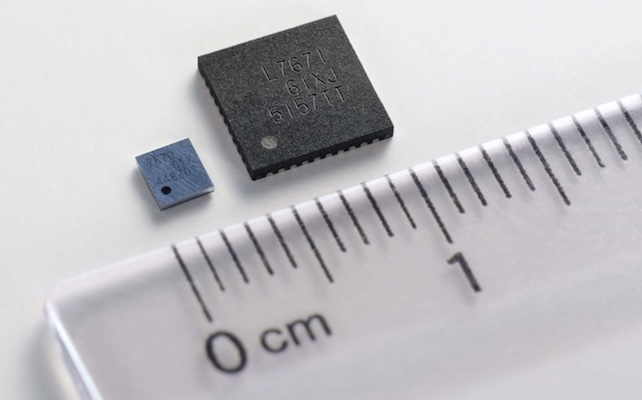
The ML7670 receiver and ML7671 transmitter provide a compact wireless charging solution. Image used courtesy of Rohm Semiconductor
This generation targets a lower power envelope, with a maximum power transfer of 250 mW. It optimizes both mounting area and transmission efficiency for miniature applications.
Receiver Architecture and Integration
The ML7670 serves as the power receiver LSI within the wireless power transfer system. To fit the tight internal dimensions of devices like smart rings, it is housed in an ultra-compact WLCSP 30-pin package measuring 2.28 mm by 2.56 mm with a height of 0.48 mm. This small footprint is achieved through high internal component integration. Peripheral elements like the switching MOSFETs required to supply power to the downstream charging IC are embedded directly within the silicon.
The receiver achieves a maximum power transfer efficiency of 45% in the 250 mW output range. This performance comes from specific optimizations in rectifier circuitry, coil matching networks, and reduced losses in internal switching devices. For subsystem telemetry, the LSI integrates a 10-bit SAR-ADC to monitor the power supply status.
Notably, the device eliminates the need for a host MCU to manage the wireless power interface. All firmware required for wireless power delivery is embedded directly within the IC, reducing board space and development workload. For host communication, the chip features a single-channel serial interface acting as an I2C Target. It also contains 2 KB of data flash for user data and an NFC Forum Type 3 Tag function for features like touch-based Bluetooth pairing. The receiver is compliant with the NFC Forum WLC 2.0 specification and supports Type F communication speeds of 212 kbps and 424 kbps.
Transmitter Features
The ML7671 acts as the primary wireless power transmitter LSI. It operates from an input voltage range of 4.5 V to 5.5 V for the power transmission stage, while supporting a logic IO supply range from 1.8 V to 5.5 V. The transmitter is supplied in a 40-pin WQFN package measuring 6.0 mm by 6.0 mm with a thickness of 0.80 mm.
The transmitter integrates a 13.56 MHz power-transmission controller and an N-channel transistor driver to stimulate the external transmission coil, synchronized by an internal 27.12 MHz crystal oscillator. It features a 10-bit, 6-channel ADC for monitoring system telemetry, 2 KB of flash memory, 512 B of SRAM, and a watchdog timer to guarantee robust execution.
For link safety, the transmitter incorporates comprehensive abnormality-detection functions via software and hardware controls. These functions actively monitor for device attachment, detachment, and power-transmission faults to protect the attached hardware. The transmitter communicates with the receiver via NFC Forum Type F-based protocols at data rates of 212 kbps and 424 kbps, using a command generation function designed to interface with the ML7670. Configuration updates are handled through an external MCU via an I2C Target or SPI Peripheral host interface, and the IC includes an I2C Controller and SPI Controller for external peripheral management.
Applications and Outlook
The chipset is already in mass production and deployed in modern consumer products like the SOXAI RING 2 health tracker.
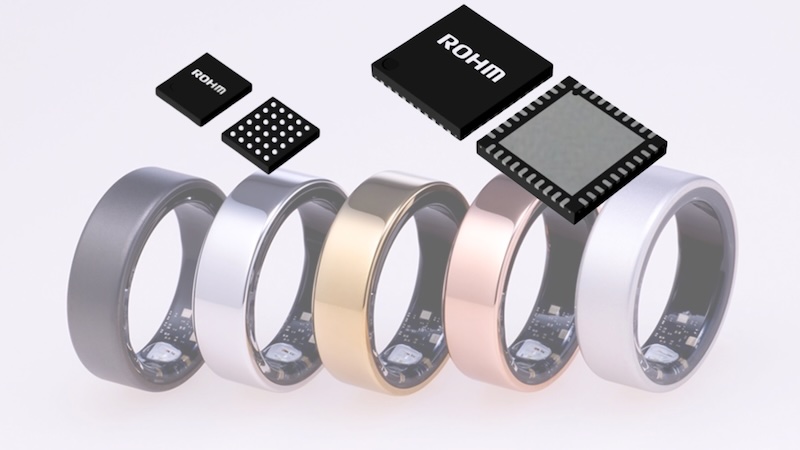
The ML7670 receiver and ML7671 transmitter have been integrated into the SOXAI RING 2 health trackers. Image used courtesy of Rohm Semiconductor
Other engineering use cases include fitness trackers, smartwatches, smart bands, smart glasses, and personal healthcare devices. Evaluation boards and reference designs are also available from Rohm to facilitate integration.


