
Microchip Covers More Display Sizes With New maXTouch Touchscreen Controllers
The ATMXT3072M1-HC and ATMXT288M1 maXTouch M1 touchscreen controllers expand the series’ display range, now covering 2 in to 45 in display sizes in automotive applications.
Microchip Technology has expanded its maXTouch M1 touchscreen controller series with two new devices designed to address opposing ends of the automotive display spectrum. The ATMXT3072M1-HC targets large-format applications with support for continuous touch sensors up to 45 inches, while the ATMXT288M1 serves compact displays ranging from 2 in to 6 in. This expansion positions the M1 family to handle the full range of touch-enabled surfaces increasingly found in modern vehicle cockpits.
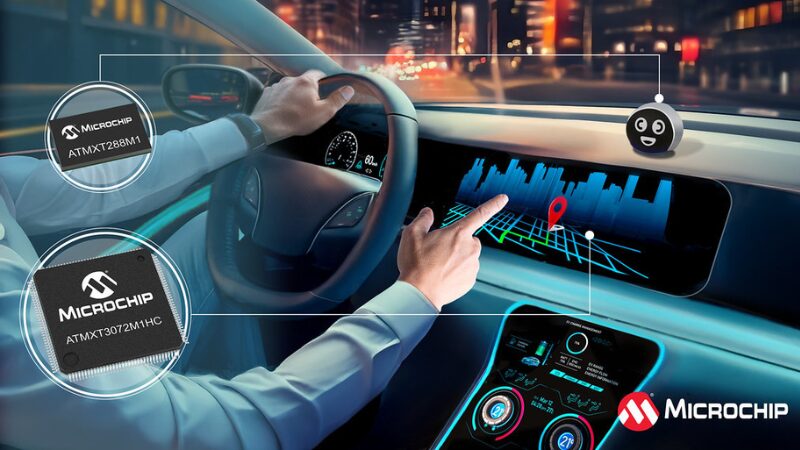
Microchip has added touchscreen controllers for a wider range of automotive displays to its maXTouch M1 family. Image used courtesy of Microchip Technology
Enhanced Signal Processing for Challenging Environments
Both new controllers implement Microchip’s Smart Mutual touch acquisition method, which employs proprietary signal processing algorithms to improve the touch signal-to-noise ratio (SNR) by up to 15 dB compared to previous generations. This enhancement addresses specific challenges posed by OLED and microLED display technologies, where integrated touch sensors experience higher capacitive loads and increased coupling with display noise.
Microchip’s Smart Mutual technology deals with the physics of modern display stacks. On-cell OLED displays, for instance, embed touch electrodes directly within the thinner panel assemblies, creating electrical environments that are more susceptible to interference. The improved SNR helps maintain reliable touch detection even when sensors encounter these unfavorable conditions.
Large-Format Design Considerations
The ATMXT3072M1-HC maXTouch touchscreen controller specifically targets applications requiring unified touch sensing across multiple display zones. In practice, this means a single controller can handle continuous touch-sensor designs spanning both the instrument cluster and the center information display. This approach offers practical benefits for automotive manufacturers managing global markets, as a single hardware design can accommodate both left-hand and right-hand drive configurations without requiring separate controller implementations for each mirror-image layout.
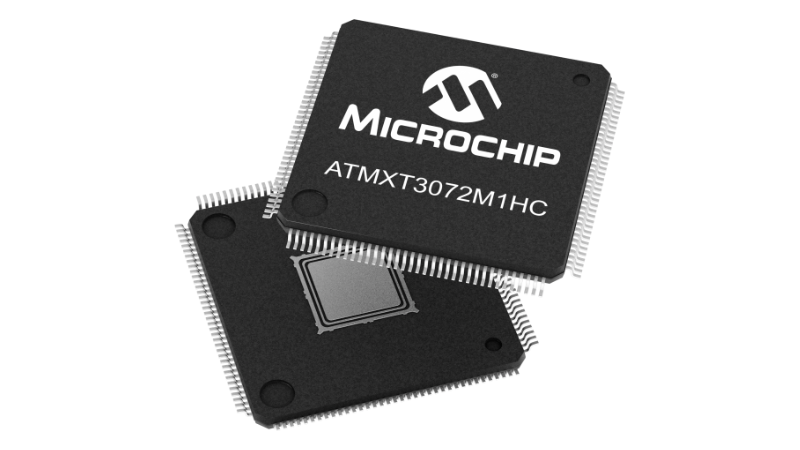
Microchip’s ATMXT3072M1-HC maXTouch touchscreen controller for large displays up to 45 in. Image used courtesy of Microchip Technology
From an integration standpoint, reducing the number of discrete touch controllers in a system simplifies both the electrical architecture and the software stack. Fewer controllers mean fewer I2C or SPI interfaces to manage, fewer potential failure points, and simplified calibration procedures during manufacturing.
Compact Package for Space-Constrained Applications
On the opposite end of the size spectrum, the ATMXT288M1 maXTouch touchscreen controller introduces a Thin Profile Fine-Pitch Ball Grid Array (TFBGA60) package to the M1 family. This represents the first time Microchip has offered a TFBGA option in this controller line. The package delivers a 20% reduction in PCB area compared to the smallest previous automotive-qualified maXTouch product.
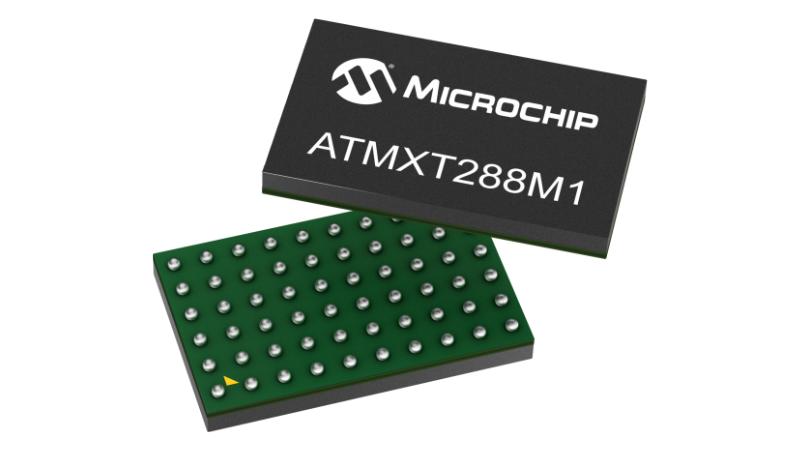
Microchip’s ATMXT288M1 maXTouch touchscreen controller for small displays in the 2 in to 6 in range. Image used courtesy of Microchip Technology
The size reduction addresses emerging automotive use cases where display functionality must fit into constrained physical spaces. Examples include traditional analog clock replacements with digital displays, driver assistant screens integrated into A-pillars or rearview mirrors, and control panels for HVAC systems. In these applications, board space comes at a premium, and component miniaturization directly enables design feasibility.
The TFBGA60 package also aligns well with OLED and microLED display technologies, which themselves trend toward thinner profiles. As these display technologies mature and costs decline, their adoption in automotive applications will likely accelerate, making compact controller packages increasingly relevant.
Development Support and Availability
Both controllers integrate into Microchip’s existing maXTouch development ecosystem. The maXTouch Studio IDE provides configuration and debugging capabilities during development, while the maXTouch Analyzer supports production-line testing. This toolchain continuity means engineers already familiar with earlier M1 family members can apply existing knowledge when designing systems around the new controllers.
The M1 architecture maintains compatibility with multiple RTOS platforms through available drivers, allowing integration into diverse software environments without requiring custom driver development. This reduces one barrier to adoption in complex automotive systems where software architecture decisions may already be locked in.
The ATMXT3072M1-HC and ATMXT288M1 are available through Microchip sales representatives and authorized distributors. Development boards and evaluation kits support initial prototyping and testing phases.


