
MIKROE’s RTC 27 Click Brings Nano-Power Timekeeping to Embedded Designs
A new add-on board pairs NXP's PCF8525 real-time clock with alarms, a watchdog, and timestamp capture for low-power designs.
MikroElektronika (MIKROE) has introduced the RTC 27 Click, an add-on board built around NXP’s PCF8525, a nano-power CMOS real-time clock and calendar chip that communicates over I2C. The release carries additional significance for the company: it marks the 2,000th board in the Click lineup, a catalog of compact modules designed to snap directly into any host system equipped with a mikroBUS socket.
A Milestone Built on a Familiar Formula
Reaching 2,000 entries in a single product family is no small feat, and the RTC 27 Click reflects the philosophy that brought MIKROE to that milestone. Rather than chasing a single flagship design, the company has built its catalog by packaging widely used ICs in a standardized, drop-in form factor. That approach lets engineers swap functions in and out of a project without redesigning the surrounding hardware, and it keeps evaluation costs well below what a custom board spin would require. For the RTC 27 Click specifically, that philosophy means fast access to a timekeeping chip that would otherwise require its own layout and bring-up cycle.
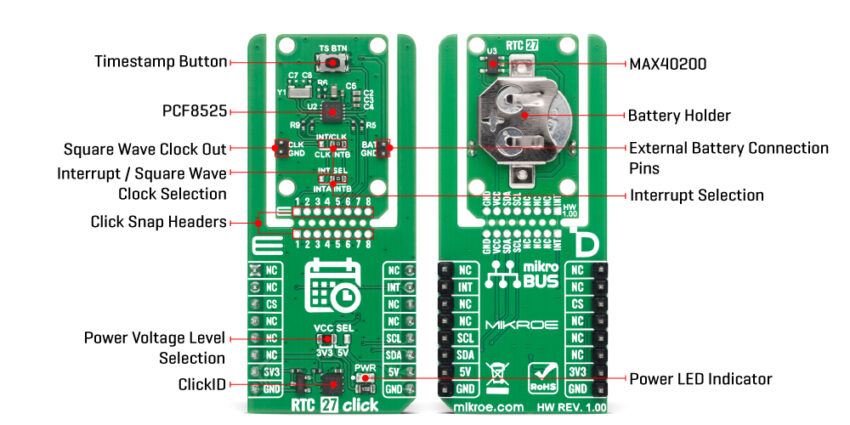
The RTC 27 Click pairs NXP’s PCF8525 with a MAX40200 ideal diode for battery-backup switching, along with onboard headers for interrupt and clock-output selection. Image used courtesy of MIKROE
Precision Timekeeping Without the Power Penalty
At the center of the board sits the PCF8525, which tracks year, month, day, weekday, hours, minutes, seconds, and hundredths of a second. NXP built in selectable crystal temperature compensation and aging offset support, two features that help the oscillator maintain accuracy as ambient conditions and component age drift over time. Beyond basic timekeeping, the chip supports programmable alarms and watchdog timer functions, so a host system can schedule wake-ups or catch a hung process without dedicating a separate timer peripheral to the job. A timestamp capture function logs the moment of an external event, which is useful for flagging tampering, power interruptions, or sensor triggers. Battery backup with automatic power-source switching rounds out the feature set, allowing the clock to keep running during a main power loss without any intervention from the host processor.
Ready to Drop Into Any Design
Like other boards in the Click family, the RTC 27 Click includes ClickID. This feature lets the host system automatically recognize which board is attached, and it ships with open-source mikroSDK libraries for evaluation and further customization. Together, these features are designed to shorten the time between unboxing the module and running working code. The board is priced at $19.
For engineers needing dependable timekeeping without drawing significant current from a battery-backed rail, the RTC 27 Click is a straightforward way to achieve it. Portable test instruments, wearable electronics, and industrial controllers all rely on accurate, low-power clocks to log events, schedule tasks, and maintain consistent timestamps across power cycles. IoT nodes, in particular, benefit from a chip that can track time accurately for years on a coin cell. Given MIKROE’s existing library support and the mikroBUS ecosystem behind it, the board looks like an easy way to bring that kind of timekeeping into a design with minimal additional engineering overhead.


