
Murata Introduces Ultra-Low-Power AMR Sensors for Space-Constrained Designs
The new solid-state magnetic sensors deliver ultra-low current consumption in a compact package, targeting battery-powered medical, wearable, and IoT devices requiring an extended operating life.
Murata Manufacturing has begun mass production of two new anisotropic magnetoresistance (AMR) sensors, the MRMS166R and MRMS168R, designed for battery-powered applications in healthcare, wearables, and IoT devices. The headline figure for the MRMS166R is an average current consumption of 20 nA combined with operation from a supply voltage as low as 1.2 V, a pairing Murata claims is a first for AMR sensors in this category.
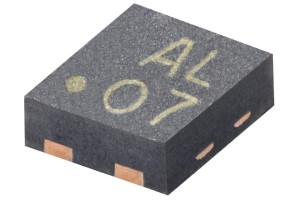
Murata’s new AMR sensors are housed in a compact 1.0 mm × 1.0 mm × 0.4 mm package. Image used courtesy of Murata Manufacturing
Solid-State Magnetic Switching
Both the MRMS166R and the MRMS168R operate as solid-state magnetic switches. Rather than continuously measuring field strength, they detect the presence or absence of a magnetic field to generate an output signal that system logic can act on, typically triggering transitions between active and sleep modes. The contactless nature of this approach eliminates mechanical wear, and the absence of moving parts supports sealed, miniaturized enclosures where reliability over a long service life matters.
This type of magnetic switching is well established in battery-constrained products. The sensor stays in a low-power state until a magnet approaches; the output then changes state, waking the host system or putting it to sleep. The design is straightforward, but the standby current drawn by the sensor itself still factors into overall battery life calculations, particularly in products expected to run for a year or more on a small coin cell.
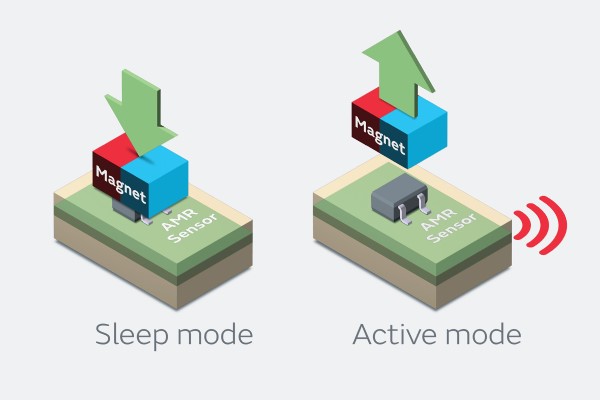
By automatically shifting into a low-power sleep state when a magnet approaches, the sensors reduce battery consumption while on standby. Image used courtesy of Murata Manufacturing
Key Electrical Parameters
The MRMS166R is aimed squarely at the tightest power budgets. It operates over a 1.2 V to 3.6 V supply range with a typical operating voltage of 1.5 V, an average current consumption of 20 nA, and a maximum output current of 1 mA. The 1.2 V lower bound is directly relevant to silver oxide coin cells, which are typically rated at 1.55 V but exhibit a decline in terminal voltage during discharge. Sustaining operation down to 1.2 V lets designers extract more usable capacity from the cell before the system shuts down.
The MRMS168R targets applications that require higher drive current. It operates over a 2.0 V to 3.6 V range with a typical supply of 3.0 V, draws 80 nA on average, and can source up to 12 mA at its output. This higher drive capability accommodates downstream loads, such as LEDs or small relays, that exceed the MRMS166R’s capacity.
Both parts share the same 1.0 mm × 1.0 mm × 0.4 mm package footprint. Murata attributes the reduction in current consumption to a redesign of the sensor’s internal circuitry and states that typical deployments can achieve more than two years of operation on a single coin cell.
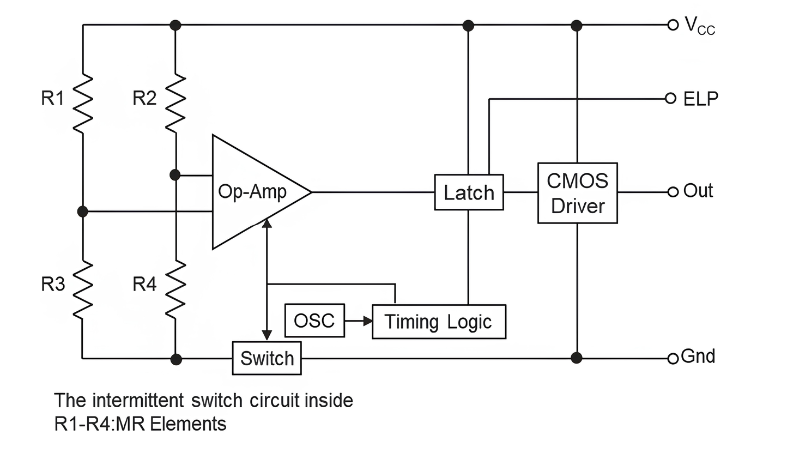
Block diagram of the MRMS166R. Image used courtesy of Murata Manufacturing
Applications and Availability
These two sensors address a common set of constraints found across several growing product categories: small batteries, sealed or compact housings, long expected operating life, and a need to respond quickly to a magnetic trigger event. Murata identifies capsule endoscopes, medical patches, AR glasses, wireless earbuds, door open/close detectors, and smart locks as representative use cases. The MRMS166R is the better fit for the lowest-power end of that space, particularly for coin-cell-powered designs near or below 1.5 V, while the MRMS168R suits designs where output load current is the primary driver. Both parts are in mass production now, with product details available on the Murata product pages.


