New 6-Axis IMU Solution for Optical Image Stabilization
TDK’s new family of high-performance 6-axis IMUs, the ICM-536xx, is designed to expand the adoption of optical image stabilization (OIS) while still offering high data rates in a compact form.
TDK Corporation has introduced the SmartMotion ICM-536xx family of high-performance 6-axis Inertial Measurement Units (IMUs), a solution engineered to accelerate the adoption of optical image stabilization (OIS) in a wider range of consumer electronics. Historically, high-performance IMUs suitable for OIS have been confined to premium devices due to their cost, size, and power consumption. The new ICM-536xx series is designed to address these limitations, bringing advanced stabilization capabilities to a broader market segment.
6-Axis IMU Aims to Drive OIS Beyond High-End Devices
The ICM-536xx is a custom sensing solution built specifically for the demands of OIS. It features a dual-interface architecture that allows for simultaneous use by a user interface and the OIS system. This capability is crucial for ensuring that the IMU can provide the high-frequency data required for stabilization while also serving other system functions. The device offers a high output data rate of up to 6.4 kHz, which is essential for capturing rapid, minute movements that can cause blur in images and videos.
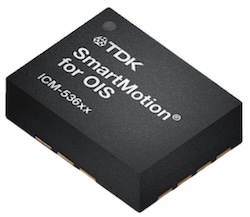
The ICM-536xx family aims to make professional-grade stabilization accessible in mid-range and mainstream devices. Image used courtesy of TDK.
From a technical perspective, the ICM-536xx family includes a number of features that will be of interest to electrical engineers. It supports a wide full-scale range (FSR) of ±32 g for acceleration and ±4000 dps (degrees per second) for gyroscope measurements. This wide range ensures that the IMU can handle both the subtle vibrations and the more extreme movements that occur during device use. The device supports multiple serial interfaces, including I3C, I²C, and SPI, with a 1.2 V VDDIO. This offers integration flexibility into a wide range of system architectures.
High-End Performance from a Compact Design
The physical design of the IMU is also a key feature. TDK has engineered the ICM-536xx with a thinner package height compared to previous solutions. This enables greater placement flexibility within space-constrained devices, such as slim smartphones and other portable electronics. The reduced footprint and improved power efficiency are critical factors in making OIS a more viable feature for lower-cost devices.
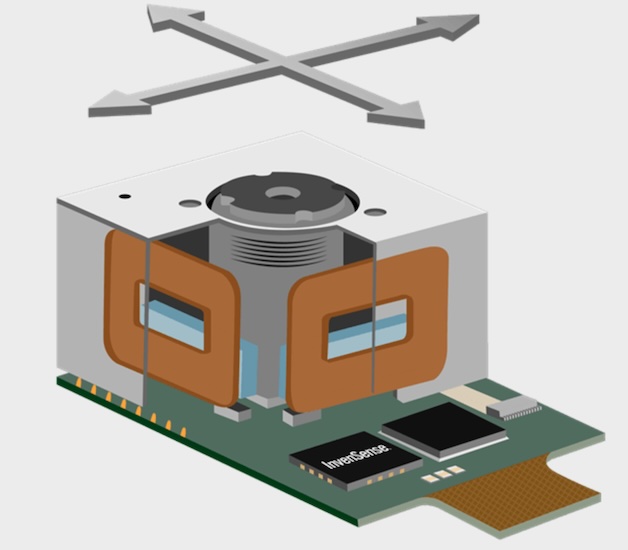
The availability of smaller, high-performance gyroscopes has enabled the integration of OIS into camera modules, improving image quality. Image used courtesy of TDK.
Beyond the core specifications, the ICM-536xx includes several advanced features. It provides a 20-bit data option for high-resolution measurements, which can improve the precision of the OIS algorithm. A dedicated FSYNC input is included for synchronizing the IMU’s data with the image sensor’s frame timing—a critical function for effective stabilization. The IMU also incorporates an on-chip free-fall detection feature, which can be used to protect the OIS actuator by retracting it in the event of a drop, thereby preventing mechanical damage.
Summary
By combining a high-performance feature set with a smaller, more power-efficient design, the ICM-536xx family represents a step forward in making OIS more accessible. This development could enable engineers to incorporate advanced stabilization capabilities into a wider array of products, from mid-range smartphones to new categories of imaging devices, ultimately enhancing the user experience through clearer and steadier images.