
New Infineon PMIC Consolidates Power and Safety for EV Traction Inverters
A single-chip design folds resolver excitation and ASIL-D fault supervision into the same package as core voltage regulation for hybrid and electric drivetrains.
Traction inverters sit at the electrical core of hybrid and electric vehicles, turning battery-rail voltage into the three-phase current that spins the drive motor. Supporting that conversion, though, usually takes a small crowd of auxiliary circuitry: separate regulators for the microcontroller, communication transceivers, and sensors, plus dedicated hardware to excite and monitor the resolver that tracks rotor position. Infineon Technologies has folded much of that supporting cast into a single part, the OPTIREG PMIC TLE9744QK, built specifically for high-voltage traction-inverter electronic control units (ECUs).
Trimming the Rail Count
At its core, the TLE9744QK is a power-supply IC, and it approaches that job with two buck-boost pre-regulators feeding a set of downstream rails: one branch supplies 5.8/5.95 V for the microcontroller and communication interfaces, while the second delivers a 10 to 16 V rail for the resolver excitation circuit and external gate-driver supplies. Two additional 5 V trackers feed off-board sensors, and a reference LDO rounds out the analog side. A 32-bit, 10 MHz SPI interface with 8-bit CRC ties the device into the rest of the ECU. Infineon says consolidating these functions into one package can shrink the printed circuit board area occupied by the replaced components by as much as 70 percent, while also trimming the overall bill-of-materials count. The part is designed to work alongside existing AURIX microcontroller and EiceDRIVER gate-driver platforms, so swapping in the TLE9744QK shouldn’t force a wholesale redesign of the surrounding control architecture.
Resolver Excitation Without the Extra Parts
Rotor-position feedback in a traction motor is commonly handled by a resolver, an analog rotary transformer that needs a high-frequency sinusoidal excitation signal to operate. Generating and monitoring that signal has traditionally required a handful of discrete op-amps, power transistors, and filtering components outside the main power-management IC. This is real estate that’s increasingly scarce as automakers push toward compact e-axles that pack the motor, gearbox, and inverter into one housing. By generating the excitation signal internally, the TLE9744QK lets designers drop that external circuitry where the inverter architecture allows, reducing another source of electromagnetic interference inside an already crowded, high-voltage enclosure.
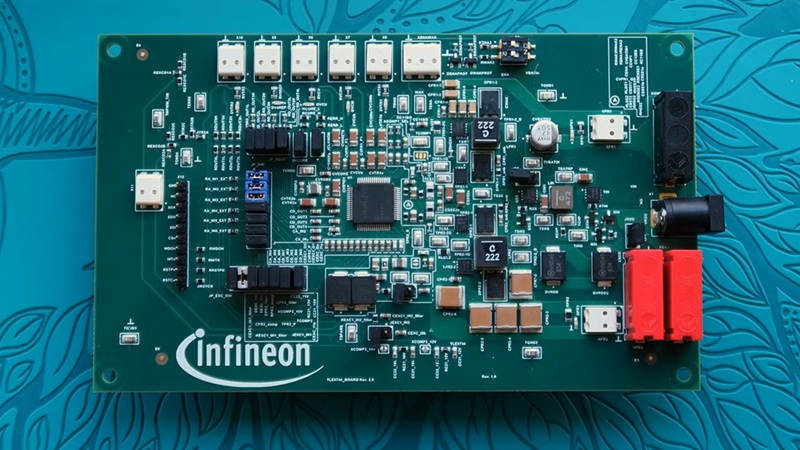
The TLE9744-BOARD supports analysis of the PMIC’s power rails, resolver excitation, and Integrated Safety Logic under real operating conditions. Image used courtesy of Infineon
A Safety Engine That Doesn’t Need the Microcontroller
The more distinctive piece of the design is its Integrated Safety Logic (ISL) block, a hardware safety engine that runs independently of the main processor. It watches six analog inputs and five digital inputs to track phase currents, DC-link voltage, gate-driver status, and microcontroller clock health. If the primary microcontroller stops responding, the ISL can act on its own: driving DC-link active discharge or invoking torque-control responses such as active short circuit or freewheeling through four digital outputs, using logic that’s configurable ahead of time or at runtime. A dedicated redundant supply input, labeled VRDD, keeps the ISL and one voltage tracker powered even during a low-voltage supply fault, so the safety path stays alive when the rest of the system might not. Infineon developed the device to ISO 26262, targeting systems up to ASIL D, and it’s rated for junction temperatures up to 150°C.
The TLE9744QK is available now, with samples, evaluation boards, reference designs, and supporting software already on offer. For engineers sketching the power architecture of a next-generation traction-inverter ECU, or looking to shave board space from an e-axle design, the chip is worth a closer look. It’s the kind of integration that turns what used to be three or four separate design decisions into one part-selection exercise, without giving up the independent safety monitoring that high-voltage automotive systems demand.


