
NTX Embedded Adds Edge AI to Its Octolux Rapid Development System
The HMI-centric platform now bundles a sensor suite and training flows for on-device machine learning, targeting validated pre-production hardware in 12 weeks.
NTX Embedded has expanded its Octolux RDS (Rapid Development System) with embedded AI capabilities, layering a new sensor suite and model-training flows onto a platform originally built around the company’s industrial HMI touchscreens. Announced September 21, the platform is available now and was slated for demonstration at Embedded World North America in Anaheim, California.
The premise is simple enough. As industrial equipment migrates from deterministic control toward machines that anticipate faults and adapt to shifting operating conditions, the machine learning behind those behaviors has to execute where the data originates: inside the equipment. NTX packages the necessary hardware, firmware, and engineering support into one framework that, the company claims, can carry a design from concept to a validated pre-production system in 12 weeks.
Pushing Machine Learning to the Farthest Edge
The new toolset revolves around a defined sensor suite for sensing and curating data at the equipment sub-system level, paired with training flows for system characterization and baseline modeling. Target workloads include predictive maintenance, equipment health monitoring, anomaly detection, sensor fusion, and adaptive motor control. Because inference happens locally, the platform is designed to make deterministic, real-time decisions without relying on centralized cloud servers, which matters for machinery with spotty connectivity or none at all.
Bob Griswold, NTX’s vice president of engineering, framed the offering as a consolidation play. Rather than cobbling together evaluation boards, AI software, and control electronics from a patchwork of suppliers, developers start on production-ready hardware and focus on differentiating machine intelligence.
Under the Hood: Compute, I/O, and Expansion
At the heart of the system sits a dual-core ARM Cortex-A53 clocked at 1.2 GHz alongside an ARM Mali-G31 GPU, with support for Linux or an RTOS. The platform runs from a 12 to 24 VDC supply and is rated for –40°C to +85°C operation. Display choices span a 5-inch, 480 × 272 panel up to 21-inch units at 1920 × 1080, all using IPS TFT technology with 10-point capacitive touch that NTX says remains responsive through gloves.
On the I/O front, engineers get multi-channel 16-bit ADC inputs plus GPIO, UART, SPI, I²C, and CAN bus. Communication options cover Ethernet, RS-232/485, and Modbus, while the product page also lists Wi-Fi, Bluetooth, and LTE. Camera support arrives via MIPI CSI-2 and USB machine vision, and expansion is handled through PCIe, USB 3.0, and custom daughterboards. That daughterboard library already includes temperature sensing, relay driving, audio, and motor control; the last pairs a BLDC module spanning 700 to 7,000 RPM with PWM drive output and encoder feedback. The system carries UL/CSA certification.
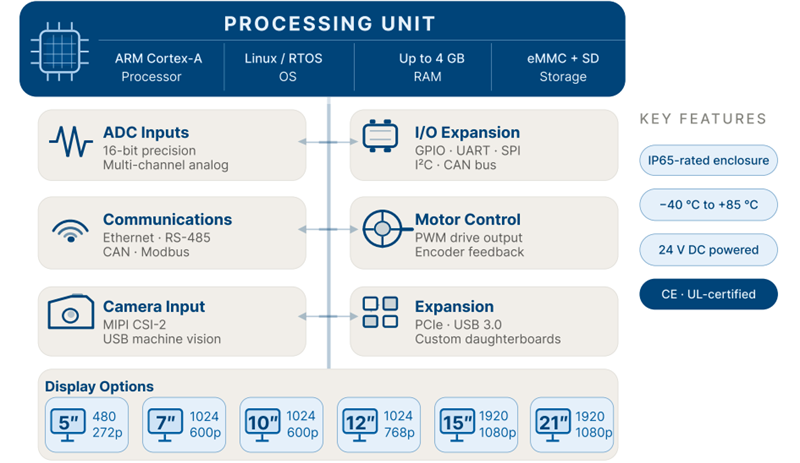
Core subsystems of the Octolux RDS platform pair a Linux- or RTOS-based processor with modular I/O and expansion hardware. Image used courtesy of NTX Embedded
A Compressed Path to Production
Beyond the silicon, NTX bundles in-house UX/UI design, firmware and control software, mechanical design, regulatory compliance, and manufacturing support. Hardware and firmware are co-developed in parallel, sidestepping the familiar bottleneck of firmware teams idling while boards spin. NTX pegs the resulting savings at up to 73% of development time, though that figure is best treated as a vendor estimate; real-world gains will hinge on how neatly a project’s requirements map onto the existing building blocks.
Taken as a whole, Octolux RDS is less a single board than a pre-integrated stack of touchscreen, compute, I/O, motor control, and now on-device machine learning, backed by a vendor prepared to shepherd designs into production. That mix should resonate with teams replacing knobs, switches, and LED segment displays in industrial and production machinery, smart ovens and dispensers, medical and diagnostic devices, transportation and automation systems, and machine tooling. For OEMs hoping to fold predictive maintenance into their next product without assembling an AI toolchain from scratch, the platform certainly merits a closer look.


