
Nuvoton Smart Buzzer IC Pairs Voice Playback With Piezo Driving
The NSP2340BA24E packs Flash storage, a boost stage, and a Class-AB amplifier into one TSSOP-28 chip, letting designers swap bare beeps for spoken prompts and melodies.
Nuvoton has unveiled the NSP2340BA24E, a Smart Buzzer IC that combines voice playback and piezo driving into one device. The part targets designs that still lean on a conventional buzzer and a handful of beep patterns to signal what a product is doing.
Buzzers have endured because they are simple and dependable, yet a run of tones can express only so much. Should an appliance need to distinguish a completed cycle from a fault, the user must remember which rhythm means what. Nuvoton’s approach lets the familiar piezo element play recorded voice prompts, sound effects, and melodies instead, letting designers say more without abandoning a well-understood component.
One Chip, Several Jobs
The NSP2340BA24E includes embedded Flash for audio storage, a voltage booster, and a Class-AB amplifier. Working together, these blocks drive a piezo buzzer directly, with booster output selectable at 10 V, 12 V, 18 V, or 24 V and no external high-voltage components required. Nuvoton says this integration reduces component cost, board area, and design complexity. The on-chip Flash stores 69 to 315 seconds of voice and sound content, eliminating the need for a separate memory device.
Host Control and Field Updates
A host microcontroller steers the device through UART, I²C (slave), or a Two-Wire interface. In-System Programming (ISP) lets the same host rewrite the stored audio, so a single hardware design can carry different voices and melodies across product variants or receive revised content later. The chip also exposes six GPIO pins.
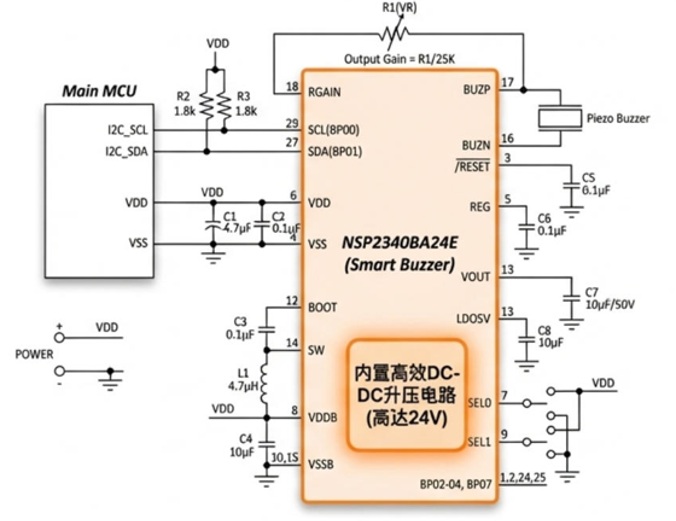
Booster output is selectable up to 24 V, so the piezo element connects to the NSP2340BA24E with no external high-voltage components. Image used courtesy of Nuvoton
On the electrical side, the part runs from 2.0 V to 5.5 V and operates across -40°C to +85°C. Standby current stays at or below 3 µA, and it includes built-in over-temperature, over-current, and under-voltage protection. You can adjust the output gain with an external resistor, and the RoHS-compliant TSSOP-28 package is included.
Developers who want to experiment can use the SB2340-HN30A evaluation board, which combines buzzer output, user input buttons, and power-management circuitry. It accepts power through USB Type-C or an external supply.
Putting Sound to Work
Taken together, the NSP2340BA24E gives a plain piezo buzzer a much larger vocabulary while keeping the surrounding design to one chip and a host microcontroller. Home appliances could announce operation and completion, security systems could deliver warnings that leave little room for guesswork, and industrial equipment could report status in words rather than pulses; healthcare devices and other consumer or medical products fall within its intended range as well. For any product whose beeps have outgrown their meanings, a buzzer that can actually say something is an appealing prospect.


