
NXP FRDM-IMXRT1186 Development Board Targets Industrial Automation and Real-Time Control
Featuring dual Cortex-M7 and Cortex-M33 cores, dual Gigabit Ethernet with TSN, and EtherCAT support, the board targets industrial and embedded applications.
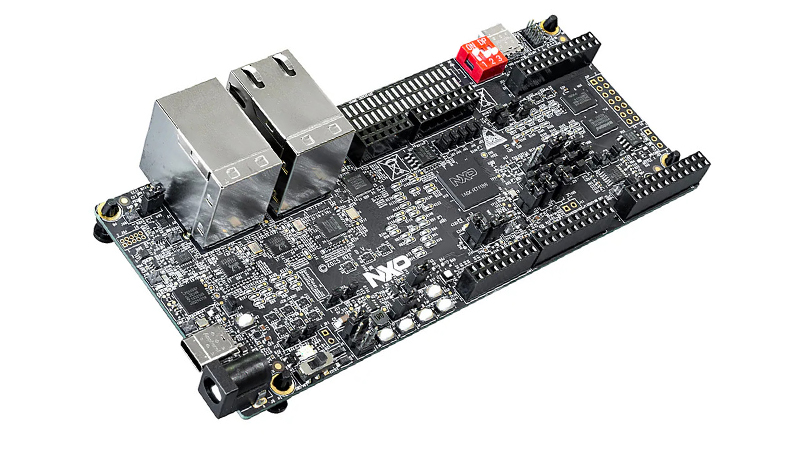
NXP FRDM-IMXRT1186 Development Board
NXP has introduced the FRDM-IMXRT1186, a development board built around the i.MX RT1186 crossover MCU. Designed for industrial automation, robotics, programmable logic controllers (PLCs), and edge computing, the MCU combines an 800 MHz Arm Cortex-M7 core for application processing with a 300 MHz Arm Cortex-M33 core for real-time control and communication tasks.
The board comes with 64 Mbit of HyperRAM, 512 Mbit of HyperFlash, and 128 Mbit of QSPI Flash for memory and storage. For networking, it offers two Gigabit Ethernet ports with TSN switching support, along with two Fast Ethernet ports for EtherCAT or TSN applications. Other connectivity options include a USB Type-C OTG port and a CAN transceiver. An onboard MCU-Link debugger and a JTAG connector simplify debugging and development. Expansion options include Arduino UNO R3 and FRDM headers, a FlexSPI follower header, an SRAMC header, and dedicated motor-control headers, making the board suitable for a range of industrial and embedded development projects.
Previously, we covered another NXP development board, the FRDM i.MX 95 Pro, an evaluation board designed to explore the company’s i.MX 95 applications processor for edge AI, industrial networking, robotics, vision processing, and advanced HMI applications.
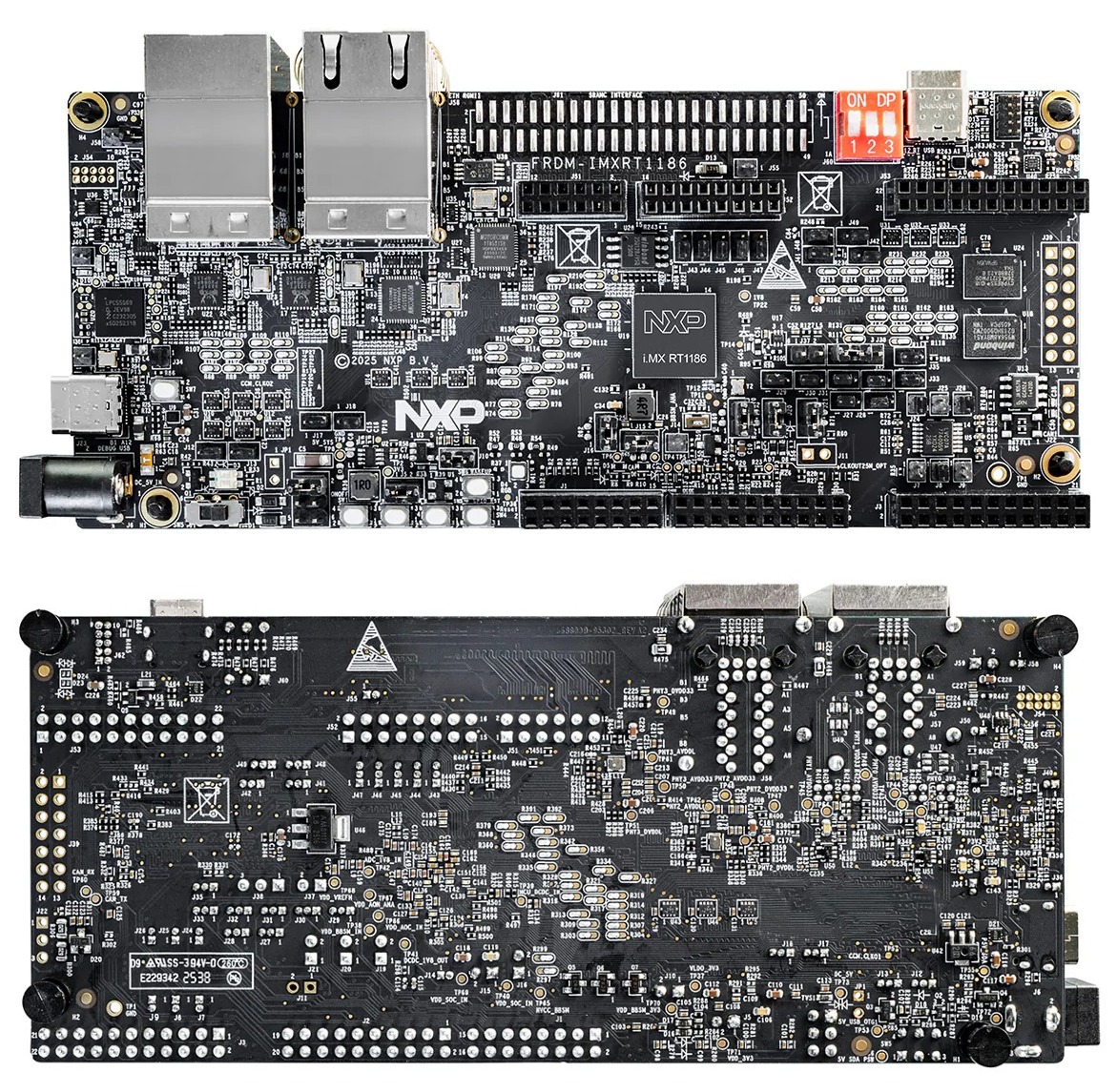
NXP FRDM-IMXRT1186 top and bottom
NXP FRDM-IMXRT1186 Development Board Specifications:
- SoC: NXP MIMXRT1186CVJ8C from the i.MX RT1180 family, housed in an LFBGA196 package
- Application Processor: Arm Cortex-M7 core operating at up to 800 MHz, featuring an FPU, 32 KB instruction cache, 32 KB data cache, and up to 512 KB ECC-protected Tightly Coupled Memory (TCM)
- Safety and Communications Processor: Arm Cortex-M33 core running at up to 300 MHz, with TrustZone-M, 16 KB instruction and data caches, and 256 KB ECC-protected TCM; supported by a TÜV-certified self-test library
- On-Chip SRAM: Up to 1.5 MB of ECC-protected SRAM, including 512 KB of M7 TCM, 256 KB of M33 TCM, and additional OCRAM
- Memory and Storage:
- External RAM: 64 Mbit HyperRAM
- HyperFlash: 512 Mbit
- QSPI Flash: 128 Mbit
- Memory Expansion: FlexSPI follower header for connecting additional HyperFlash, HyperRAM, or QSPI memory devices
- Ethernet and Networking:
- Gigabit Ethernet: Two YT8531SH-CA PHYs with RGMII interfaces and support for a Time-Sensitive Networking (TSN) switch
- Industrial Ethernet: Two RTL8201FI PHYs supporting 10/100 Mbps MII Ethernet for EtherCAT or TSN applications, with jumper-based routing
- USB Connectivity:
- USB OTG: One USB 2.0 Type-C port connected to the i.MX RT1186 MCU
- Debug USB: One USB Type-C port for the integrated MCU-Link debugger
- Power Delivery: Either USB-C port can supply the board’s 5 V power rail
- Industrial Interfaces:
- CAN Connectivity: NXP TJA1057BT high-speed CAN transceiver for industrial communication and control applications
- Expansion and Peripheral Interfaces:
- Arduino and FRDM Headers: Arduino UNO R3-compatible and FRDM expansion headers (J1, J2, J51, and J52), providing UART, SPI, I²C, ADC, PWM, and GPIO connectivity
- Motor Control: Dual motor-control headers compatible with FRDM-MC-LVPMSM and similar motor-control shields
- SRAMC Expansion: 50-pin header for interfacing with asynchronous SRAM or FPGA devices
- Debugging and Development:
- Integrated MCU-Link debugger for software development and troubleshooting
- MCU-Link Serial Wire Debug (SWD) interface
- Dedicated JTAG/SWD header for external debugging tools
- Onboard Controls and Indicators:
- Power slider switch
- Five user-accessible buttons, including three user buttons and two reset buttons, as indicated in the block diagram
- RGB status LED
- DIP switch for boot-mode selection
- Power Supply and Monitoring:
- DC Input: 5 V through a DC barrel jack
- USB Power: 5 V supplied through either USB Type-C port
- Power Monitoring: Onboard current-measurement points for monitoring individual MCU power domains
- Dimensions: To be announced
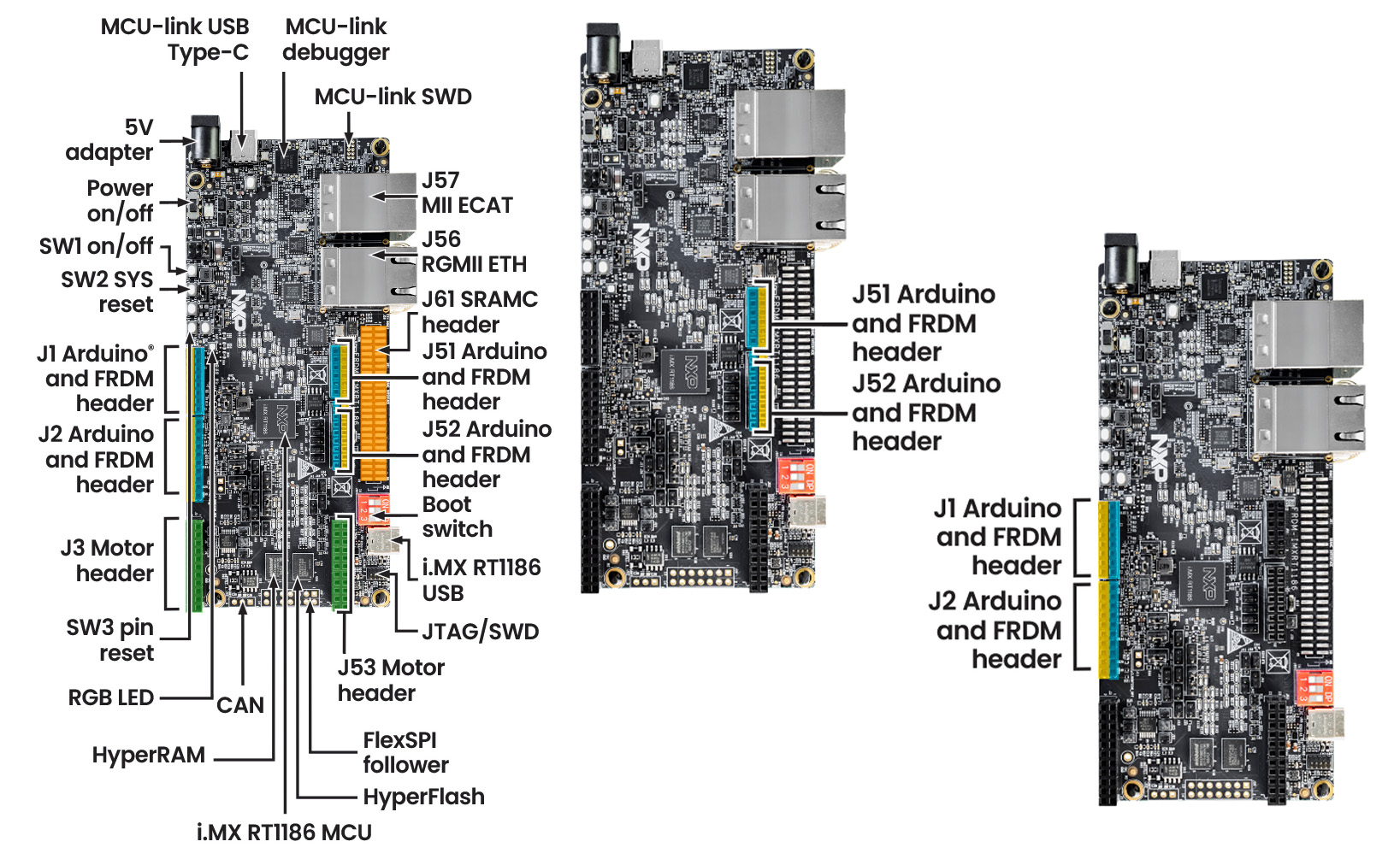
FRDM-IMXRT1186m Development Board Interfaces
The MCUXpresso SDK offers software support for the FRDM-IMXRT1186, with usage examples for FreeRTOS, lwIP, EtherCAT, multicore operation, USB, security, and peripheral drivers. Development is supported by MCUXpresso for VS Code, MCUXpresso IDE, IAR Embedded Workbench, Keil MDK and Arm GCC with CMake. The board also has support for Zephyr RTOS with separate CM33 and CM7 targets, and drivers for Ethernet, FlexCAN-FD, LPSPI, LPUART, ADC, PWM and GPIO. Support for industrial networking includes EtherCAT, PROFINET, EtherNet/IP, Modbus TCP, TSN and OPC UA. Additional software includes TrustZone-M, EdgeLock Enclave, MCUBoot, OTA updates, eIQ, FreeMASTER and secure provisioning.
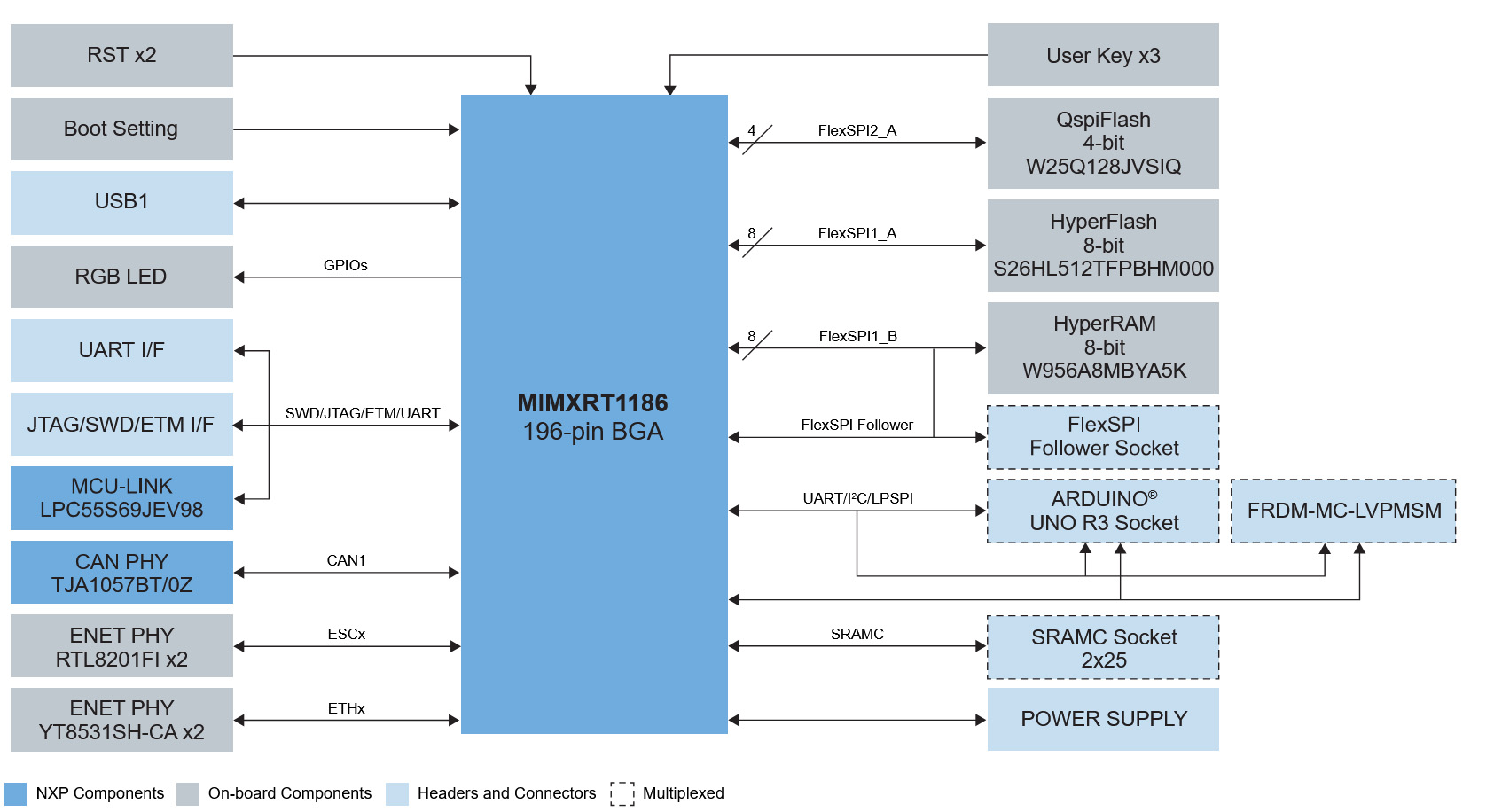
FRDM-IMXRT1186 block diagram
The NXP FRDM-IMXRT1186 development board is currently active and costs $85.00 USD. Additional documentation including design files, software downloads, user manuals and other information can be found on the product page; the press release also contains additional specifics.
Images used courtesy of NXP.


