
Realtek RTL8773J Bluetooth 7 SoCs Combine Quad-Core CPU and AI Audio
Designed for TWS earbuds and wearables, this multi-core IC integrates advanced DSPs and AI accelerators to deliver zero-compression lossless sound and edge computing features.
RealMCU, Realtek’s microcontroller division, has unveiled the RTL8773J Series of Bluetooth 7 dual-mode, multi-core SoCs designed for next-generation audio applications like high-end TWS earbuds, gaming headsets, and AI smart glasses.
The chip uses a powerful multi-core architecture that combines an Arm Cortex-M55 main processor with MVE (Helium) technology, a Cortex-M33 network/sensor processor, and dual HiFi1s-VFPU DSPs. It supports high-fidelity audio codecs, adaptive Active Noise Cancellation (ANC), and on-device machine learning via a dedicated “Haydn” AI accelerator. The SoC supports Bluetooth Classic and LE Audio, as well as proprietary 2.4 GHz protocols, making it suitable for 3-in-1 gaming dongles and ultra-low-latency applications.
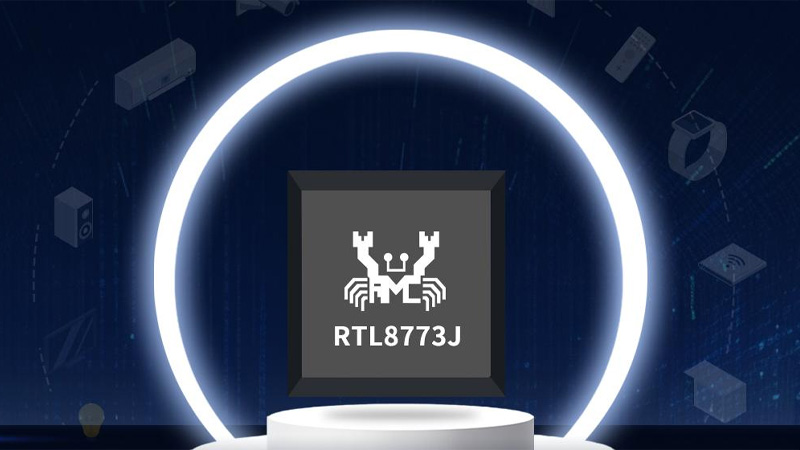
Realtek RTL8773J Bluetooth 7 dual-mode audio SoC with Cortex-M55/M33 cores and dual DSPs
Realtek RTL8773J Series Specifications:
- MCU:
- Arm Cortex-M55F with MVE up to 240 MHz
- Arm Cortex-M33F up to 200 MHz
- DSP: Dual HiFi-1s VFPU DSPs up to 360 MHz, hardware FFT engine, Haydn accelerator for audio processing
- Memory: 2.2MB SRAM (including 1024KB configurable shared SRAM), optional 8MB embedded PSRAM (RTL8773JBS)
- Storage: 4MB, 8MB, or 16MB embedded flash depending on the model, QSPI flash interface
- Wireless:
- Bluetooth 6.2 core specification with Bluetooth Pre-7 features
- BR/EDR/LE-1M/LE-2M/LE Coded (Long Range)
- Bluetooth LE Audio and AoA/AoD support
- HDT / Realtek-HDT+ for high-bandwidth audio (up to 7.5Mbps)
- Channel Sounding
- Short Connection Interval (SCI) of 1.25ms and Frame Space Update (shorter or longer than 150us)
- 2.4GHz proprietary protocol support
- Forward Error Correction (RS-FEC) for stable connections in crowded environments
- Max Tx Power – 15 dBm (BLE), 12 dBm (EDR 2M)
- RX Sensitivity – -101 dBm (1M BLE), -97 dBm (1M BR / 2M EDR)
- Audio:
- Up to 3x analog microphone inputs and 6x or 10x digital microphone inputs, depending on model
- Speaker output, stereo line input, I2S and PDM interfaces
- SBC and mSBC codecs; LC3, LC3Plus, and Opus support depends on model
- Adaptive ANC (selected models), AI Talk Clear (RTL8773JBS)
- USB: USB 2.0 (selected models)
- Other I/O: I2C, UART, SPI, PWM, SDIO (selected models), up to 8-channel 12-bit ADC, 13 to 30 GPIOs
- Security: AES-128/256, SHA-256/384, RSA-4096, ECC P-384
- Power management: Integrated LDOs for I/O and flash, Li-ion battery charger supporting up to 500mA
- Package:
- QFN52 (4.1 × 6.4mm) – RTL8763JKU and RTL8773JKE
- BGA108 (4.2 × 5.9mm) – RTL8773JBM and RTL8773JBS
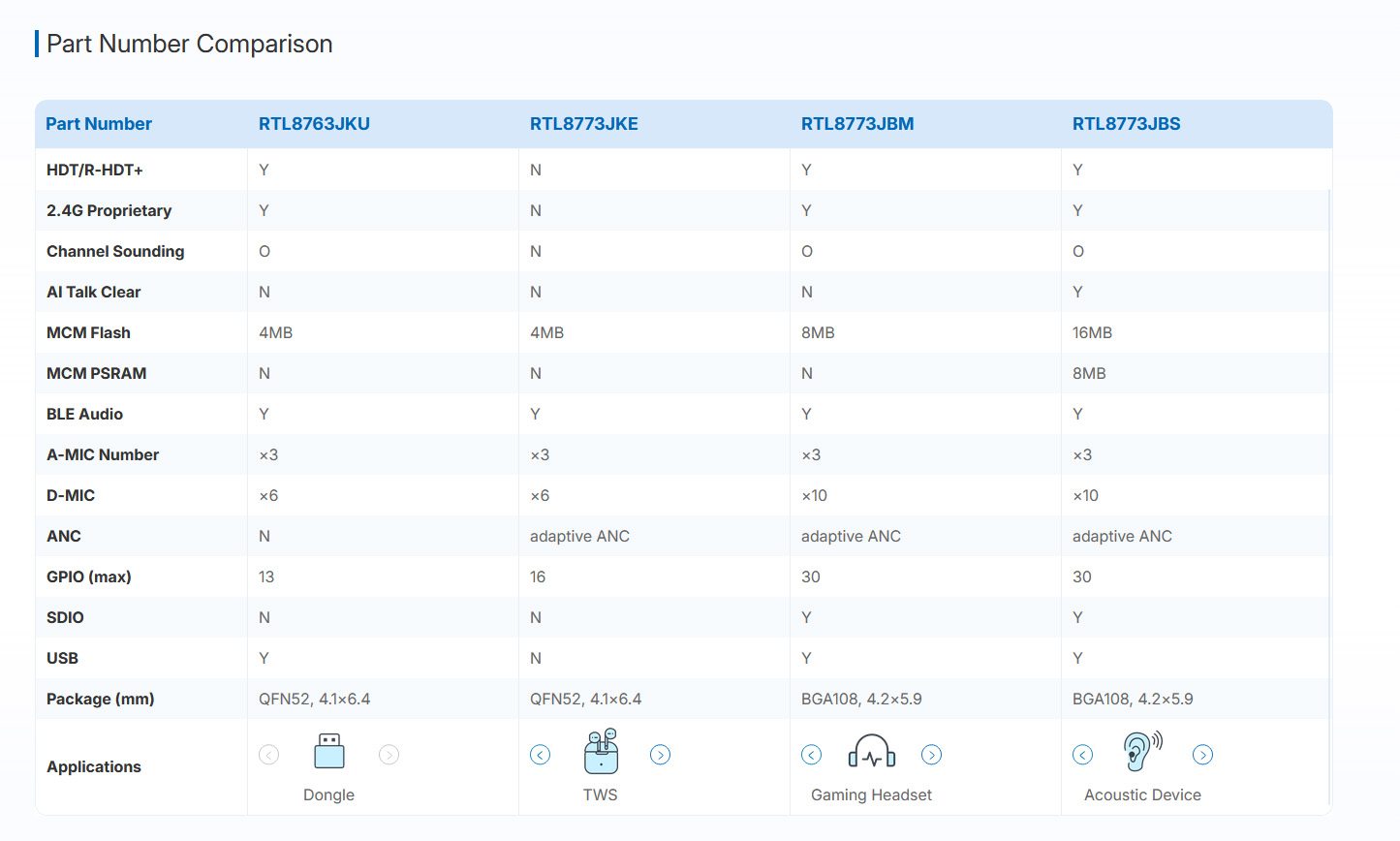
Comparison of Realtek RTL8773J series Bluetooth 7 SoCs, showing differences in memory, connectivity, audio features, and target applications
The RTL8773J series includes four variants: RTL8763JKU, RTL8773JKE, RTL8773JBM, and RTL8773JBS. All four feature an Arm Cortex-M33 and Cortex-M55 processor, dual HiFi 1s DSP cores running at 360 MHz, and Bluetooth LE Audio support. The main differences are in memory, connectivity, and audio features. The RTL8763JKU comes with 4 MB flash but lacks ANC support, while the RTL8773JKE adds adaptive ANC but does not support HDT. The RTL8773JBM increases flash to 8 MB and adds more microphone inputs, GPIOs, and SDIO support. The highest-end RTL8773JBS includes 16 MB flash, 8 MB PSRAM, and exclusive AI Talk Clear support. The first two models come in QFN52 packages, while the latter two use BGA108 packages.
For audio processing, selected RTL8773J variants support ANC, environmental noise cancellation (ENC), and AI scene recognition without relying on cloud connectivity. Realtek says the chips can adjust performance based on the workload to reduce power consumption. The series also includes USB, SDIO, and SPI interfaces on selected models, allowing them to connect to external storage and LCD screens, including those used in TWS charging cases with displays.
Previously, we reported on Rohde & Schwarz and Realtek’s Bluetooth LE High Data Throughput (HDT) test solution, which shows the RTL8773J’s support for high-speed wireless audio. We also wrote about Ceva’s Waves Links200 connectivity IP, which supports Bluetooth HDT at up to 7.5 Mbps, and Synaptics’ SYN4383 and SYN43756(E) wireless SoCs with LE Audio and Channel Sounding. Other related products include the Realtek RTL8730E-based Stream210 module, designed for wireless speakers, headphones, and IoT audio applications.
More information, documentation, and SDK details can be found on the RealMCU product page.
Images used courtesy of RealMCU


