
Bluetooth LE HDT: Rohde & Schwarz and Realtek Showcase Test Solution
The two companies have validated what they say is the industry's “first” test solution for Bluetooth LE high data throughput (HDT), a feature that pushes the maximum data rate from 2 Mbps to 7.5 Mbps.
Rohde & Schwarz and Realtek Semiconductors have jointly validated what the companies describe as the “industry’s first test solution” for Bluetooth LE High Data Throughput (HDT). The demonstration, built around Rohde & Schwarz’s CMP180 radio communication tester and Realtek’s next-generation chipsets, was shown at Mobile World Congress (MWC) Barcelona 2026 and is also making an appearance at Embedded World 2026 in Nuremberg, running March 10–12.
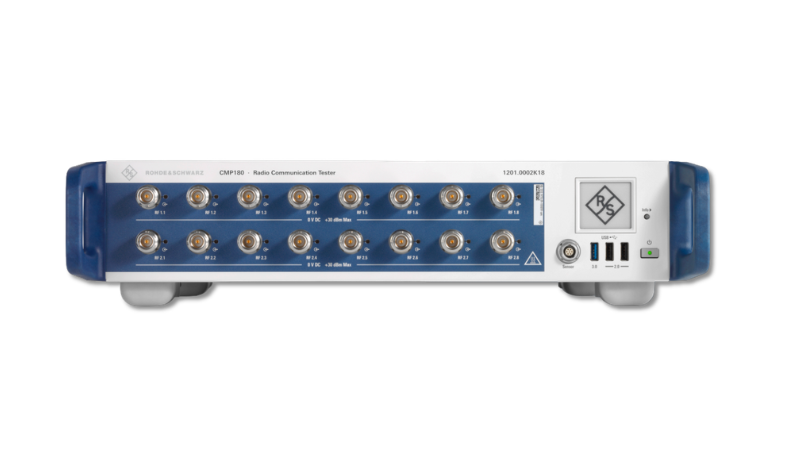
Rohde & Schwarz’s CMP180 radio communication tester now covers Bluetooth LE HDT. Image used courtesy of Rohde & Schwarz
What Is Bluetooth LE High Data Throughput (HDT)?
Bluetooth LE HDT is a forthcoming enhancement to the Bluetooth LE standard that raises the maximum data rate from 2 Mbps to 7.5 Mbps. The new PHY layer supports five distinct data rates in the 2–7.5 Mbps range by combining three new modulation schemes with varying levels of forward error correction.
Beyond raw throughput, the spec is characterized by up to 4x increased capacity, improved spectrum efficiency, better energy efficiency, and enhanced reliability compared to the current LE PHY. Target applications include low-latency audio streaming, fast media sharing, and accelerated over-the-air software updates — areas where the existing 2 Mbps ceiling has been a limiting factor.
Realtek’s HDT-Ready Chips
Realtek is demonstrating two chips in the setup. The RTL8922D is a multi-function Wi-Fi and Bluetooth combo chip that integrates HDT, channel sounding, and IEEE 802.15.4 support. It can handle simultaneous Wi-Fi, dual Bluetooth, and Zigbee/Thread connectivity, targeting PCs, TVs, gaming hardware, automotive, and smart-home applications.
The RTL8773J is a dedicated Bluetooth audio SoC that consolidates BT Legacy, Bluetooth LE, LE Audio, and HDT into a single device. Realtek positions it for intelligent audio products, emphasizing low-latency audio processing and improved transmission robustness through HDT.
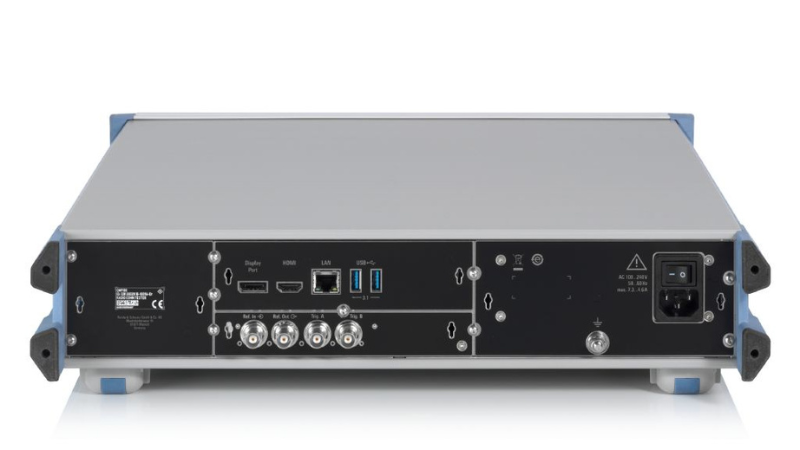
Back view of the CMP180 radio communication tester. Image used courtesy of Rohde & Schwarz
Testing With the CMP180
The CMP180 is a multi-technology tester in a single enclosure that houses two signal analyzers, two generators, and two sets of eight RF ports. It covers a broad range of cellular and non-cellular technologies, including Wi-Fi 8 and 5G NR FR1 up to 8 GHz with bandwidths up to 500 MHz.
For Bluetooth specifically, the CMP180 supports LE testing via direct test mode and chipset-specific test control. It is also ready for the new universal test protocol. Rohde & Schwarz says the tester is positioned for use across the full product development cycle: from R&D and pre-conformance work through mass production.
The HDT validation with Realtek’s chips is a notable milestone because the Bluetooth HDT specification has not yet been finalized. Getting test equipment and silicon in sync this early gives chipmakers a head start on characterization and helps compress the time between spec release and product readiness.
For engineers working on next-generation wireless audio or high-throughput BLE applications, this collaboration signals that HDT test infrastructure is beginning to take shape ahead of the eventual spec release.


