
SECO Samples First SMARC Module Built on Qualcomm Dragonwing IQ8
Engineering samples of an industrial system-on-module pairing 40 TOPS of AI acceleration with PCIe Gen4, dual Ethernet, and camera inputs are heading to select OEMs.
SECO has started shipping the first engineering samples of its SOM-SMARC-Dragonwing-IQ8, an industrial SMARC system-on-module built around Qualcomm’s Dragonwing IQ-8275 processor. By the company’s account, no other firm has yet placed a SMARC module based on the Dragonwing IQ8 Series in OEMs’ hands for evaluation. The first batch is deliberately modest, reserved for selected customers and engineering teams after encouraging early builds.
Compute, Memory, and Display Support
At the heart of the module sits the Dragonwing IQ-8275, offered as either the QCS8275-0-AA or the QCS8275-0-AC. The block diagram shows a Kryo CPU complex split between four Gold cores at up to 2.35 GHz and four Silver cores at up to 1.95 GHz, while the Hexagon NPU delivers up to 40 TOPS of peak AI acceleration. An Adreno 623 GPU handles graphics at up to 877 MHz.
Memory scales to 32 GB of soldered LPDDR5 or LPDDR5X. Storage comes from a soldered, two-lane UFS 3.1 Gen4 drive up to 1 TB, with an SDIO interface offering a second boot path. Two independent displays are supported: DisplayPort 1.4 drives 4K at 120 Hz, while the second output is LVDS or, as a factory option, a four-lane DSI link at 4K120.
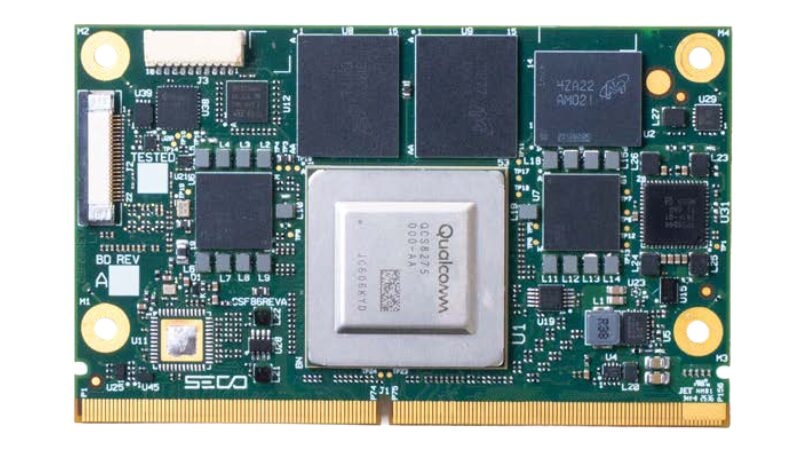
Soldered LPDDR memory flanks the Dragonwing processor, while the SMARC connector fingers run along the lower edge. Image used courtesy of SECO
Interfaces and Industrial Hardening
Connectivity shows the industrial intent. One Gigabit Ethernet port and one 2.5 Gigabit Ethernet port sit alongside PCIe Gen4, configurable as a single x4 link or, as a factory option, two x2 links. USB support spans up to five USB 2.0 ports plus SuperSpeed options. Two four-lane MIPI CSI inputs with ISP support handle vision, while two CAN interfaces and four UARTs round out the control-side I/O.
Protection and resilience are not neglected, either: the module integrates a FIPS 140-3 compliant TPM 2.0 device, plus watchdog and fan-management functions. Power arrives from a 5 V rail, and the board measures 82 x 50 mm. Buyers can choose a commercial range of 0 to +60°C or an industrial range of −40 to +85°C; both are specified at the heat spreader, so the final cooling solution remains the system designer’s responsibility.
Software, Sampling, and Where It Fits
On the software side, the module runs Clea OS, a Yocto-based Linux that SECO pairs with secure device management, update delivery, and long-term maintenance. Born from a collaboration among SECO, Qualcomm Technologies, and Arduino, the design also carries Works With Arduino compatibility, giving developers a route from prototyping on the Arduino VENTUNO Q to an industrial product.
Interested OEMs can request a sample through SECO’s product page. Allocation hinges on project evaluation and availability, with priority going to teams working on industrial Edge AI and Physical AI applications.
All told, the module packs a respectable helping of edge inference, display output, and I/O into a footprint just shy of a credit card’s. Robots, drones, industrial vision systems, handheld devices, and autonomous or unmanned platforms are the headline targets, though the datasheet also points toward medical equipment, smart buildings and cities, transportation, and even coffee and vending machines. For anyone sketching out a compact, AI-heavy industrial design, this one looks well worth a closer evaluation.


