
ST Combines Gyroscopes and Accelerometers in Automotive Safety Sensors
Four new inertial parts pair multi-axis motion sensing with ISO 26262 compliance and SafeSPI, targeting crash, rollover, and stability-control designs across every vehicle tier.
STMicroelectronics has unveiled four automotive combination sensors, each pairing an angular rate sensor with a multi-axis accelerometer in a single package. Designed for active and passive safety systems alike, the parts give OEMs and Tier-1 suppliers a common platform that can scale from premium vehicles to mass-market models. They are also the first mass-market products to emerge since ST acquired NXP’s automotive and industrial MEMS sensors business in early 2026.
Four Variants, Several Axis Pairings
What sets the family members apart is the pairing of rotation axis and acceleration range. The NCS1012BAEP couples a z-axis (yaw) rate sensor with xy low-g acceleration sensing, while the NCS1012CAEP trades in an x-axis (roll) rate sensor and shifts the accelerometer to the yz axes. The NCS1012EAEP returns roll-axis sensing, this time alongside xy medium-g acceleration. Rounding out the set, the NCS10135AEP combines a yaw-axis rate sensor with xyz low-g sensing.
Across the lineup, angular rate full-scale ranges run ±125, ±250, or ±350 dps, with low offset and minimal drift over the −40°C to +105°C automotive temperature range. An integrated low-pass filter offers 3 dB frequencies from 12.5 Hz to 400 Hz, and an optional single-pole high-pass filter comes with fast startup. Low-g acceleration channels span nominal full-scale ranges of ±1.50 g to ±34 g; medium-g channels span ±15.5 g to ±150 g. Each acceleration sensor has an independent signal chain to reduce noise, plus low offset, low drift, and an integrated low-pass filter.
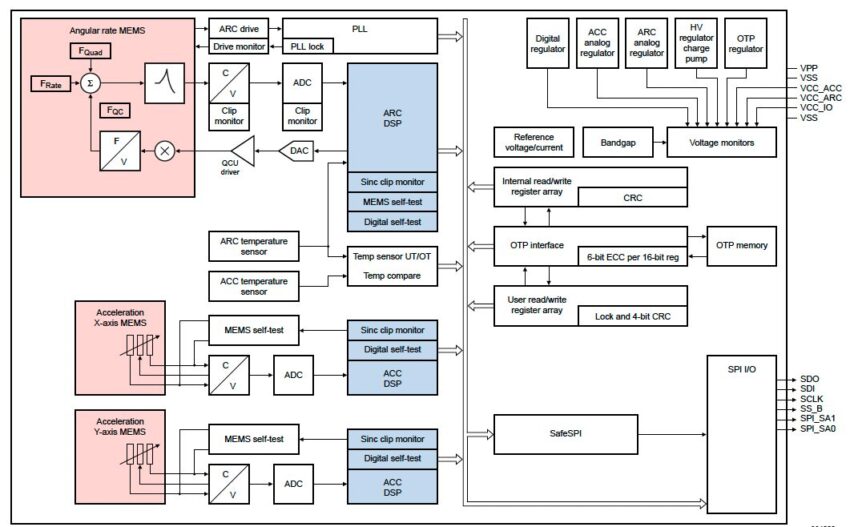
The NCS1012BAEP’s internal architecture, from the MEMS sensing elements through to the SPI output, including register protection and voltage monitoring. Image used courtesy of STMicroelectronics
Diagnostics and Interface
Every device is ISO 26262 compliant and carries full internal diagnostics. All four speak SafeSPI, the standard serial peripheral interface for automotive safety, which permits independent monitoring of sensor data. The NCS1012BAEP datasheet adds detail: a single 3.3 V supply; 16-bit data words with a 2-bit status field and a 3-bit CRC; and user-controlled self-test, signal clip monitoring, and DSP self-test for both the rate and acceleration channels. Housekeeping protections include NVM with ECC, a runtime memory lock with 4-bit CRC verification, undervoltage and overvoltage detection on the internal regulators, and SPI-bus contention detection.
Package and Availability
All four sensors are now in production, supplied in 24-pin QFN packages measuring 6 mm × 6 mm × 1.90 mm. Wettable flanks satisfy automotive optical inspection requirements. ST also commits to keeping the parts available for at least 15 years, a pledge aimed at easing lifecycle and redesign risk for long-running programs. Samples and pricing are available through local ST sales offices.
In short, one sensor family now spans crash protection, rollover detection, airbag deployment, vehicle stability control, and even radar beam stabilization, so it’s easy to see why a shared platform might appeal to designers. The timing seems apt, too: Omdia expects inertial measurement units to grow at a compound annual rate of 17.7% from 2025 to 2030, thanks to advanced driver assistance systems (ADAS) and automakers’ pursuit of higher levels of autonomy.


