
Nexperia Strengthens USB-C Ecosystem with New Controllers and Diodes
Nexperia has released a new line of ESD protection diodes for USB4 and Thunderbolt interfaces, as well as robust USB Type-C and PD controllers for 18-140 W charging adapters.
As the USB Type-C standard continues to evolve, integrating features like USB Power Delivery (USB PD) and high-speed data transfer (USB4 and Thunderbolt) presents a unique set of design challenges for engineers. The need for robust protection against electrostatic discharge (ESD) and efficient power management becomes critical in consumer applications. Nexperia has recently released two new series of components to address these issues: a family of ESD protection diodes for high-speed interfaces and a series of USB Type-C and USB PD controllers.
Trace Length Variability and the Battle Against Electrostatic Discharge
The first release focuses on safeguarding the high-speed data lines of USB4 and Thunderbolt interfaces. These interfaces operate at data rates exceeding 10 GHz, which makes signal integrity a primary concern. Traditional ESD protection devices, with their inherent parasitic capacitance and inductance, can introduce signal degradation and insertion loss at these frequencies. Nexperia’s new line of five 1-V ESD protection diodes is specifically designed to mitigate these issues.
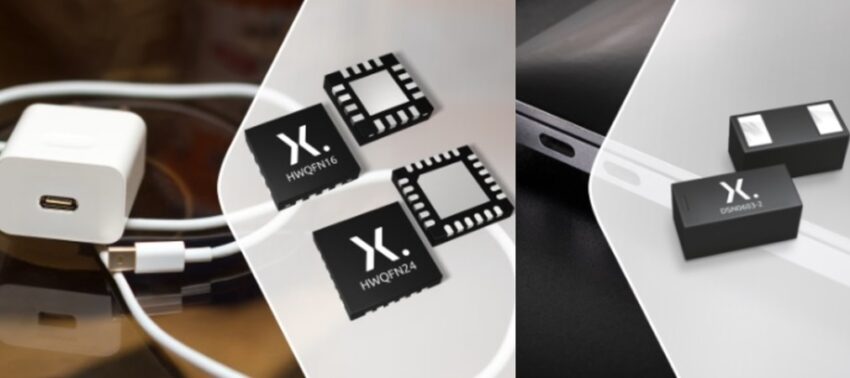
Nexperia’s new ESD diodes and PD controllers are targeting more efficient and safer high-speed USB devices. Image used courtesy of Nexperia
These new diodes feature an ultra-low capacitance of just 0.1 pF and offer minimal insertion loss—down to -0.21 dB at 12.8 GHz—with no resonance up to 40 GHz. Housed in a small, leadless DSN0603-2 (SOD962-2) package, they are optimized for placement close to the protected ICs. However, the company notes a design trade-off: while shorter traces reduce parasitic inductance, they can inadvertently lower the overall system-level ESD robustness.
Conversely, longer traces can improve clamping but may compromise signal integrity. This new portfolio provides designers with a selection of devices to help balance these conflicting requirements based on their specific PCB layout. The diodes are also highly robust, protecting against ESD events up to ±18 kV and offering a surge robustness of up to 9.6 A.
Building USBs Focused on Longevity in Both Usage and Compliance
In a separate but related announcement, Nexperia has introduced a new series of USB Type-C and USB PD controllers. These controllers, the NEX52041 and NEX52080, are designed for consumer adapter applications in the 18 W to 140 W range. The key feature of these controllers is their high level of integration and robustness, which simplifies the design process for engineers.
These controllers feature an embedded microcontroller (MCU) with 16 kB and 32 kB of MTP-ROM, respectively. This allows for flexible customization and firmware updates, ensuring long-term compliance with evolving USB standards. Unlike some competing devices that rely on external components for protection, the NEX52041 and NEX52080 provide up to 30 V of overvoltage tolerance on the VBUS, CC, DP, and DM pins. This integrated protection helps to minimize the external component count and reduces the overall bill of materials (BOM), while still safeguarding against potential short circuits between VBUS and other signal lines.
Charging requirements are expanding daily, making it necessary for companies like Nexperia to develop USB elements that are safer, more versatile, and more reliable. Image used courtesy of Adobe Stock
The controllers support a wide array of charging protocols beyond USB PD, including multiple D+/D- based fast-charging protocols, which ensure broad compatibility with both modern and legacy devices. For applications like multi-port chargers, the controllers can communicate with each other via an I²C interface and programmable GPIOs to enable smart power distribution. This capability allows for dynamic power sharing between ports, optimizing the charging experience for different connected devices without exceeding the total power budget of the adapter.
Summary
By combining these new components, designers can create a comprehensive solution for modern USB-C adapters. ESD diodes handle the high-speed data protection, ensuring signal integrity, while the PD controllers manage the power negotiation and delivery, simplifying the power path design and offering robust fault protection. This two-pronged approach addresses the critical electrical challenges that arise from the convergence of high-speed data and high-power delivery in a single, compact interface.


