
NXP’s New Battery ICs Boost EV and ESS Performance
The new BMx7318/7518 series 18-channel Li-ion battery controllers for EVs and energy storage feature dedicated ADCs for each cell, enhancing accuracy, safety, and efficiency.
The ongoing electrification of transportation and the push for grid-scale energy storage systems (ESS) are placing greater demands on battery management systems (BMS). These systems are critical for ensuring the safety, longevity, and performance of large battery packs. NXP Semiconductors has recently introduced a new family of 18-channel Li-ion battery cell controller ICs, the BMx7318/7518 series, designed to address these evolving requirements in high-voltage battery management systems (HVBMS) for electric vehicles and industrial applications.
Dedicated ADCs Improve Battery Management System Accuracy
A key architectural innovation in these new controllers is the implementation of a dedicated analog-to-digital converter (ADC) for each of the 18 cell inputs. This is a significant departure from traditional multiplexed designs, where a single ADC is rapidly switched between multiple channels. While multiplexed ADCs can be cost-effective, they often suffer from signal crosstalk and timing inaccuracies, which can degrade measurement fidelity. By providing an independent ADC for each channel, NXP’s new ICs eliminate these issues, leading to more precise and simultaneous cell voltage measurements. This improved accuracy, stated as a maximum error of just 0.8 mV, is crucial for calculating the battery’s state of charge (SOC) and state of health (SOH) with greater confidence over the battery’s lifetime.
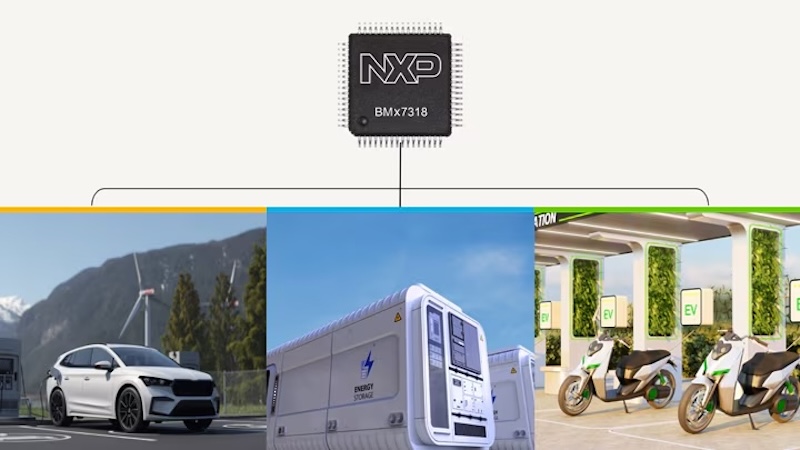
The BMx7318/7518 series Li-ion battery controllers are designed for EVs, energy storage, and e-mobility applications. Image used courtesy of NXP.
The increased accuracy and independence of the measurement channels also have a direct impact on the efficiency of cell balancing. The new ICs feature all-channel parallel balancing capability up to 150 mA, with a single channel reaching up to 300 mA. This parallel approach, combined with the precise measurement data from the dedicated ADCs, allows the BMS to correct imbalances in the battery pack more effectively. This not only extends the battery’s usable capacity but also helps to prolong its overall lifespan.
Integrated Solutions for Safe and Efficient BMS Design
Beyond the core measurement and balancing functions, the new NXP controllers offer a high degree of integration to simplify BMS design. They combine several key functions that were previously handled by separate components, including the analog front-end, battery junction box, and gateway functionalities. This level of integration can reduce the need for external components by up to 50%, which in turn lowers system costs and saves valuable board space. The ICs also feature an integrated SPI-to-TPL bridge, offering designers flexibility in their communication architecture. This integration supports a semi-centralized BMS architecture, a popular design choice that balances the benefits of centralized and distributed systems.
Another critical aspect of the new family is its robust design and functional safety certifications. The ICs are designed to be highly resistant to electromagnetic interference and bulk current injection, which are common challenges in the harsh operating environments of EVs and industrial systems. They are also certified to meet Automotive Safety Integrity Level C (ASIL-C) under the ISO 26262 standard and Safety Integrity Level 2 (SIL-2) for industrial applications. This compliance with rigorous safety standards is a key requirement for safety-critical battery systems.

Block diagram of the BMx7318/7518 series Li-ion battery controllers. Image used courtesy of NXP.
The BMx7318/7518 series is also designed with a focus on flexibility and long-term viability. The different IC variants offer pin-to-pin compatibility, allowing designers to easily scale or modify their systems without a complete hardware redesign. The inclusion of an ultra-low-power mode, which consumes only 5 µA, is a practical feature for meeting the requirements of long-term storage or transportation.
Summary
By providing a single, highly integrated chip that addresses the core challenges of accuracy, balancing, and safety, NXP is offering a streamlined solution for the next generation of battery management systems. The architecture’s focus on dedicated per-channel ADCs and system-level integration suggests a shift toward more robust and reliable battery control, which is essential for the continued growth of the EV and ESS markets.


