
Qualcomm Unveils UNO Q Dual-MCU SBC After Acquiring Arduino
Qualcomm acquires Arduino and launches the Arduino UNO Q, a QRB2210 + STM32 SBC supporting Linux, real-time control, and AI applications.

Arduino UNO Q Development Board
Qualcomm has announced its acquisition of Arduino to merge its advanced SoC technologies with Arduino’s massive open-source ecosystem. Alongside the deal, the company unveiled the Arduino UNO Q, a “dual-chip” single board computer that combines a Qualcomm QRB2210 processor for Linux applications with an STM32U585 microcontroller for real-time control, designed to bridge the gap between embedded, AI, and traditional maker platforms.
The Arduino UNO Q integrates a quad-core Cortex-A53 CPU running at 2.0 GHz with an Adreno 702 GPU, Hexagon DSP, dual ISP, and VPU for 1080p video. The board supports up to 4GB RAM with up to 32GB eMMC flash, with WiFi 5 and Bluetooth 5.1 connectivity, and supports HDMI via USB-C or MIPI DSI. Expansion options include Arduino UNO headers, 47 GPIOs, multiple UARTs, SPI, I2C, CAN, ADC/DAC, and dual MIPI CSI camera interfaces. These features make this board useful in various IoT and edge AI applications.
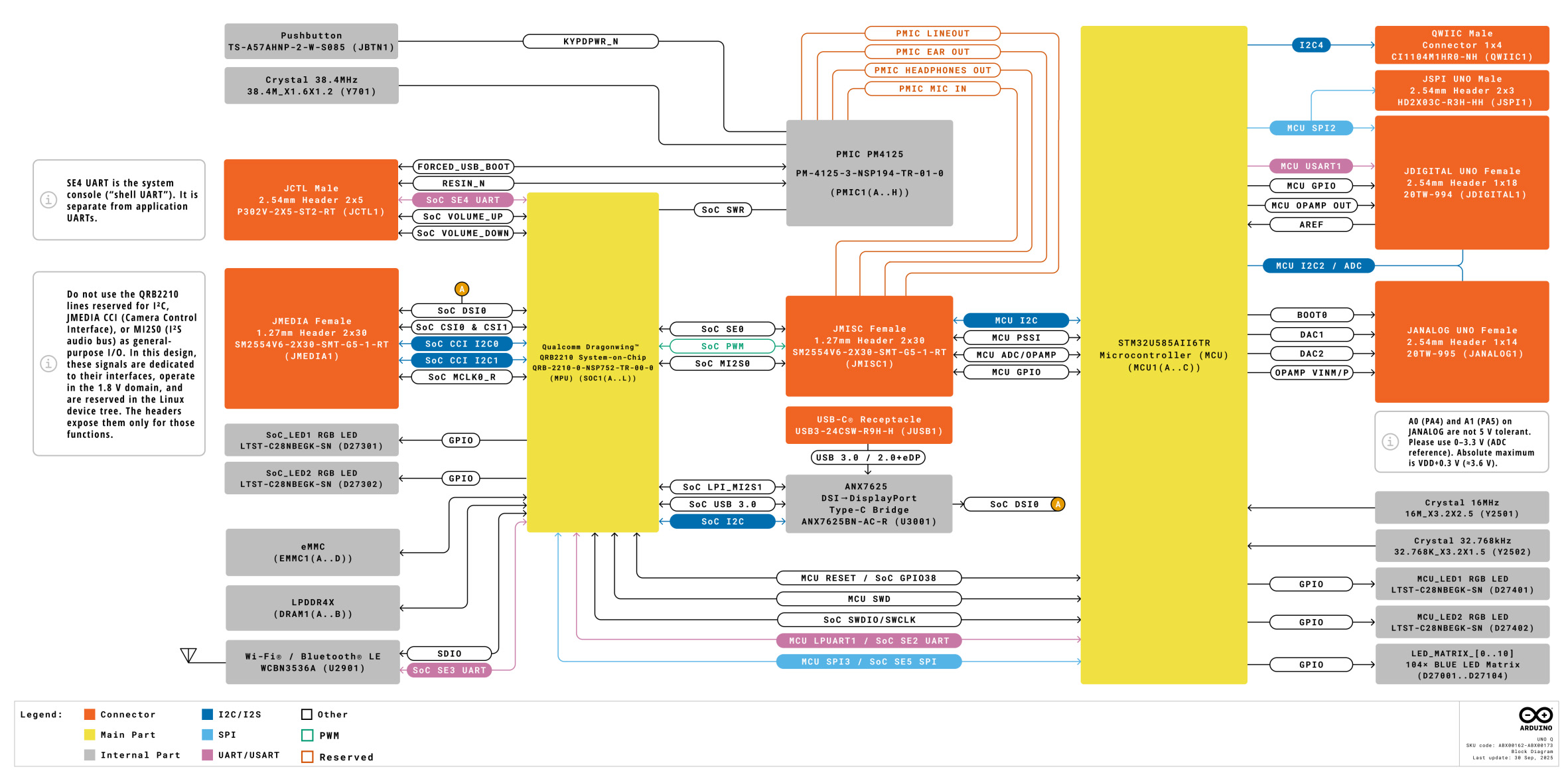
Arduino UNO Q Block Diagram
Arduino UNO Q Development Board Specifications:
- Processing Unit: Dual Chip Architecture
- SoC (MPU): Qualcomm DragonWing QRB2210
- CPU: Quad-core Arm Cortex-A53 @ up to 2.0 GHz
- GPU: Adreno 702 @ 845 MHz; supports OpenGL ES 3.1, Vulkan 1.1, OpenCL 2.0
- DSP: Hexagon QDSP6 v66
- VPU: 1080p @ 30 fps encode/decode
- ISP: Dual ISPs supporting up to 2x 13 MP or 1x 25 MP @ 30 fps
- MCU: STMicro STM32U585 Arm Cortex-M33 @ 160 MHz with 2 MB flash, 786 KB RAM
- SoC (MPU): Qualcomm DragonWing QRB2210
- Memory: Up to 4 GB RAM (ABX00173), 2GB on the (ABX00162) model
- Storage: Up to 32 GB eMMC flash (ABX00173), 16GB on the (ABX00162) model
- Display: USB-C (DisplayPort Alt Mode) or HDMI via USB-C dongle; MIPI DSI header
- Networking: Dual-band WiFi 5 (802.11 a/b/g/n/ac) and Bluetooth 5.1 via WCBN3536A module
- USB: 1x USB Type-C port for power, programming, and video output
- Debugging: JCTL MPU remote debug connector
- I/O:
- STM32 MCU: 47 total GPIOs with 22 on Arduino headers, 25 on JMISC supports UART, I2C, SPI, FDCAN, ADC, SAI, PSSI and more
- QRB2210 MPU:
- JMISC and JMEDIA connectors with up to 12x GPIO
- MIPI DSI display, dual MIPI CSI camera interfaces
- Audio I/O (Mic IN, Headphone OUT, Line OUT, Ear OUT)
- Qwiic I²C connector
- Misc:
- STM32: 2x RGB LEDs, 13×8 RGB LED matrix
- Qualcomm: 2x RGB LEDs, power button
- Power:
- 7–24 V DC via Vin pin
- Operating Voltage – +3.3 V (MCU, 5 V tolerant) / +1.8 V (MPU)
- Current per I/O pin – 20 mA
- Dimensions: 68.58 × 53.34 mm (Arduino UNO form factor)

Arduino UNO Q Dev Board Pinout
In terms of software support, the Qualcomm QRB2210 SoC runs Debian Linux with upstream support, whereas the STM32U585 microcontroller operates on Zephyr RTOS. More information, along with documentation, can be found on the Arduino UNO Q’s wiki page.
Since its not a MCU board, traditional C/C++ programming wont cut it so the company have intrioductd Arduino App Lab is a new cross-platform development environment for Windows, macOS, and Linux designed to program both the MPU and MCU on hybrid boards like the UNO Q. It unifies Arduino, Python, Linux, and AI development within a single interface using modular “Bricks,” simplifying workflow integration across real-time and high-level applications.
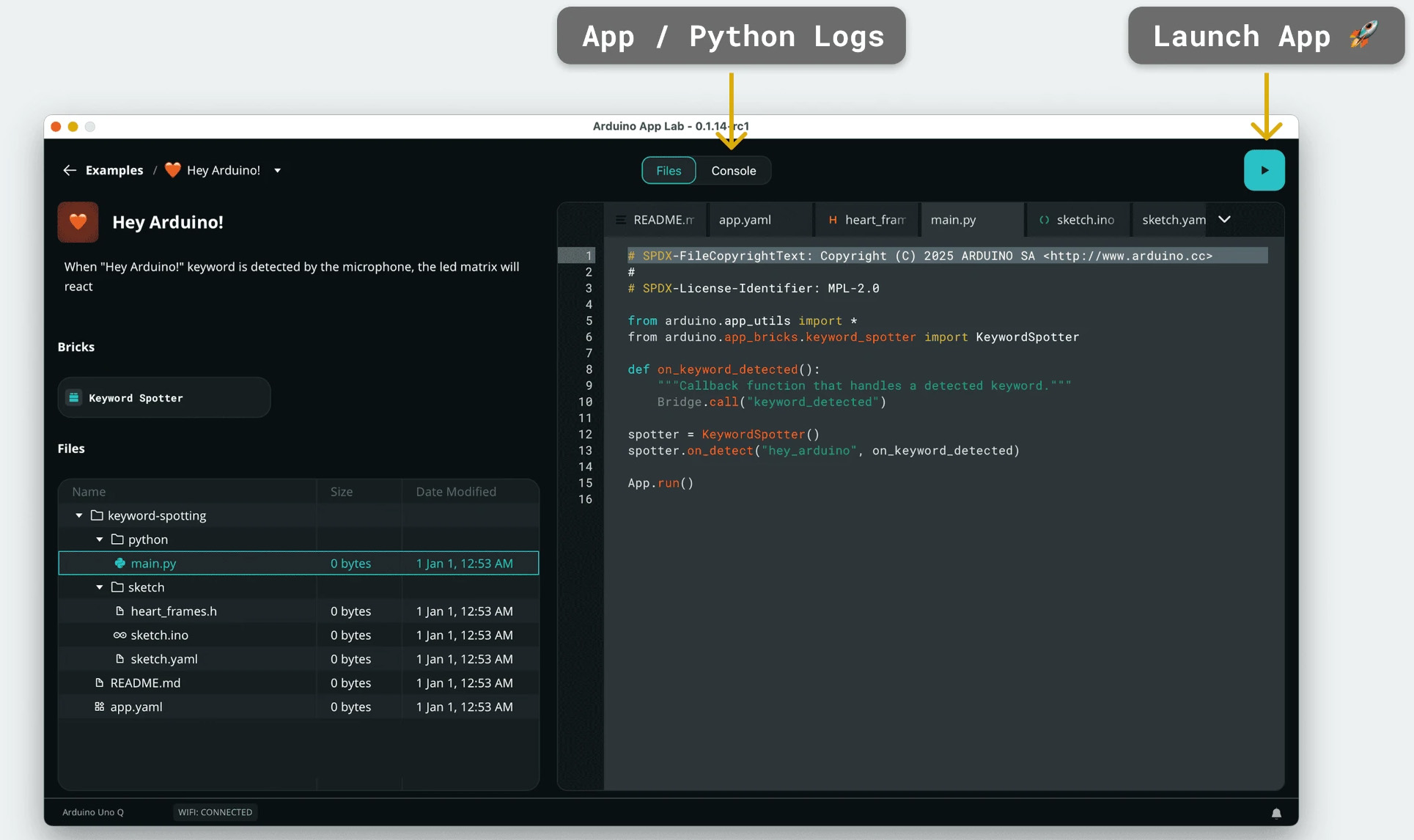
Arduino App Lab Interface
I have to assume now we will see more and more Arduino Boards based on Qualcomm chips, but the company promises to maintain the open source nature of the products and its community:
Arduino will retain its independent brand, tools, and mission, while continuing to support a wide range of microcontrollers and microprocessors from multiple semiconductor providers as it enters this next chapter within the Qualcomm family. Following this acquisition, the 33M+ active users in the Arduino community will gain access to Qualcomm Technologies’ powerful technology stack and global reach. Entrepreneurs, businesses, tech professionals, students, educators, and hobbyists will be empowered to rapidly prototype and test new solutions, with a clear path to commercialization supported by Qualcomm Technologies’ advanced technologies and extensive partner ecosystem.
This new board is a hybrid device, combining a Linux single-board computer powered by a Qualcomm Dragon Wing chip, but only time will tell how things will progress. For me, the only concern is Qualcomm’s long-term commitment to open-source standards, consistent Linux software support, and maintaining a focus on the traditional educational and maker markets over the more lucrative industrial space.
The Qualcomm SoC-based Arduino UNO Q SBC (ABX00162) is available for pre-order at $44.00 on the Arduino store, with shipping starting October 24, 2025. More information about the product can be found on the product page and the press release page.
Images used courtesy of Qualcomm


