
Silanna Semiconductor Launches Compact and Efficient Laser Firing System ICs
The SL2001 and SL2002 laser driver ICs integrate resonant capacitor charging and laser firing on a single 3.5 mm chip, reducing footprint and power consumption in LiDAR and rangefinder applications.
Silanna Semiconductor has released production quantities of the SL2001 and SL2002, laser firing system ICs that combine resonant-capacitor charging and high-current laser diode firing on a single unit. The integration eliminates multiple external discrete components typically required in laser driver systems.
According to Silanna, implementing the SL2001 with a 400 W quad-edge-emitting laser module reduces the system footprint from 400 mm² to 80 mm², an 80% reduction. Both devices are housed in a 1 mm by 3.5 mm WLCSP package and operate with both EEL and VCSEL laser configurations.
Silanna has designed the SL2001 and SL2002 laser firing system ICs to reduce power loss and system size. Image used courtesy of Silanna Semiconductor
Charging Architecture and Efficiency
Silanna’s FirePower laser firing system ICs, the SL2001 and SL2002, employ an integrated boost charger with inductive current control to charge the resonant capacitor during each pulse cycle. This approach achieves input-to-resonant-capacitor charging efficiency up to 85% while maintaining precise capacitor energy despite input voltage fluctuations. The architecture eliminates losses associated with transferring charge from standard high-voltage supply rails.
The resonant charging implementation allows the devices to generate laser diode anode voltages exceeding 100 V from supply voltages as low as 2.8 V. No-load system power consumption remains below 5 mW. The integrated GaN/MOS drivers provide sufficient current to fire dual GaN or MOS FETs directly, eliminating the need for external driver stages.
Both ICs include inductor-current control circuitry that regulates resonant-capacitor energy independent of input-voltage variations. This maintains consistent pulse energy across the operating voltage range without software compensation or lookup tables.
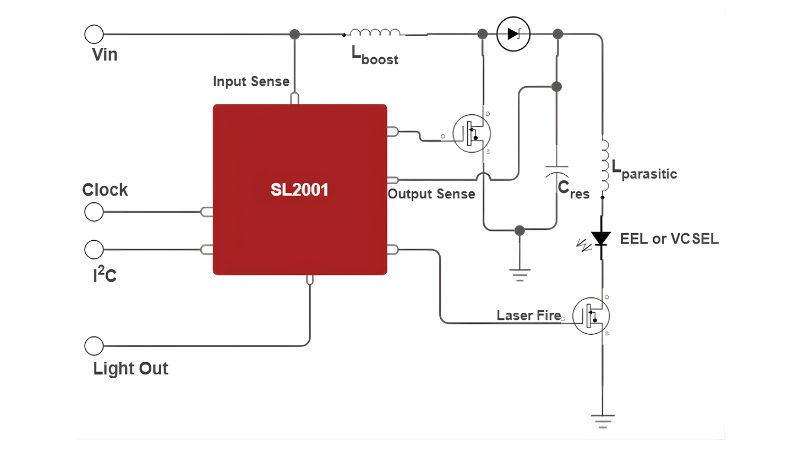
Block diagram of the SL2001 integrated laser drive system. Image used courtesy of Silanna Semiconductor
Device Specifications and Control Features
The SL2001 operates from a 3 V to 24 V supply and delivers sub-2 ns FWHM laser pulses, with a peak power output of 1000 W. The device targets automotive-grade LiDAR applications and supports repetition rates up to 10 MHz, limited by thermal management in the laser diode and board components rather than the IC itself.
The SL2002 operates from a 2.8 V to 5.5 V supply, delivering 100 W pulses at a 1 MHz pulse repetition frequency. The lower-voltage range addresses handheld and battery-powered ranging systems. Peak power output reaches 200 W for this variant.

Both the SL2001 and SL2002 feature a built-in I2C interface for fault monitoring and power control. Image used courtesy of Silanna Semiconductor
Both devices integrate an I²C interface for output power control and fault monitoring. The ICs include 7 bytes of multiple-time programmable memory for fault and timing configuration, plus 219 bytes of one-time programmable memory for customer use. Dual-polarity LIGHT output signals indicate laser firing events with time error jitter below 0.1 ns, supporting precise time-of-flight measurement synchronization.
The SL2001 incorporates laser-cathode sensing for eye-safety monitoring. Both devices include integrated fault protection and monitoring functions accessible through the I²C interface.
Laser-Based Measurement
The SL2001 and SL2002 are available in production quantities through distribution, with evaluation kits offered for both devices. The integration addresses system-level challenges in laser-based measurement applications, including automotive LiDAR, industrial ranging systems, 3D mapping, sports and hunting rangefinders, and consumer time-of-flight sensors, where size, power consumption, and thermal management constrain traditional implementations.


