
Renesas Releases Magnet-Free IPS IC Family With Web-Based Design Tool
The new magnet-free inductive position sensor (IPS) ICs offer high precision and robust performance in industrial, medical, and consumer applications, providing a low-maintenance and cost-effective alternative to traditional encoders.
Renesas Electronics Corporation has announced the release of a new family of magnet-free inductive position sensor (IPS) ICs, providing a new option for designing systems that require high-precision position sensing in challenging environments.
The RAA2P3226, RAA2P3200, and RAA2P4200 ICs shift away from traditional magnetic and optical encoders, offering a solution less susceptible to external magnetic fields and mechanical wear. This release expands Renesas’ existing industrial sensing portfolio, catering to applications where reliability and cost-effectiveness are paramount.
The new line of magnet-free IPS ICs is built to bring high precision and low maintenance to industrial, medical, and consumer applications. Image used courtesy of Renesas Electronics Corporation
What Is Magnet-Free Inductive Sensing?
Inductive position sensing operates on the principle of electromagnetic induction. Unlike magnetic encoders, which rely on a permanent magnet and a Hall-effect sensor, an IPS utilizes a set of coils: a transmitter coil, a main receiver coil, and a secondary receiver coil. The transmitter coil generates an AC magnetic field. As a conductive target, such as a metal rotor, moves over the coils, it alters the coupling between the transmitter and receiver coils. This change in coupling is detected by the receiver coils, and the IC calculates the target’s position based on the induced voltage differential.
A magnet-free design provides several key advantages. It eliminates the need for a bulky and potentially expensive permanent magnet, simplifying the mechanical design and reducing the overall system cost. More importantly, it makes the sensor impervious to stray magnetic fields, a common issue in industrial settings with large motors and power electronics. Optical encoders, while precise, can be sensitive to dirt, dust, and moisture. These are environmental factors that have little to no effect on an inductive sensor’s performance.
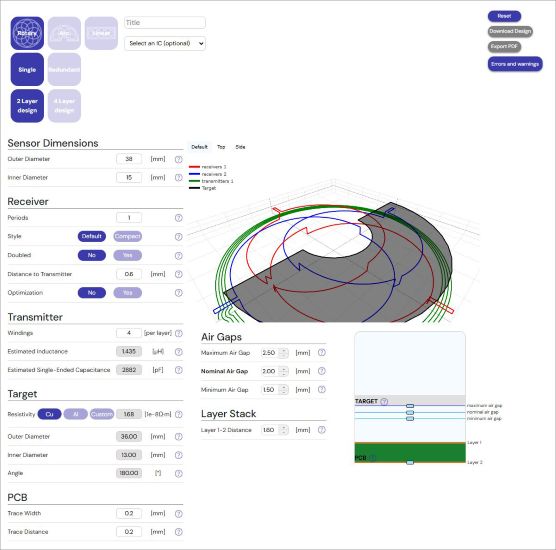
Renesas’s Inductive Position Sensor Coil Optimizer is a web-based simulation design tool that simplifies sensing coil configuration and customization. Image used courtesy of Renesas Electronics Corporation
Magnet-Free Inductive Position Sensor (IPS) ICs
Renesas’ new magnet-free IPS IC family is designed for a high degree of customizability. Users can design their own sensing elements (coils) to match specific form factors and system requirements. The ICs are compatible with a wide range of external coil geometries, providing flexibility for integration into various mechanical systems. The sensors are capable of both low-speed and high-speed applications, with the RAA2P4200 supporting speeds up to 600,000 RPM.
Alongside its new devices, Renesas has also released a web-based design tool, the Inductive Position Sensor Coil Optimizer, to assist engineers in creating and optimizing these custom coil designs, streamlining the development process.
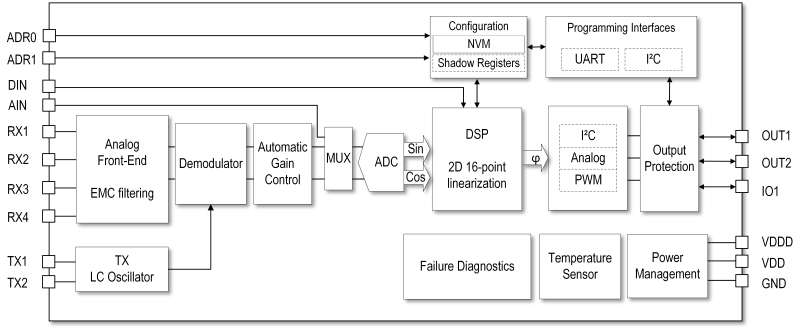
Functional block diagram of the RAA2P4200 sensor IC with single-coil sensing element, built for use in low-speed applications. Image used courtesy of Renesas Electronics Corporation
The product family includes three distinct ICs to address different application needs. The RAA2P3226 is a dual-coil sensor primarily built for position sensing in industrial applications, such as robotics. It features 19-bit resolution and an absolute accuracy of 0.01 °. The RAA2P3200 is a single-coil solution for high-speed, high-precision linear and rotary position sensing. Finally, the RAA2P4200 features a single-coil sensing element for low-speed applications, such as in medical equipment.
All IPS ICs are designed to withstand vibration, moisture, and particulate matter, making them suitable for harsh environments. The three ICs feature an operating temperature range of -40 °C to 125 °C and a 3.0 V to 5.5 V supply voltage.
Enhancing Industrial Sensing
Renesas’ new ICs offer a robust and reliable alternative to traditional encoders by leveraging an inductive sensing principle that is inherently resistant to common environmental challenges. The magnet-free architecture simplifies system design and reduces reliance on external components, while the customizable coil design allows for precise tailoring to specific application requirements. The new family of sensors offers a compelling option for engineers seeking a durable, low-maintenance solution for a range of industrial applications, from robotics and motor control to home appliances and medical equipment.


Renesas’ magnet-free IPS ICs are a strong alternative to magnetic and optical encoders, especially in harsh or high-interference environments. By eliminating permanent magnets and adding a web-based coil design tool, they reduce maintenance, improve reliability, and give engineers more flexibility in precision industrial, medical, and consumer applications.