
Robots Get a Brain Upgrade With NVIDIA’s Jetson Thor System-on-Module
Powered by NVIDIA’s Blackwell GPU architecture, the Jetson Thor system-on-module (SoM) delivers a boost in AI compute to enable real-time reasoning for the next generation of robots.
In a move poised to accelerate the development of the next generation of robotics, NVIDIA has officially announced the availability of the Jetson Thor, a new system-on-module (SoM).
The Jetson Thor is powered by an NVIDIA Blackwell GPU and is designed to represent a significant leap in edge computing capabilities, delivering unparalleled performance to power humanoid robots, surgical assistants, and other intelligent machines operating in real-world environments.
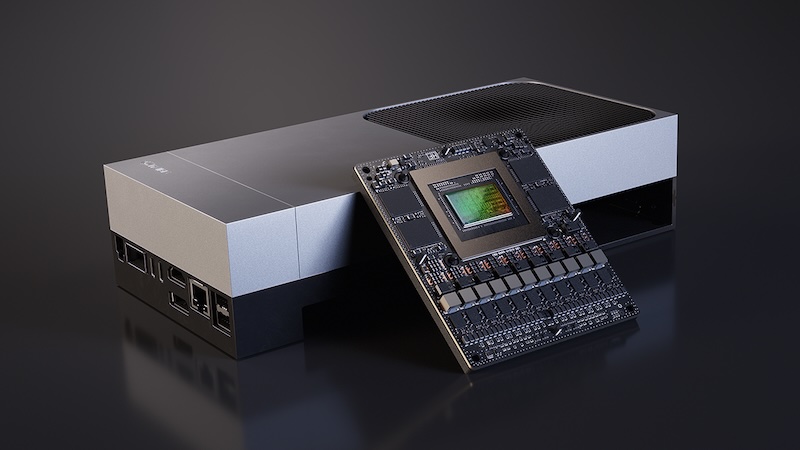
Jetson Thor production module (foreground) and development kit (background). Image used courtesy of NVIDIA
NVIDIA Jetson Thor
The new NVIDIA Jetson Thor modules are engineered to be the central processing hub for complex robotic systems, providing the raw computational power required for real-time sensor processing and generative reasoning at the edge.
With the increasing demand for autonomy and on-device intelligence, the Jetson Thor is designed to minimize reliance on cloud connectivity, enabling robots to make faster, more efficient decisions locally. This is a critical factor for applications where latency and reliability are paramount, such as in medical robotics or high-speed manufacturing.
A Look Under the Hood: The Technical Specifications
For electrical and embedded systems engineers, the technical specifications of the Jetson Thor reveal a powerful and purpose-built platform. The SoM delivers an astonishing 2,070 FP4 teraflops of AI compute performance. To put that in perspective, this is a 7.5x increase in AI compute over its predecessor, the Jetson Orin, which has been the industry standard for a while.
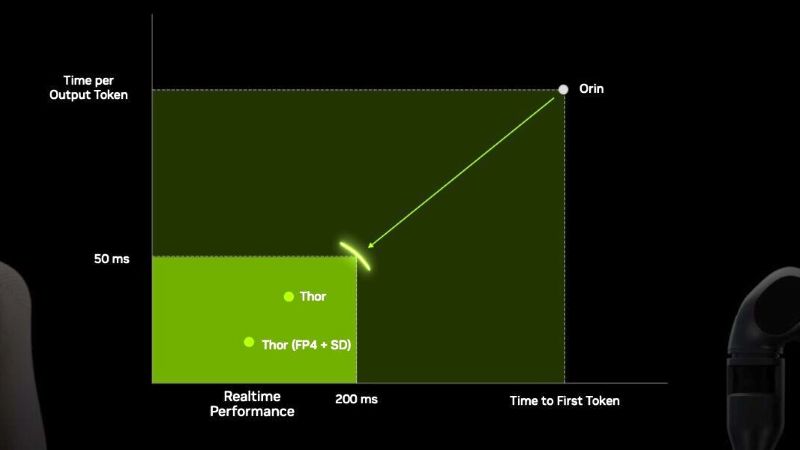
Jetson Thor improves performance over the Jetson Orin, and further performance improvement is expected with FP4 and speculative decoding optimization. Image used courtesy of NVIDIA
The Jetson Thor also boasts 3.1x more CPU performance and double the memory, a crucial improvement for handling the immense data streams from high-resolution cameras, LiDAR, and other sensors. NVIDIA has built this performance leap to enable a new class of robotic perception, planning, and navigation models that were previously infeasible on edge devices.
The Jetson Thor module is powered by NVIDIA’s Blackwell GPU. The SoM integrates seamlessly with the hardware, allowing for the concurrent processing of multiple deep learning models. This is particularly important for tasks like multi-camera visual simultaneous localization and mapping (SLAM), where a robot must process and fuse data from several sources to understand its surroundings. The Jetson Thor is designed to handle these multi-modal, real-time workloads with a level of efficiency and speed that aims to redefine what is possible for on-device reasoning.
A look at the NVIDIA Jetson AGX Thor developer kit. Video used courtesy of NVIDIA Developer
NVIDIA AI Software Stack
The Jetson Thor is fully integrated into the NVIDIA AI software stack, which includes essential tools for developers. Key platforms include:
- NVIDIA Isaac: A comprehensive robotics platform that provides tools for simulation, manipulation, and navigation.
- NVIDIA Metropolis: Tailored for video analytics and computer vision, enabling smart cameras and vision-based systems.
- NVIDIA Holoscan: Designed for real-time sensor processing, particularly for medical devices and scientific instruments.
This cohesive software suite accelerates the development cycle, allowing engineers to quickly build, test, and deploy complex AI models on the Jetson Thor. The platform also supports popular generative AI frameworks and large language models like Cosmos Reason and Llama, opening up new avenues for robots that can understand and interact with their environments using natural language commands.
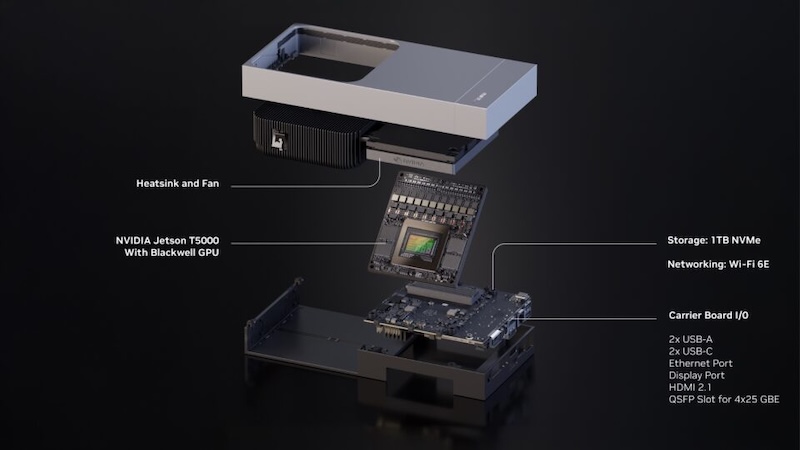
The Jetson AGX Thor developer kit helps designers improve their time-to-market. Image used courtesy of NVIDIA
Powering the Next Wave of Robotics
NVIDIA has combined its hardware and integrated software stack to make the Jetson Thor not just a component, but a complete solution for bringing physical AI to life. The impact of the Jetson Thor is already being seen in various applications. The platform is currently being used to power Agility Robotics’ Digit and Boston Dynamics’ Atlas humanoid robots.
Beyond humanoids, the Jetson Thor’s capabilities extend to a wide range of fields, including medical devices, agriculture, and logistics. For example, it can provide the computational backbone for smart tractors that can identify and navigate around crop rows with sub-meter precision or for surgical assistants that require split-second, accurate decision-making.


