
Rohm’s New Gate Driver Aims To Optimize Three-Phase BLDC Motor Applications
The new three-phase brushless DC motor gate driver utilizes Rohm's TriC3 technology to control gate drive current dynamically, reducing heat generation and suppressing EMI in 12 V to 48 V systems.
The development of high-efficiency motor control circuitry, particularly for 12 V to 48 V brushless DC (BLDC) systems, remains a challenge. A persistent technical hurdle is the trade-off between minimizing power consumption, specifically MOSFET switching losses, and suppressing electromagnetic interference (EMI). High-speed switching reduces conduction losses but increases ringing, demanding extensive external filtering.
Recently, Rohm Semiconductor has introduced the BD67871MWV-Z, a three-phase BLDC motor gate driver optimized for medium-voltage systems. The new device leverages Rohm’s proprietary TriC3 Active Gate Drive technology to reconcile this long-standing compromise.
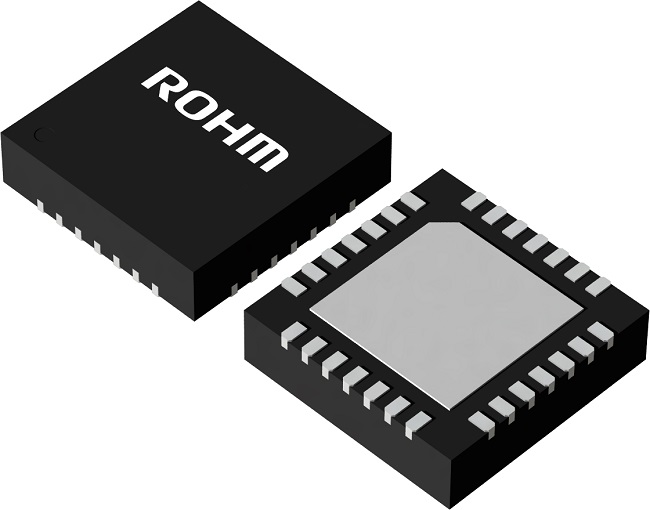
Rohm has developed the BD67871MWV-Z three-phase brushless DC motor gate driver for 12 V to 48 V systems. Image used courtesy of Rohm Semiconductor
Solving Switching Loss and EMI Trade-Off
Rohm has designed the BD67871MWV-Z to drive three half-bridges consisting of six external N-Channel power MOSFETs, supporting a wide input voltage range from 4.5 V up to 60 V, with a maximum Vcc of 65 V. The core innovation of the device is Rohm’s TriC3 technology, which operates as a multi-step constant current drive. It does not rely on a fixed gate resistance but instead actively monitors voltage characteristics at the external power FETs in real-time. This dynamic feedback loop allows the gate drive current to be intelligently adjusted across three stages during the switching event.
By controlling the gate current in response to the FET’s output state, the driver significantly reduces switching losses (and corresponding heat generation) while simultaneously suppressing voltage overshoot, known as ringing. In motor evaluations, this technique demonstrated approximately a 35% reduction in FET heat generation compared to ROHM’s conventional constant-current drive solutions, all while maintaining equivalent EMI levels. This allows for increased power density, as the need for oversized heatsinks and extensive external EMI filtering components is minimized, simplifying the overall design process.
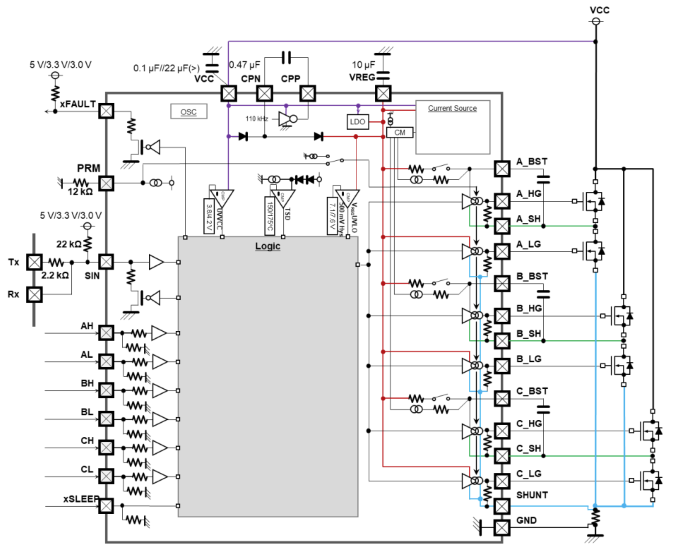
Functional block diagram of the BD67871MWV-Z. Image used courtesy of Rohm Semiconductor
High-Performance Control and Compact Design Robustness
The new IC incorporates several features critical for robust high-performance control. It supports a 100% PWM duty cycle, enabled by a bootstrap gate driver that includes a current source circuit. Dead time control is adjustable via an external resistor, allowing designers to fine-tune the synchronous rectification period from 10 ns up to 3000 ns to optimize for application-specific motor parameters and minimize shoot-through risk. Furthermore, the device supports both 3.3 V and 5 V logic inputs, integrating seamlessly with a variety of microcontroller units.
For applications prioritizing low power consumption, the gate driver exhibits super low IVCCQ consumption of less than 1 μA in sleep mode. Robustness is ensured through integrated protection features, including VCC UVLO, Bootstrap UVLO, VREG UVLO, Thermal Shutdown, and a dedicated xFAULT pin to indicate fault conditions. The device is housed in a compact UQFN28 package (4.0 mm × 4.0 mm), offering a space-saving solution common to medium-voltage industrial control equipment, thereby simplifying circuit modification for new and existing designs.
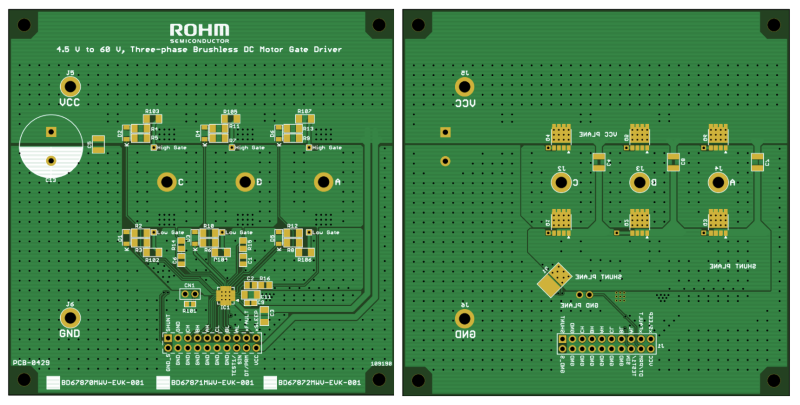
The BD67871MWV-EVK-003 evaluation board for prototyping and development of the BD67871MWV-Z gate driver. Image used courtesy of Rohm Semiconductor
Targeting High-Efficiency Operation
The BD67871MWV-Z gate driver utilizes Rohm’s TriC3 technology to manage the FET switching curve dynamically, fundamentally resolving the trade-off between high efficiency and low EMI in 1 2V to 48 V BLDC motor systems. By achieving up to 35% heat reduction through active gate current control, the component enables greater power density and reliability while simplifying the integration of external power MOSFETs. This level of technical integration is essential for demanding applications in industrial equipment, such as high-performance electric drills and industrial fans, as well as high-efficiency consumer appliances like air conditioners, air purifiers, and light e-mobility systems.


