
STMicroelectronics Ushers in Smart Motion Tracking With Dual-Range IMU
The ISM6HG256X is a six-axis IMU with dual-range accelerometers, a high-range gyroscope, and a machine learning core for tracking everything from small motions to large shocks.
The deployment of inertial measurement units (IMUs) in industrial monitoring and high-stress environments necessitates sensors that can simultaneously manage high-fidelity motion tracking and detect significant shock events. The new ISM6HG256X is a six-axis IMU, part of STMicroelectronics’ iNEMO family of inertial modules. The device integrates dual-range acceleration sensing and on-chip processing resources, allowing it to function as an intelligent sensor node rather than a simple data stream source.
The ISM6HG256X Dual-Range Motion Sensor
The ISM6HG256X IMU integrates a three-axis digital gyroscope and two distinct three-axis digital accelerometers. This architecture is designed to capture the full spectrum of industrial motion, from minute, continuous vibrations to extreme, short-duration shocks.
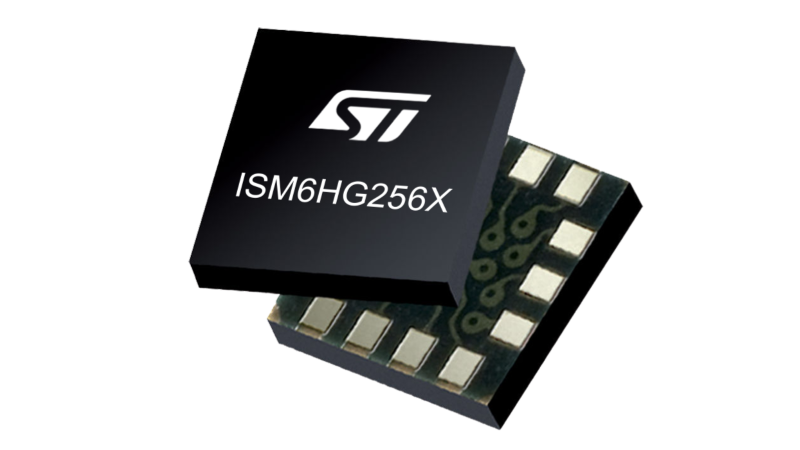
The ISM6HG256X is a compact “three-in-one” motion sensor in a surface-mount 2.5 mm x 3 mm package. Image used courtesy of STMicroelectronics
The first accelerometer channel, dedicated to fine motion tracking, offers selectable full-scale ranges of ±2 g up to ±16 g. This low-g channel provides the resolution necessary for standard orientation sensing, vibration analysis, and low-rate movement detection.
The second channel, which employs a dedicated high-g sensor, extends the measurement capability up to a full scale of ±256 g, with intermediate options at ±32 g, ±64 g, and ±128 g. This dedicated high-g path is critical for detecting severe impacts, such as those encountered in machine fault scenarios or logistics shock events.
The integrated 3-axis digital gyroscope supports an extended full-scale range from ±250 dps up to ±4000 dps, providing the high angular rate measurement often required for robotics and rapid control loop applications.
Quad-Channel Data Processing
The ISM6HG256X utilizes a quad-channel architecture, which enables the sensor data (accelerometer and angular rate) to be processed through four distinct, configurable channels. This parallel processing capability allows developers to allocate separate channels for different tasks, such as a user interface path, an optical image stabilization path, an electronic image stabilization path, and a high-g shock detection path. Each channel can be configured with its own dedicated filtering and output data rate without data path conflicts.
In terms of power management, the device is engineered for low-power operation, drawing 0.67 mA in the standard six-axis combo high-performance mode. Even when running the dual accelerometer full-scale configuration, a more complex operational state, the current consumption remains low at 0.80 mA in high-performance mode. This efficiency is critical for battery-powered industrial IoT devices.
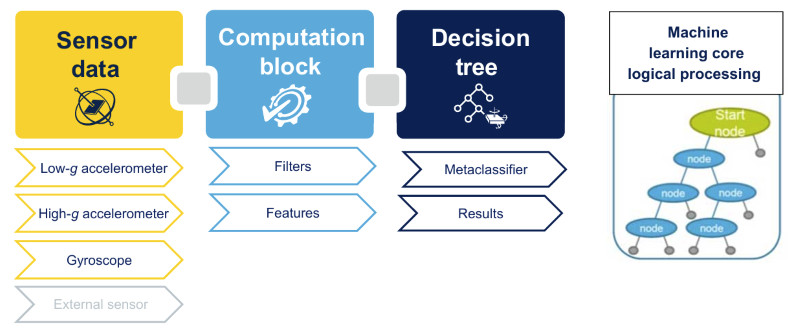
The ISM6HG256X features built-in machine learning for AI applications. Image used courtesy of STMicroelectronics
Edge Computing and Adaptive Behavior
Moving data processing from the host microcontroller to the sensor, known as edge computing, is a primary function of the ISM6HG256X. It embeds two key intellectual property blocks for this purpose: the finite state machine (FSM) and the machine learning core (MLC).
The FSM is a programmable logic engine that can run simple, deterministic algorithms at a high rate of 960 Hz. It can process data from the gyroscope, low- and high-g accelerometers, and external sensors. The FSM can implement custom motion-triggered logic, such as wake-up conditions, free-fall detection, or initial data pre-filtering, reducing the computational load and wake-up time of the host processor.
The MLC, a configurable engine, enables the execution of basic AI algorithms for context awareness. The core supports exportable AI features that classify patterns of motion or environmental states. This capability is leveraged by the adaptive self-configuration feature. This feature enables the IMU to automatically reconfigure its own settings, such as data rates, full-scale ranges, or active processing blocks in real time based on the detected motion pattern or an MLC-derived decision, without requiring intervention from the host processor.

The ISM6HG256X features an embedded finite state machine (FSM) for configurable motion detection. Image used courtesy of STMicroelectronics
Interface and System Integration
STMicroelectronics’ new sensor offers flexible digital interfacing, supporting standard SPI and I²C protocols, alongside the high-speed MIPI I3C v1.1 serial interface for data synchronization with the main processor. A separate auxiliary SPI and MIPI I3C v1.1 interface is available for specific data outputs, such as OIS. The physical footprint of the component is 2.5 mm × 3 mm × 0.83 mm, facilitating integration into size-constrained designs. The device also integrates an embedded sensor fusion low-power algorithm and a 4.5 KB smart FIFO buffer to minimize system latency and host processor wake-ups.
Intelligent Motion Tracking
The ISM6HG256X is an integrated inertial measurement platform designed for industrial reliability and autonomy. Its architecture, featuring simultaneous high- and low-g sensing, high-efficiency operation, and embedded processing capabilities like the FSM and MLC, enables sophisticated motion tracking and shock detection at the sensor node level. This makes the component suitable for condition monitoring systems on factory equipment, high-value asset tracking where shock detection is crucial, robotics and factory automation requiring precise and high-rate angular control, and worker personal protective equipment for safety monitoring and fall detection.


