
Allegro’s A81415 Merges Safety, Power, and Wheel-Speed Sensing
A single-chip PMIC folds rotational-speed decoding into brake-by-wire voltage regulation, trimming parts count and board space in EMB corner modules.
Brake-by-wire is quickly becoming a load-bearing pillar of the software-defined vehicle, shifting mechanical stopping power into electronics that live right at the wheel. That corner-module real estate is unforgiving: vibration, thermal cycling, and tight enclosures all compete with the need for fail-operational power and precise wheel-speed data, and functional safety requirements sit at the top of the stack regardless. Allegro MicroSystems has introduced the A81415, which the company describes as the first ASIL-D-certified Power Management IC (PMIC) to fold a wheel-speed sensor interface directly into its architecture, aiming to replace a scattered mix of safety PMICs, standalone decoders, and discrete power components with a single part.
One Chip, Fewer Parts
At the center of the A81415 sits an on-chip wheel-speed sensor interface (WSSI) capable of decoding 2-level, 2-level Pulse Width Modulation (PWM), and 3-level AK protocols, including the high-resolution AK variant, without any external decoder or supporting analog circuitry. Power delivery comes from a fully integrated buck-boost pre-regulator paired with a single-inductor topology that dispenses with external switches and diodes altogether. Allegro credits this combination with erasing as many as nine external components from a typical design, translating into roughly $4 of semiconductor bill-of-materials (BOM) savings per vehicle and freeing more than half the board space previously reserved for these functions, headroom that corner modules, chronically starved for space, can put to immediate use.
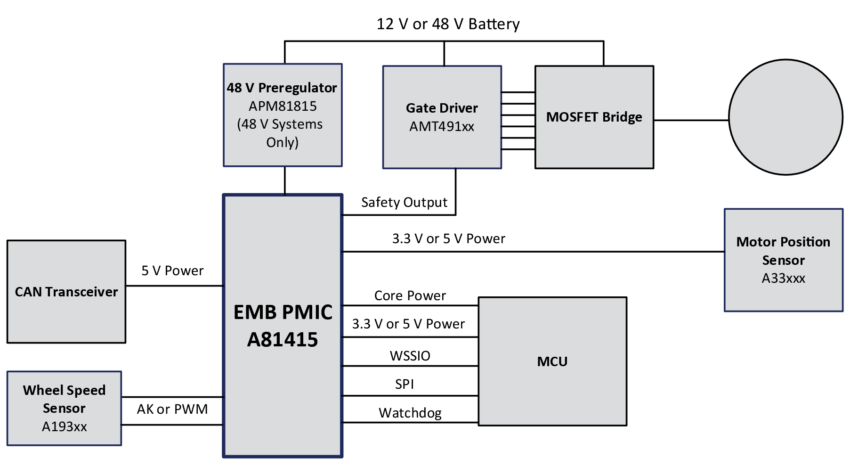
A single A81415 replaces what used to require a separate safety PMIC, sensor decoder, and discrete power components in a brake-by-wire corner module. Image used courtesy of Allegro
Tightening the Sensing Loop
Rather than passing raw wheel-speed signals to an MCU for interpretation, the A81415 performs the physical-layer decoding internally and delivers the finished data over a Serial Peripheral Interface (SPI), shortening the safety-critical loop and freeing MCU cycles for other tasks. Its power rails are also tuned to feed Allegro’s XtremeSense TMR angle sensors, so the commutation and clamping-force signal chain, from wheel to caliper, behaves as a single, coherently tuned system rather than a patchwork of independently specified parts.
A Route From 12 V to 48 V
Built on Allegro’s automotive grade-0 process, the A81415 carries ASIL-D and AEC-Q100 qualifications, backed by dual bandgap references, one for regulation and one for fault detection, plus three separate watchdog timers, pulse-width, window, and Q&A, that monitor system health without added external circuitry. Operating natively across a 3.2 V to 36 V input range, the device also pairs with Allegro’s APM81815 pre-regulator and 48 V gate drivers to form a chipset that lets Tier 1 suppliers carry proven 12 V braking architectures into 48 V corner modules without a ground-up redesign. Allegro’s Peter Wells, Business Line Director for High Performance Power, framed the release around the idea that sensing and power electronics at the wheel increasingly need to function as a single, tightly integrated unit rather than as separately sourced building blocks.
Between the sensing integration and the safety qualifications packed into one 40-pin QFN package, the A81415 reads as a fairly direct answer to the parts-count and board-space squeeze that corner-module designers have been living with for years. Electromechanical braking systems and brake-by-wire chassis architectures, more broadly, stand to benefit most, particularly as automakers push toward 48 V platforms that demand tighter integration without sacrificing fail-operational safety margins. Samples and further technical details are available through Allegro, and the part is on display at electronica Shanghai for anyone wanting a closer look.


