Roundup: New Digital Isolator Launches Target Industrial and Automotive Systems
Three chipmakers roll out isolators addressing RS485 links, low-power quad channels, and integrated power delivery for compact isolated designs.
Digital isolators are one of the quieter workhorses of modern electronics, sitting between high- and low-voltage domains to keep data flowing without letting fault currents follow it home. Over the past two months, three semiconductor suppliers have refreshed their isolation lineups, each chasing a different design constraint: communication bandwidth, standby current, and board real estate. The announcements from NOVOSENSE, Toshiba, and Skyworks collectively suggest that isolator design is splintering into application-specific niches rather than settling on a single universal part.
NOVOSENSE Targets RS485 Networks with the SP301H/L
NOVOSENSE’s new SP301H/L series is a three-channel digital isolator built on the company’s third-generation capacitive isolation technology and designed for RS485 communication links. The chips are pitched as direct replacements for the three-optocoupler circuits that have long anchored RS485 isolation, folding the equivalent function, along with its supporting resistors and capacitors, into a single SSOW10 package. NOVOSENSE reports that this consolidation reduces PCB area by more than 60 percent compared with optocoupler-based designs.
Beyond the size reduction, the SP301H/L pushes data-channel throughput to 8 Mbps and enable-channel switching to 1 Mbps, comfortably clearing the bandwidth ceiling that optocouplers tend to impose. A default-high SP301H and default-low SP301L variant give designers flexibility in how they wire enable logic to an MCU. Reliability figures are notable too: NOVOSENSE cites roughly 10 percent better electrical overstress (EOS) tolerance than its prior SP301A and NIRS31 parts, latch-up immunity above 10 V, and common-mode transient immunity (CMTI) around 200 kV/µs, alongside a 5 kVrms withstand voltage and surge capability past 10 kV. The part targets smart electricity meters, industrial fieldbus equipment, and other RS485 nodes operating over the –40°C to +125 °C range.
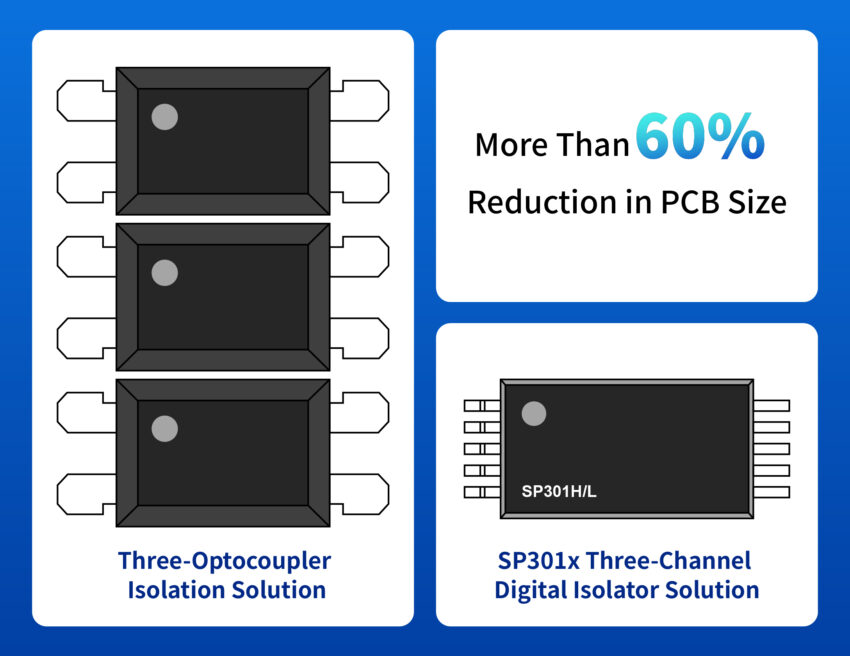
Consolidating three optocouplers into a single SP301H/L device trims the PCB footprint by over 60 percent. Image used courtesy of Novosense
Toshiba Rounds Out Its Isolator Line with Low-Power Quad Channels
Toshiba’s contribution is the DCL341x0B series, a pair of quad-channel standard digital isolators built for medium-speed, multi-channel communication in industrial and consumer gear. Using Toshiba’s proprietary edge-transmission method, the devices manage data rates up to 25 Mbps while drawing just 0.18 mA per channel, a combination the company positions as useful for programmable logic controllers (PLCs), sensor and actuator wiring, and SPI-based I/O interfaces.
The DCL341L0B and DCL341H0B differ only in their default output logic, low and high respectively, and both offer a three-forward, one-reverse channel arrangement alongside 30 kV/µs (minimum) CMTI and a 3000 Vrms withstand rating. Packaged in a compact SSOP16 and rated across a –40°C to +125°C range, the series slots in below Toshiba’s existing high-speed isolator families, giving system designers a lower-power option when raw throughput matters less than energy budget and board footprint.
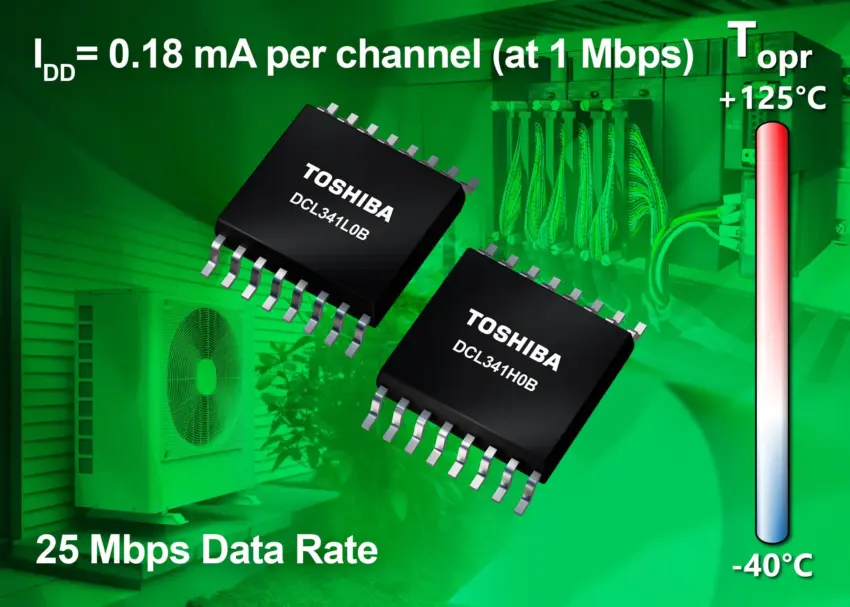
The DCL341L0B (low-default output) and DCL341H0B (high-default output) are Toshiba’s new quad-channel, low-power isolators. Image used courtesy of Toshiba
Skyworks Folds Power Delivery into the Si86Px Isolator
Skyworks took a different tack with the Si86Px family, pairing its established digital isolator technology with an integrated isolated dc-dc converter and a matched miniature transformer in a single package. The idea is to solve a specific headache for designers: generating clean isolated power on a board where space is tight or where the isolated side has no local power source of its own.
The Si86Px can deliver up to 0.5 W of isolated power with 0.1 percent typical load regulation, which Skyworks says is roughly ten times tighter than comparable integrated-power isolators, a meaningful figure for anyone powering ADCs or other sensitive analog circuitry downstream. On the signal side, the family supports data rates up to 150 Mbps for protocols such as SPI and RS-485, along with 100 kV/µs CMTI for noisy environments, such as motor drives. Housed in a wide-body SOIC-16/20 package, the Si86Px carries a 3.75 kVrms isolation rating, operates from –40°C to +125°C, and is available now for industrial automation, PLC, and automotive designs.
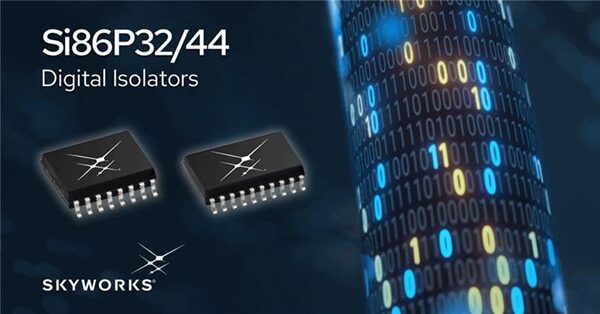
Skyworks’ Si86Px digital isolators integrate signal and power isolation into one WB SOIC package. Image used courtesy of Skyworks
Summary and Analysis
Taken together, these three launches read like a quick snapshot of where isolated communication is headed: cheaper multi-channel replacements for aging optocoupler circuits, leaner power budgets for battery-backed field equipment, and single-package solutions that spare designers the trouble of sourcing a separate isolated supply. Smart meters, motor drives, PLCs, and renewable-energy inverters all stand to benefit, whether the priority is squeezing extra runtime out of a battery-powered sensor node or freeing up board space next to a fast data bus. With isolator options now tailored to the application—whether bandwidth, power, or PCB real estate—matching the part to the application constraint has become as important as matching it to the voltage rating.