
Senseair Unveils Ultra-Compact SMD-Reflow-Solderable CO2 Sensor
The next-generation S12 CO2 sensor is 75% smaller than its predecessors, features an SMD-solderable design, and utilizes NDIR sensor technology for indoor air quality applications in smart buildings.
Senseair, a Swedish subsidiary of Asahi Kasei Microdevices, has introduced the S12 CO2 sensor for demand-controlled ventilation systems and battery-powered indoor air quality monitors. The S12 CO2 achieves a 75% volume reduction compared to Senseair’s earlier CO2 sensors.
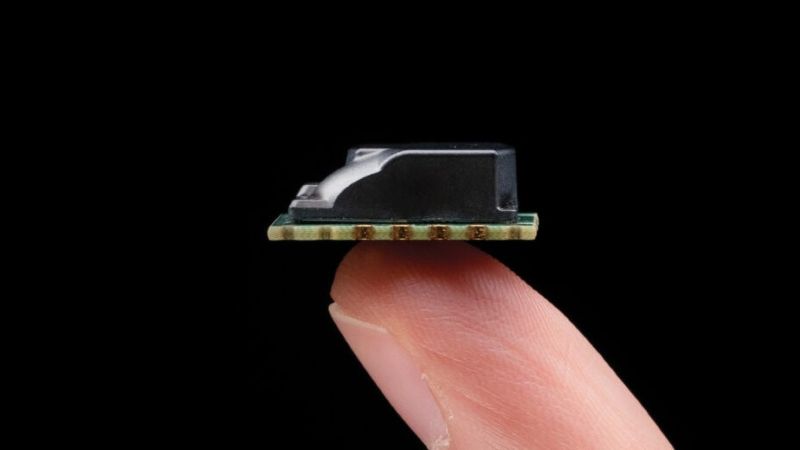
Senseair’s next-generation CO2 sensor, the S12 CO₂, measures just 18 mm x 15 mm x 7mm. Image used courtesy of Senseair
Introducing the S12 CO2 Sensor
Senseair’s S12 CO2 sensor employs LED-based non-dispersive infrared (NDIR) technology. The sensor is approximately 75% smaller than its predecessors, measuring just 18 mm x 15 mm x 7 mm. The S12 CO2 maintains a measurement range of 400 ppm to 10,000 ppm with an accuracy specification of ±30 ppm ±3% of reading. The operating temperature range spans -10°C to 60°C, with a relative humidity tolerance of up to 95% RH non-condensing.
Power consumption figures indicate average current draw below 34 µA with a peak current of 20 mA, operating from a 3.05 V to 5.5 V supply. The module supports both I2C and UART communication interfaces. Response time is specified at under 30 seconds, with a stated operational lifetime exceeding 15 years. The sensor incorporates automatic compensation for long-term drift, eliminating the need for field calibration throughout its operational life.
PCB Integration and Mounting
The S12 CO2 is designed for reflow soldering directly onto circuit boards, marking a departure from through-hole or connector-based mounting schemes typical of earlier CO2 modules. This SMD-compatible design enables automated assembly processes and reduces the z-height profile in finished products. The compact dimensions allow integration into wall-mounted monitors, HVAC controllers, and other equipment where board space is constrained or where visible sensor placement would compromise industrial design requirements.
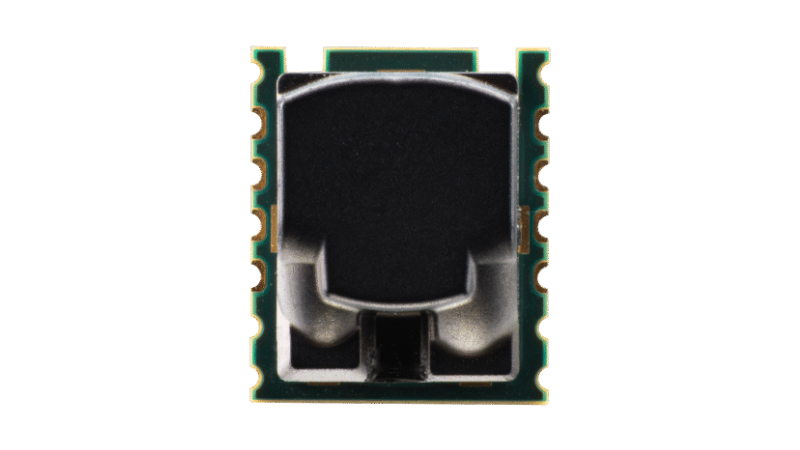
Senseair has built the S12 CO2 for wireless and battery-powered systems in smart buildings. Image used courtesy of Senseair
Enhancing Indoor Air Quality
Sensair’s development of the S12 CO2 aligns with the EU’s Energy Performance of Buildings Directive, which mandates zero-emission standards for new public buildings by 2028 and for all new buildings by 2030. Demand-controlled ventilation systems, which modulate airflow based on measured CO2 levels, have emerged as an energy-saving strategy within these regulatory frameworks.
The sensor’s low average power consumption addresses retrofit scenarios where running power cables is impractical. Battery-powered monitors can operate for extended periods without maintenance, expanding deployment flexibility in existing structures.
The S12 CO2 complies with ANSI/ASHRAE Standard 62.1-2022 Addendum d, RESET Grade B, Title 24 California Energy Code, and WELL Building Standard v2, which define minimum sensor requirements for indoor air quality monitoring.
Compact CO₂ Measurement
Senseair has begun sample distribution of its S12 CO2 and plans to initiate volume production in 2026. Target markets include building energy management systems in office and commercial facilities across Europe, North America, and Asia. Additional applications include residential air conditioning units and heat recovery ventilators where integrated CO2 sensing is specified.
The S12 CO2 extends Senseair’s NDIR sensor portfolio into applications where the company’s previous modules could not fit due to space or assembly constraints. By reducing sensor dimensions while maintaining measurement specifications and adding reflow capability, the module addresses design requirements in compact wall controllers, thermostat replacements, and portable IAQ monitors where both size and power consumption are critical parameters.


