
Siglent Adds Cost-Effective, Entry-Level Model to Its Vector Network Analyzers
The SNA5000X-E vector network analyzer features a 9 kHz to 6.5 GHz frequency range, a 125 dB typical dynamic range, and various measurement and calibration types, targeting RF testing applications.
Siglent Technologies has announced the SNA5000X-E, the newest addition to its SNA5000 vector network analyzer lineup. Positioned as an entry-level model within the series, the instrument targets engineers who need solid RF measurement fundamentals (S-parameter characterization, time-domain analysis, and production test support) without the cost of higher-tier models.
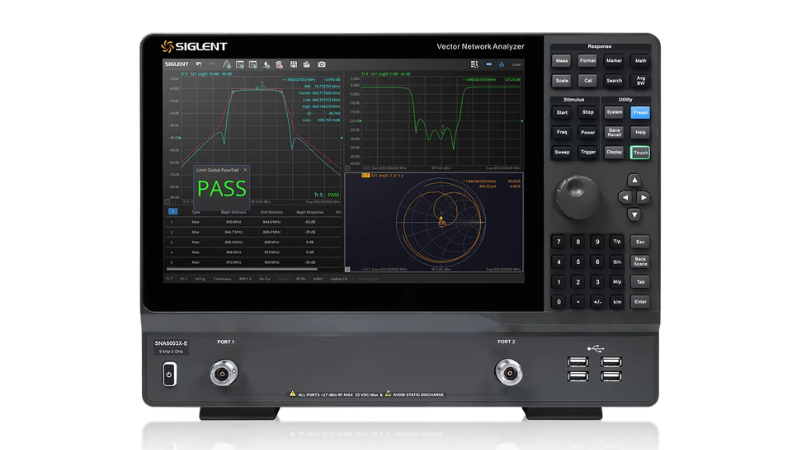
Siglent’s SNA5000X-E vector network analyzer covers a 9 kHz to 6.5 GHz frequency range. Image used courtesy of Siglent Technologies
The SNA5000X-E Vector Network Analyzer (VNA)
The SNA5000X-E VNA covers a frequency range of 9 kHz to 6.5 GHz with 1 Hz frequency resolution. The IF bandwidth is adjustable from 1 Hz to 10 MHz, output power spans -40 dBm to 10 dBm, and the instrument delivers a typical dynamic range of 125 dB. Trace noise is rated at 0.006 dB rms and 0.05° rms. Two models are available: the SNA5003X-E (9 kHz to 3 GHz) and the SNA5006X-E (9 kHz to 6.5 GHz), both sharing the same two-port hardware platform.
The unit ships with a built-in OCXO reference and a standard Bias-Tee on each port, features that sometimes carry additional cost on competing instruments. Supported calibration types include response calibration, enhanced response calibration, full one-port calibration, full two-port calibration, and TRL calibration.
The SNA5000X features a 12.1-inch touchscreen and multi-window display. Video used courtesy of Siglent Technologies
Analysis Capabilities
Beyond standard S-parameter and differential measurements, the SNA5000X-E includes time-domain analysis, enhanced time-domain analysis, and a spectrum analysis mode as part of its measurement suite. The time-domain functions allow engineers to locate impedance discontinuities and isolate faults in devices under test without requiring a separate instrument. A built-in eye diagram function adds signal integrity analysis to the mix, which can help during high-speed digital design validation.
To address measurement errors introduced by test fixtures and cables, the instrument includes automatic fixture removal, port extension, de-embedding, and impedance conversion. These tools work to compensate for cable delay and loss before results are reported, reducing the manual error-correction steps that would otherwise be required.
Form Factor and Interface
The SNA5000X-E has a chassis depth of just 12.6 cm and weighs under 5.4 kg, making it notably more compact than traditional bench-top network analyzers. The front panel features a 12.1-inch touchscreen with multi-window display support and HDMI output for external monitors. Connectivity includes LAN, USB Device, and USB Host ports, with the USB Host supporting a USB-GPIB adapter for legacy instrument bus connections.
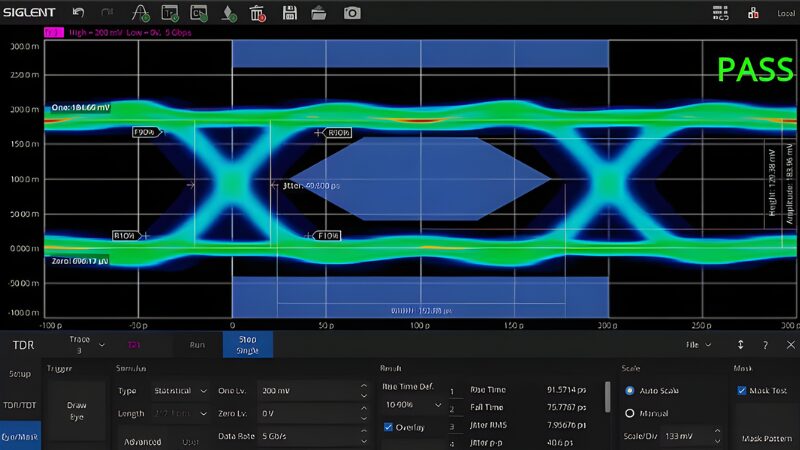
The SNA5000X-E supports a variety of analysis functions, including S-parameter and differential measurements. Image used courtesy of Siglent Technologies
Production and Automation Support
For teams integrating the SNA5000X-E into automated test systems, the instrument supports remote control via SCPI, LabVIEW, and IVI drivers over USB-TMC, VXI-11, Socket, Telnet, or a built-in Web server. A one-click filter analysis function lets users quickly extract key parameters, such as insertion loss and bandwidth, and custom formula operations are available for derived measurements. These features make it straightforward to drop the instrument into existing production workflows or scripted test environments without significant retooling.
A Cost-Effective RF Testing Solution
The SNA5000X-E shares its core performance architecture with the SNA5000A family, so engineers already familiar with that platform will find the interface and calibration workflow consistent. The tradeoff for the lower price point is a frequency ceiling of 6.5 GHz rather than the higher ranges available in the A-series — a ceiling that still covers the majority of Wi-Fi, Bluetooth, and sub-6 GHz cellular applications. For labs that need a capable two-port VNA for R&D, education, or batch quality inspection and can work within that frequency range, the SNA5000X-E is worth a close look.


