
SolidRun’s Fanless Industrial PCs Feature AMD Ryzen AI 300 Mobile AI SoC
SolidRun has expanded its modular IPC lineup with the Bedrock RAI300, powered by AMD Ryzen AI 300 processors, targeting edge AI inference with higher NPU performance and fanless cooling.
SolidRun has released the Bedrock RAI300, a fanless industrial PC (IPC) built around the AMD Ryzen AI 9 HX 370 “Strix Point” processor.
The system is designed for high-performance Edge AI applications, including smart cities, industrial automation, medical imaging, and robotics, where local AI processing is required without active cooling. By integrating a mobile processor of a high-end laptop, SolidRun wants to bridge the gap between consumer-grade AI performance and industrial-grade reliability. Solidrun mentions that their PC is available in two form factors: a thin “Tile” model and a thicker “60W” model, to accommodate different thermal design power (TDP) configurations ranging from 8W to 54W.
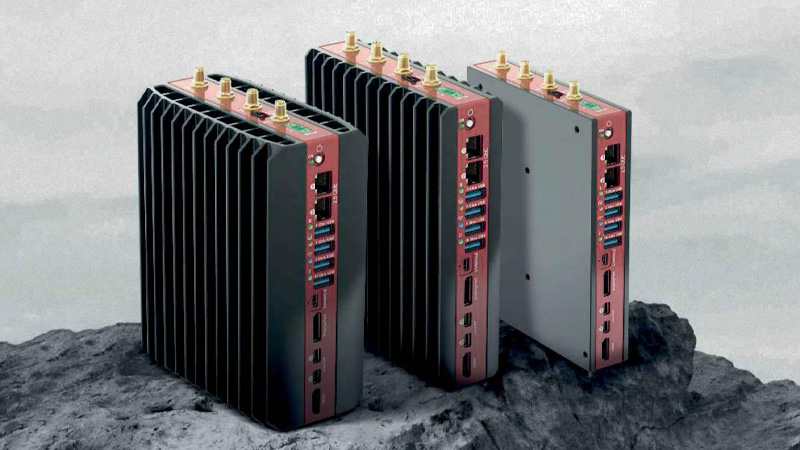
SolidRun’s Bedrock RAI300 Fanless Industrial PC. Images used courtesy of SolidRun
Processor Architecture and AI Performance
The Bedrock RAI300 is powered by the AMD Ryzen AI 9 HX 370 SoC, with a hybrid 12-core/24-thread design which includes four high-performance Zen 5 cores (up to 5.1 GHz) and eight efficiency-focused Zen 5c cores (up to 3.3 GHz), supported by 36MB of total cache (12MB L2 + 24MB L3).
For AI applications, the system integrates AMD Ryzen AI (XDNA 2) NPU, with up to 50 TOPS of INT8 performance. When combined with the CPU and the 16-core Radeon 890M (RDNA 3.5) GPU, the total system performance reaches approximately 80 TOPS. This supports the local AI models and is compatible with the AMD ROCm 7 open-source software platform for GPU-accelerated computing.
Memory and Storage Configuration
The module supports up to 128 GB of 128-bit DDR5-5600 RAM via two SO-DIMM slots, for high-bandwidth data-intensive applications.
For storage, the device supports up to three NVMe SSDs via M.2 PCIe Gen4 x4 2280 sockets. This allows for significant local data logging and rapid retrieval speeds required by edge analytics.
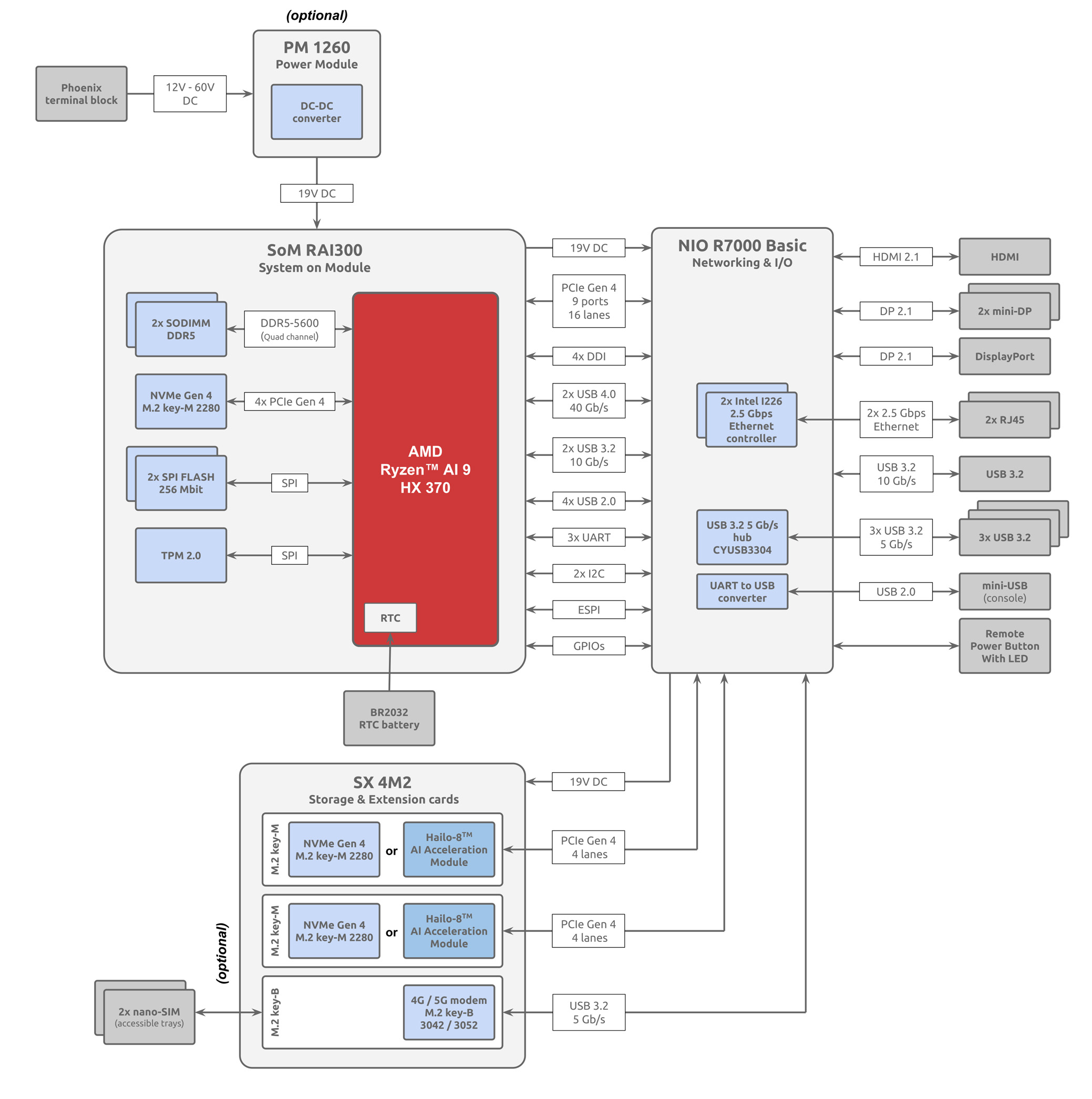
Bedrock RAI300 Fanless Industrial PC Block Diagram. Images used courtesy of SolidRun
Thermal Design and Modular Architecture
From the block diagram its clear that the Bedrock RAI300 is built around a SoM and dev board type architecture where the SoC, memory, storage, and TPM(security) are built in the SoM, and the other interfaces are coming out of the NIO R7000 development board, along with separate power modules.
The fanless PC comes in two variants to match thermal and space requirements: a compact 0.6-liter Tile model measuring 160 × 130 × 29 mm for space-constrained installations, and a larger 1.5-liter 60 W model measuring 160 × 130 × 73 mm with extended cooling fins to support higher TDP configurations up to 54 W. Both variants are rated for operation from −40 °C to 85 °C and rely on convection-based passive cooling to eliminate moving parts.
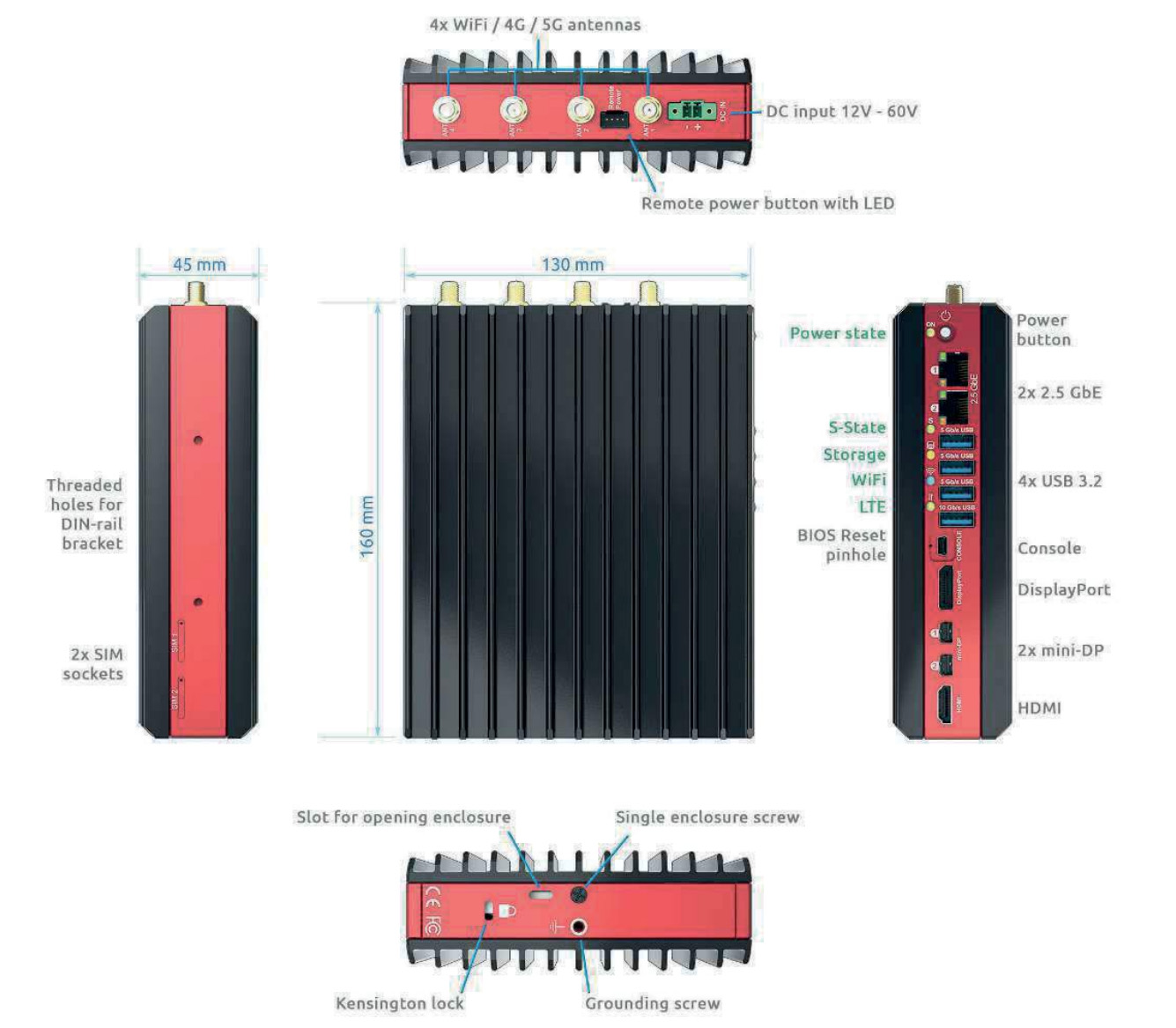
Bedrock RAI300 Industrial PC Interfaces. Images used courtesy of SolidRun
Interface and Connectivity Features
The Bedrock RAI300 offers various I/Os options, including multiple USB ports and a serial console for industrial interfacing. For Networking, there are four 2.5 GbE RJ45 ports supported by Intel I226 controllers, and for wireless, it supports Wi-Fi 6E and 4G/5G cellular support via a dedicated M.2 Key-B socket, complete with dual SIM slots and four SMA antennas.
The system supports up to four independent displays via an HDMI 2.1 port, with optional configurations adding DisplayPort 2.1 and mini-DP outputs.
For power thre is a Phoenix terminal block that supports a wide DC input range of 12V to 60V, compatible with standard industrial rails. The unit supports versatile mounting options, including DIN-rail, wall, VESA, and table-top. The Bedrock RAI300 is compatible with Windows 10/11/IoT and various Linux distributions.
To ensure reliability in remote deployments, the BIOS is stored on redundant SPI Flash modules to prevent corruption, alongside a Watchdog Timer (WDT) and TPM 2.0 (fTPM + dTPM options). The system supports “painless integration” via DIN-Rail, wall mount, or VESA mounting options.


