Epson Shrinks High-Precision TCXOs for GNSS, Wearable, and IoT Equipment
The TG1210SRN and TG1210STN temperature-compensated crystal oscillators (TCXOs) come in a compact 1.2 mm × 1.0 mm package and deliver ±0.5 ppm stability across a temperature range of -40°C to 105°C.
Seiko Epson Corporation (Epson) has developed two new temperature-compensated crystal oscillators (TCXOs), the TG1210SRN and TG1210STN, aimed at GNSS modules, smartwatches, IoT devices, and industrial equipment. Both products share the same 1.2 mm × 1.0 mm × 0.45 mm footprint and deliver ±0.5 × 10⁻⁶ (max.) frequency-temperature stability across an operating range of -40°C to 105°C. Epson notes that the package is 63% smaller in cubic volume compared to its TG1612SLN, the current comparable product.
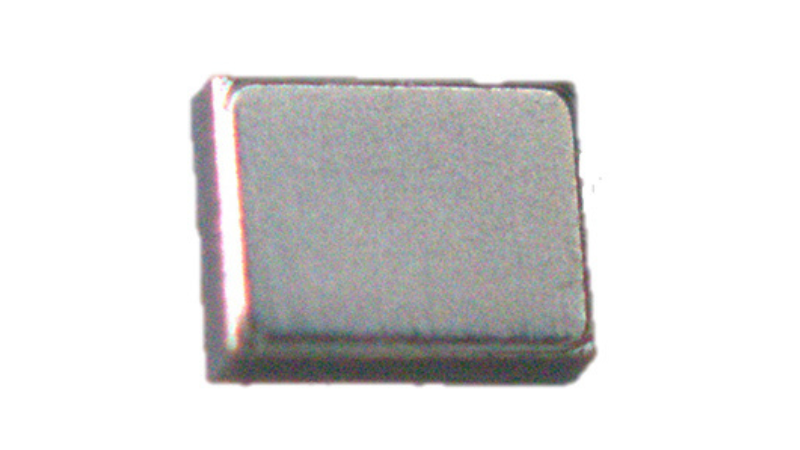
Epson’s TG1210SRN / TG1210STN TCXOs come in a compact 1.2 mm × 1.0 mm package. Image used courtesy of Seiko Epson Corporation
Temperature-Compensated Crystal Oscillators (TCXOs)
Both TG1210SRN and TG1210STN oscillators output a clipped sine wave and support output frequencies from 10 MHz to 80 MHz. Current consumption is rated at 1.7 mA maximum for frequencies up to 26 MHz, and standby current drops to 5 µA max — a useful figure for battery-operated devices that spend significant time in low-power states.
The two models diverge primarily in their supply voltage ranges, which reflect their intended application spaces. The TG1210SRN accepts 1.70 V to 3.63 V, covering a wide range that suits communication modules and industrial equipment where supply rails vary. The TG1210STN operates on 1.10 V to 1.95 V, targeting lower-voltage systems such as smartwatches and mobile devices where minimizing power draw is a design priority.
Feature support also differs slightly. The TG1210SRN includes standby, output enable, and VC-TCXO functions. The TG1210STN supports standby and output enable but omits the voltage-controlled option.

The TG1210SRN and TG1210STN TCXOs are designed for high-accuracy positioning in IoT devices and wearables. Image used courtesy of Adobe Stock
High Precision, Low Power Timing
Epson’s dual-product approach reflects the diverging requirements within the timing device market. GNSS positioning, which demands stable frequency references even as temperatures swing rapidly, is a key target for both. Fast temperature fluctuations — common in wearable devices moving between environments — can stress oscillator performance, and both parts are designed to handle such conditions reliably.
On the industrial side, communication modules, FA equipment, and data center timing solutions are increasingly specifying wider operating temperature ranges. The -40°C to 105°C temperature range of the TG1210 family positions it for environments without requiring a separate industrial-grade part.
Beyond GNSS and industrial applications, the compact size and low standby current make the parts practical for IoT nodes and smart home sensors that need accurate timing but have tight board space and energy budgets.
Epson notes that the TG1210 family sits alongside its existing 1.6 × 1.2 mm and 2.0 × 1.6 mm TCXO packages, and that CMOS output variants are also available in the broader lineup for designs that require logic-level-compatible clock signals rather than a clipped sine-wave output.