
STMicroelectronics Debuts PMIC for Automotive Applications
The SPSA068 is an AEC-Q100 qualified power-management IC (PMIC) that integrates a buck voltage regulator, precise voltage reference, and safety features like a watchdog and fault detection.
STMicroelectronics has released the SPSA068, a new power-management IC (PMIC) designed to serve as a compact and cost-effective solution for automotive systems. The device is engineered to meet the stringent requirements of the automotive industry, including AEC-Q100 qualification and support for ISO 26262 functional safety up to ASIL-B.
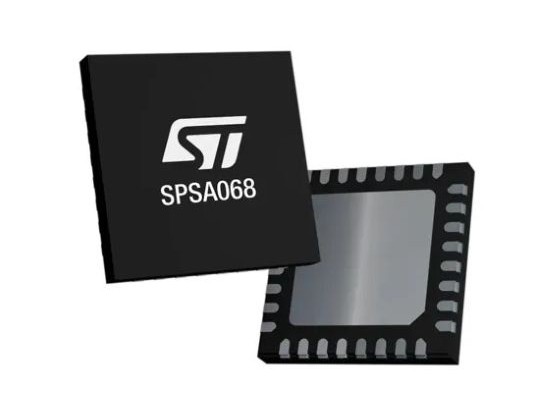
The SPSA068 PMIC can reduce quiescent current to 50 μA typ and has an internal programmable memory for selecting parameters such as output voltages. Image used courtesy of STMicroelectronics
SPSA068 Power Management IC (PMIC)
The SPSA068 AEC-Q100 PMIC combines a number of essential power management and supervisory functions. At its core is a 0.5 A or 1 A buck voltage regulator that can be configured to deliver a stable output of 5 V, 3.3 V, or 1.2 V. The regulator’s switching frequency is also programmable, with options for 0.4 MHz or 2.4 MHz, allowing engineers to optimize the design for efficiency or size, depending on the application’s needs.
In addition to the buck regulator, the PMIC integrates a precise 1% voltage reference, crucial for sensitive analog circuitry and microcontrollers. The reference output is also configurable to 5.0 V, 3.3 V, or 1.2 V. This high level of integration helps to reduce the number of external components, simplifying board layout and potentially lowering the overall bill of materials.
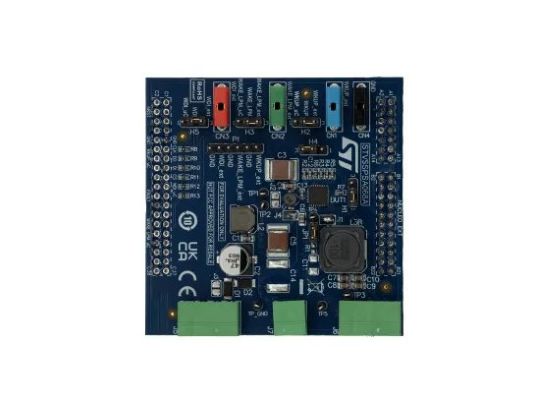
STMicroelectronics’ STEVAL-SPSA068 evaluation board supports development for the SPSA068-TR. Image used courtesy of STMicroelectronics
Advanced Safety and Low-Power Features
For system monitoring and safety, the SPSA068 includes a suite of integrated features. A window watchdog supervisor monitors the microcontroller’s operation, while an MCU reset control ensures reliable system startup and recovery from errors. The device also has a dedicated FAULT pin for real-time fault reporting to the microcontroller. Over/undervoltage, overcurrent, and thermal shutdown protections are also built in, providing robust defense against common power-related issues. The inclusion of digital and analog built-in self-test capabilities further enhances the device’s reliability and diagnostic capabilities.
The SPSA068 is designed for low power consumption, featuring a low-power mode with a quiescent current of 50 µA under light-load conditions and an even lower standby mode with a quiescent current of less than 5 µA. This is a critical factor for automotive applications, particularly those that are always on or need to maintain a low-power state to preserve battery life.
With non-volatile memory, users can adjust the device’s parameters. The SPSA068 also includes an SPI interface that allows for programming, diagnostics, and monitoring. This provides engineers with the flexibility to tailor the PMIC to their specific application requirements and to perform real-time diagnostics during development and in the field.

The SPSA068 PMIC is AEC-Q100 qualified for MCU power management in automotive applications. Image used courtesy of Adobe Stock
Automotive-Qualified PMICs
STMicroelectronics’ SPSA068 PMIC offers a robust and space-saving solution for automotive power delivery and supervision. Its blend of a customizable buck regulator, precise voltage reference, and integrated safety features makes it a versatile component for a range of automotive applications. The device is well-suited for powering microcontrollers and other components for body electronics, in-vehicle infotainment systems, and various driver assistance functions where size, cost, and reliability are paramount.


