Texas Instruments Unveils Dual RC-Timed Retriggerable Monostable Multivibrators
The TPUL2G123 is a two-channel monostable RC configurable pulse generator available in commercial and automotive-qualified versions for pulse generation and timing applications.
Texas Instruments has developed the TPUL2G123, a dual, retriggerable monostable multivibrator designed to provide a flexible solution for generating precise, fixed-width digital pulses. The pulse generator is also available with an AEC-Q100 Grade 1 qualification for automotive applications.
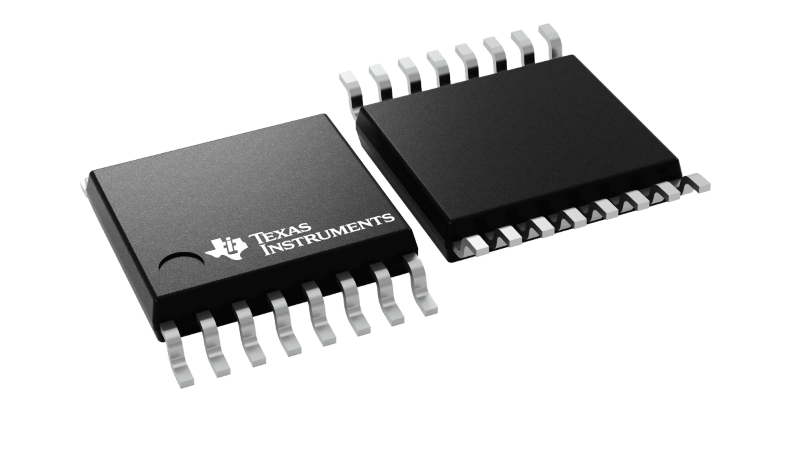
Texas Instruments’ TPUL2G123 and TPUL2G123-Q1 pulse generators feature balanced outputs, partial power down (Ioff), high speeds (tpd 10-50 ns), and over-voltage tolerant inputs. Image used courtesy of Texas Instruments
Dual RC-Timed Retriggerable Monostable Multivibrators
Texas Instruments’ TPUL2G123 and TPUL2G123-Q1 operate from a wide supply voltage range of 1.5 V to 5.5 V. The devices are based on an external resistor-capacitor network, which sets the output pulse duration. The pulse width is approximately equal to R × C, providing a simple and intuitive way for engineers to configure the timing. The datasheet specifies a resistor-capacitor configurable range from 1 µs to 860 ms, with a typical pulse width variation of 1%. This precision is a key benefit, especially for applications where timing accuracy is critical.
Both the TPUL2G123 and TPUL2G123-Q1 come in a compact TSSOP package (16-pin) to simplify integration in space-constrained electronics.
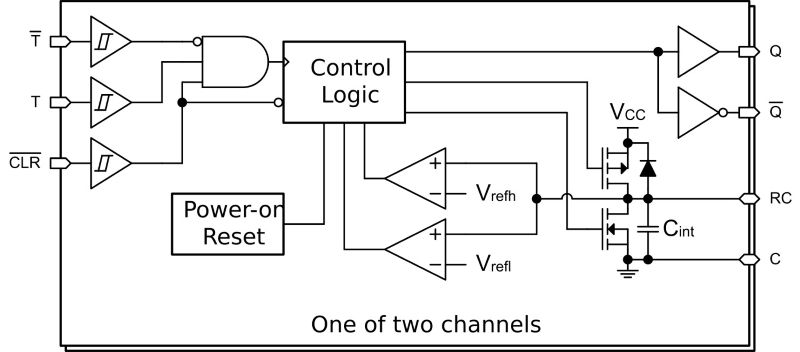
Functional block diagram of the TPUL2G123 and TPUL2G123-Q1. Image used courtesy of Texas Instruments
Enhanced Noise Immunity Using Schmitt-Trigger Inputs
The TPUL2G123 and TPUL2G123-Q1 provide three trigger inputs, supporting rising-edge, falling-edge, and an asynchronous clear input that can terminate an ongoing pulse. This versatility allows the device to serve multiple functions in a single design.
A notable feature of the monostable multivibrators is the Schmitt-trigger architecture on all inputs, which enhances noise immunity and tolerates slow input transition rates. This is particularly valuable in noisy electrical systems where signal integrity can be a challenge.
The flexibility and robustness of the devices make them suitable for a variety of applications. It can be used to demodulate amplitude shift keying (ASK) signals, reset a system for a fixed duration, or generate a simple, positive fixed-width pulse. In addition to these timing functions, the device’s Schmitt-trigger inputs and fixed-pulse output make it an effective solution for debouncing mechanical switches, a common requirement in automotive control systems.
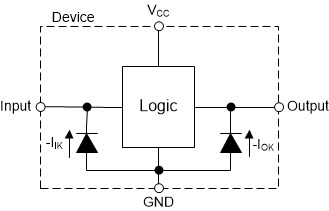
Clamping diode placement for TPUL2G123 inputs and outputs. Image used courtesy of Texas Instruments
Pulse and Delay Generation
Texas Instruments’ TPUL2G123 and TPUL2G123-Q1 offer a robust solution for pulse generation and timing applications. The combination of a wide operating voltage range, resistor-capacitor configurability, and Schmitt-trigger inputs aims to simplify designs in harsh electrical environments. Potential applications include switch debouncing, system resets, and pulse generation for automotive on-board chargers, body control modules, and infotainment systems.