
Würth Elektronik Launches Heat Sink Portfolio for Power Electronics and ICs
The new heat sinks target THT-TO packages and flat-surface ICs, with pre-coated thermal interface material variants available from stock.
Würth Elektronik has expanded its thermal management lineup with a new heat sink portfolio structured around three product groups. The release targets two broad component categories: THT-TO packages such as the TO-220 and TO-247, and flat-surface ICs, including CPUs and DC/DC converters. All parts ship from stock with no minimum order quantity, and ANSYS simulation models and 3D CAD files in IGS and STP formats are available for each SKU.
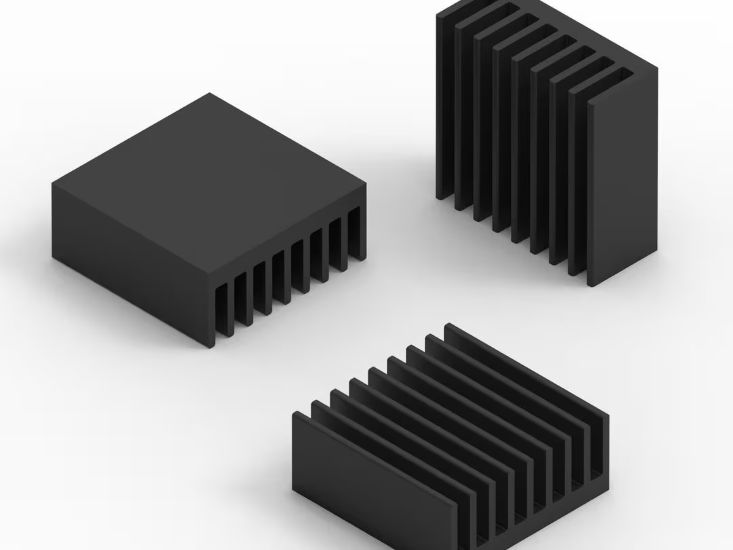
Würth Elektronik has released three new groups of heat sinks: the WE-HTO, WE-HIC, and the WE-HTOI and WE-HICI pre-coated thermal interface variants. Image used courtesy of Würth Elektronik
WE-HTO and WE-HTOI: Heat Sinks for THT-TO Packages
The WE-HTO series covers THT-TO mounting scenarios and is offered in multiple geometries, including curved sheet-metal profiles and finned configurations. Thermal resistance values across the lineup span from approximately 7 K/W for larger finned variants up to around 22 K/W for smaller clip-style bodies. Dimensions range from compact profiles around 14 mm × 19 mm up to 42 mm × 63 mm for higher-dissipation applications.
Matching M3 hardware, including screws, nuts, and insulating sleeves, can be ordered alongside the WE-HTO and its counterpart, the WE-HTOI. The WE-HTOI variant ships factory-precoated with thermal interface material, eliminating the air gap between the component case and the heat sink contact surface. That gap is a common source of increased junction-to-ambient thermal resistance in assembled designs, so removing it at the component level simplifies the assembly process and reduces variability.
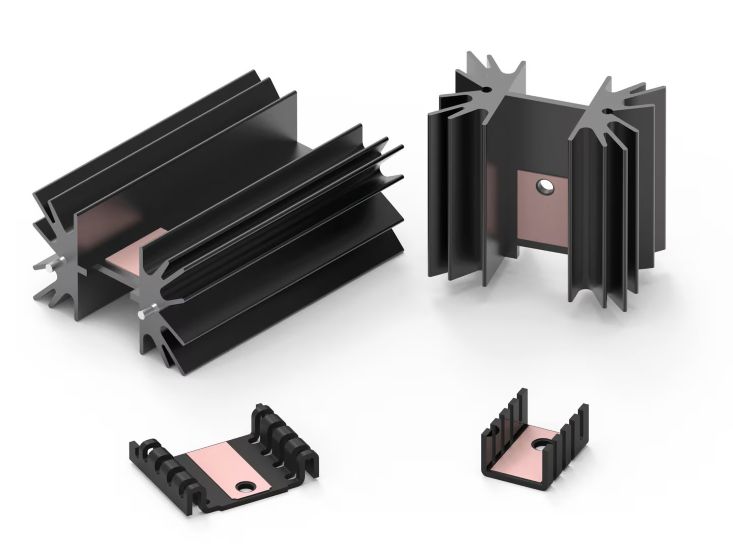
The WE-HTOI heat sinks for THT-TO packages come pre-coated with thermal interface material. Image used courtesy of Würth Elektronik
WE-HIC and WE-HICI: Finned Heat Sinks for IC Components
For components with flat mounting surfaces, the WE-HIC series offers classic finned aluminum heat sinks with footprints from 20 mm × 20 mm to 40 mm × 40 mm. Thermal resistance figures within this range range from 17 K/W for the 20 mm × 20 mm parts down to 7 K/W for the 40 mm × 40 mm parts.
Two fin configurations are available. The continuous-fin variant is intended for installations where airflow direction relative to the fins can be reliably defined, typically forced-convection setups with a known duct or fan orientation. The interrupted-fin variant is designed for environments where airflow is less predictable, as the breaks in the fin structure reduce the sensitivity to airflow direction. Like their TO-package counterparts, the WE-HICI variants arrive pre-coated with thermal interface material.
All parts across both series are constructed from aluminum with a black anodized surface finish. The black anodized surface increases emissivity compared to bare aluminum, offering a modest improvement in radiative heat transfer that can matter in low-airflow enclosures.
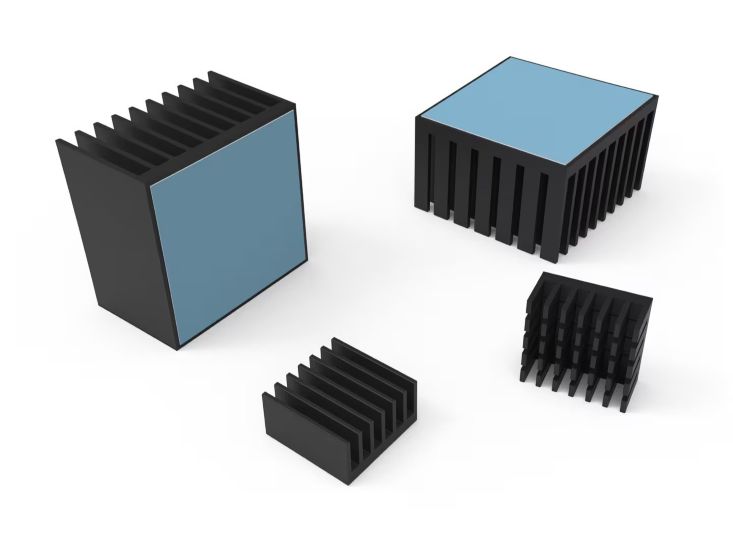
The WE-HICI heat sinks for IC components. Image used courtesy of Würth Elektronik
Support and Design Resources
Würth Elektronik notes that technical support, heat sink characteristic data, simulation files, and customer-specific modification options are available alongside the hardware. The company has offered thermal interface materials for some time, and this heat sink release extends that coverage to the mechanical dissipation side of the thermal stack.
The four in the series (WE-HTO, WE-HTOI, WE-HIC, and WE-HICI) are applicable across a broad range of power-electronics and embedded-system designs, including switch-mode power supplies, motor-drive boards, industrial control modules, voltage regulators, and RF power amplifiers. For engineers sourcing both the heat sink and the thermal interface layer from a single catalog, the pre-coated variants in particular reduce one assembly variable without requiring additional material qualification.


