
AAEON Introduces an “All-in-One” AI-Powered Robotics Development System
The CEXD-INTRBL open robotic system utilizes Intel Core Ultra (Series 3) architecture and delivers up to 180 TOPS AI performance, targeting humanoid, autonomous mobile robot, and edge AI application development.
The emergence of increasingly complex autonomous systems requires a corresponding shift in embedded computing power and data throughput. To address these requirements, AAEON has released the CEXD-INTRBL open robotics development system. This system integrates the Intel Panther Lake-H processor family, also known as the Intel Core Ultra 300-series.
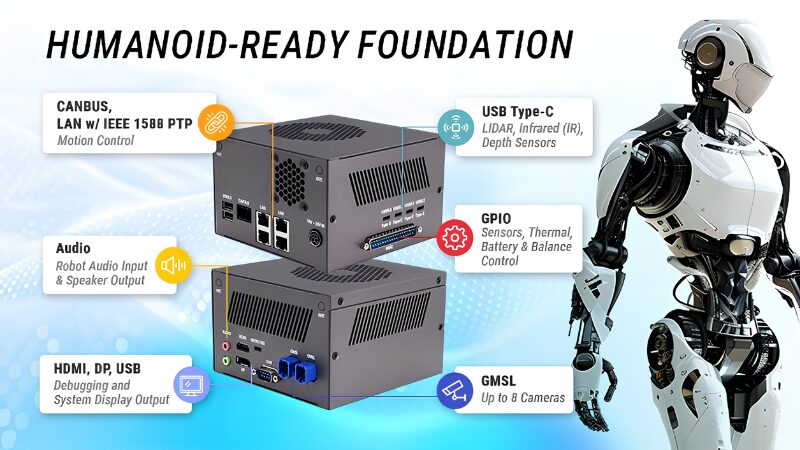
The CEXD-INTRBL system leverages the Intel Core Ultra (Series 3) architecture for AI-powered robotics development. Image used courtesy of AAEON
An Open Robotics Development System
The CEXD-INTRBL’s integration of Panther Lake-H provides a hybrid computing environment suited for edge AI. This architecture combines traditional CPU cores with an integrated Neural Processing Unit (NPU) and Intel Arc Graphics based on the Xe3 architecture. This setup delivers up to 180 TOPS of AI performance. For robotics developers, this means a single system can handle general-purpose control tasks, deep learning inference, and high-resolution computer vision processing simultaneously.
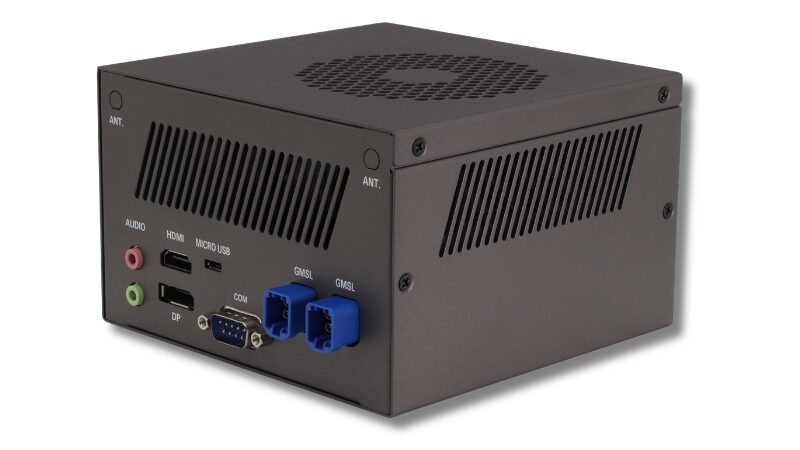
Equipped with dual-channel DDR5 and PCIe Gen 5 support, the CEXD-INTRBL ensures the high-speed data throughput necessary for multi-sensor support. Image used courtesy of AAEON
High-Speed Memory and Data Interconnects
Bandwidth is a critical factor when managing the sensor arrays found in modern autonomous mobile robots. The CEXD-INTRBL supports up to 64 GB of dual-channel DDR5 memory via two SODIMM slots, reaching speeds up to 8533 MT/s. This memory capacity is complemented by PCIe Gen 5 support, which offers twice the bandwidth of the previous generation.
The module’s primary expansion interface includes one PCIe Gen 5 [x8] slot, which is particularly useful for interfacing with high-end discrete accelerators or high-speed storage, alongside specialized GMSL connectors supporting up to eight camera channels for 360-degree situational awareness. Additionally, the board provides three PCIe Gen 4 [x1] slots and one PCIe Gen 4 [x4] slot for further peripheral expansion. For primary storage, the kit offers two SATA 6.0 Gbps ports and an M.2 2280 M-Key slot that utilizes a PCIe Gen 5 x4 interface, facilitating high-speed data logging and rapid access to large AI models.
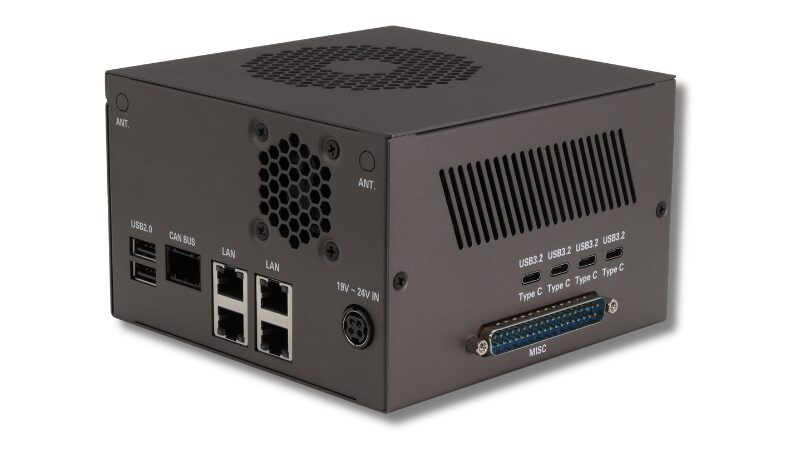
The CEXD-INTRBL provides a high-density I/O layout to accommodate a diverse array of sensors and industrial peripherals. Image used courtesy of AAEON
Connectivity and Real-Time Control
For robotics applications, the ability to synchronize communication between various controllers and sensors is essential. The CEXD-INTRBL features four 2.5 GbE LAN ports supporting IEEE 1588 PTP and Time-Sensitive Networking (TSN), a feature set that enables deterministic communication over Ethernet, which is vital for meeting the sub-millisecond timing requirements of modern robotic motion control.
Beyond networking, the development kit provides a comprehensive array of I/O for peripheral management. This includes four USB 3.2 Gen 1 ports, two USB 2.0 ports, and two UART ports supporting RS-232/485 standards. The inclusion of 22-bit GPIO, SMBus, and I2C enables direct interfacing with low-level sensors and industrial equipment.


The 180 TOPS figure is attention-grabbing, but for robotics the more consequential features are timestamp integrity, deterministic communication and sustained thermal behavior. Eight GMSL camera channels combined with PTP and TSN can be genuinely useful only if the complete sensor-to-actuator chain preserves synchronized timestamps. A strong benchmark would report latency and jitter while CPU, GPU and NPU workloads run concurrently, plus performance after thermal saturation. ROS 2 and DDS support, maintained device drivers and a safety path isolated from the AI workload will ultimately matter more than peak inference throughput.