Allegro Microsystems Unveils Magnetic Current Sensor for Power Electronics
The ACS37017 sensor achieves 0.55% typical accuracy over temperature and lifetime, with a 750 kHz bandwidth for high-voltage power conversion systems in automotive and industrial applications.
Allegro Microsystems has introduced the ACS37017, a Hall-effect current sensor designed to address accuracy and drift concerns in high-voltage power conversion systems. The factory-calibrated device integrates compensation circuitry and a precision voltage reference in a compact, reinforced-isolation package.
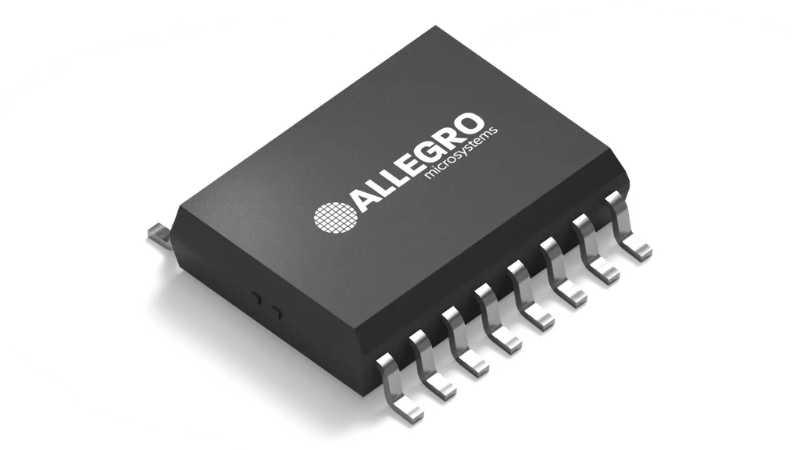
Allegro Microsystems’ ACS37017 is a 750 kHz current sensor IC. Image used courtesy of Allegro Microsystems
Accuracy and Drift Management
The ACS37017 Hall-effect current sensor achieves a typical sensitivity error of 0.55% across its operating temperature range and lifetime, positioning it for applications where measurement precision directly impacts control loop stability and efficiency. According to Allegro, the sensor employs a proprietary compensation architecture that maintains performance as the device ages and operating conditions change.
Offset error remains within ±3 mV over temperature and lifetime, contributing to the device’s overall measurement stability. This addresses a common challenge in current sensing, where thermal effects and component aging gradually degrade accuracy, requiring periodic recalibration or system-level compensation in some implementations.
The sensor delivers a 750 kHz bandwidth with a typical response time of 1 µs, accommodating control loops in switching power converters while maintaining the accuracy specifications. The factory trimming eliminates the need for customer programming or calibration during production.
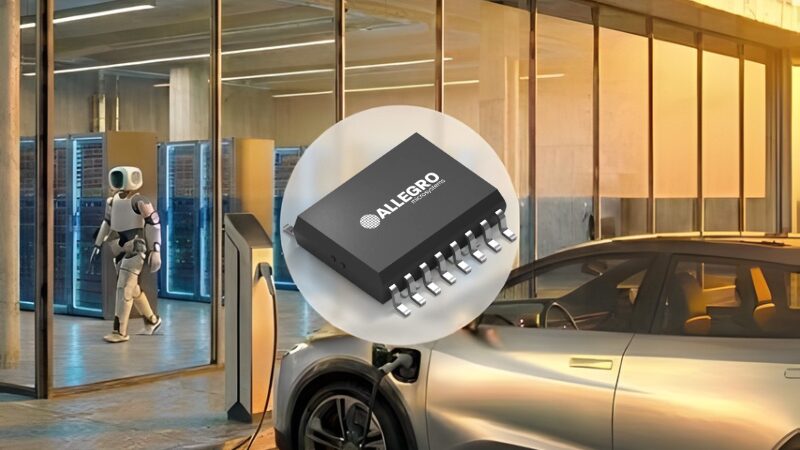
The ACS37017 brings precise measurements to high-voltage power conversion systems in automotive and industrial applications. Image used courtesy of Allegro Microsystems
Integrated Architecture and Isolation
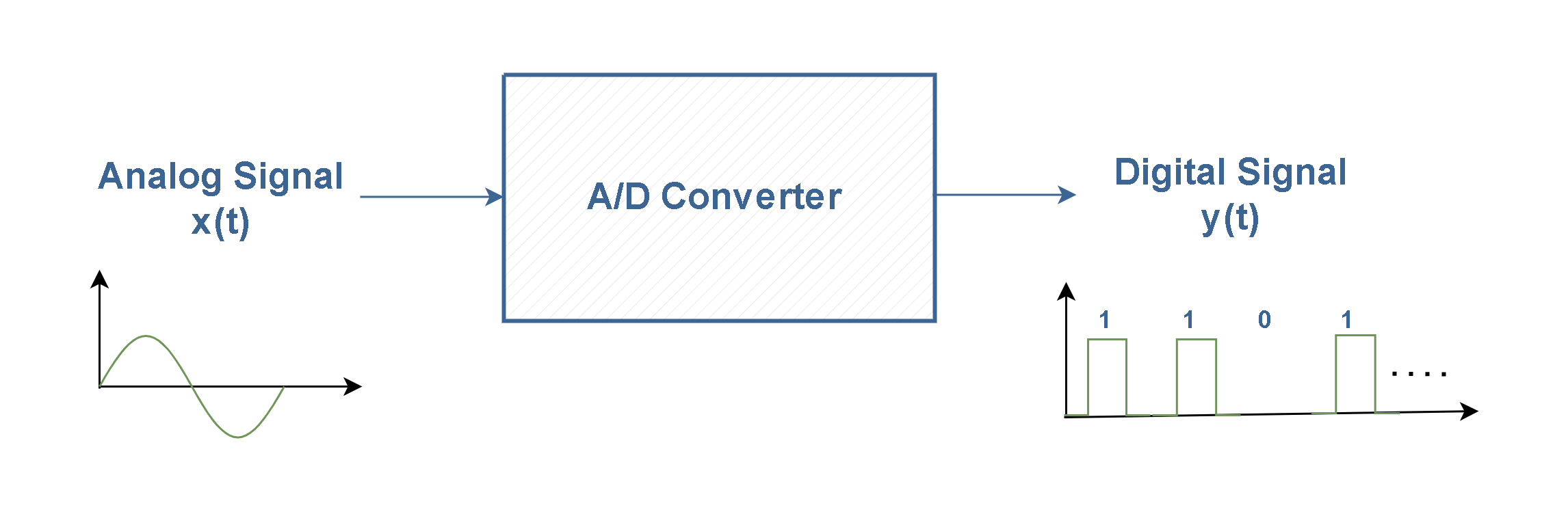
The ACS37017 incorporates an integrated voltage reference output, allowing differential signal routing between the sensor and analog-to-digital converter. This architecture reduces susceptibility to ground plane noise and voltage drops in high-current systems, where maintaining signal integrity can otherwise require additional external reference components.
The device uses an integrated coil and differential sensing architecture to reject external magnetic fields. This construction method provides immunity to stray fields from nearby conductors or components, a consideration in dense power-electronics assemblies where multiple current paths are in close proximity.
Packaged in a SOICW-16 format with 0.85 mΩ primary conductor resistance, the sensor provides 5000 VRMS withstand voltage and reinforced isolation rated for ±800 VPK or 565 VRMS. The isolation specification addresses automotive and industrial requirements for protection between high-voltage power stages and low-voltage control electronics.
The monolithic surface-mount construction offers an alternative to module-based current sensors, reducing board space requirements while maintaining the isolation performance. Eliminating the external precision reference simplifies the bill of materials and removes a potential noise source from the signal path.
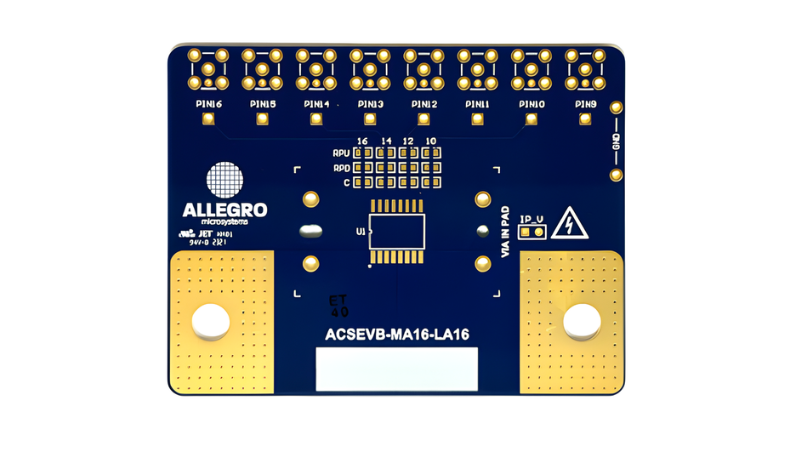
Users can begin prototyping the ACS37017 with Allegro’s ACSEVB-MA16-LA16 evaluation board. Image used courtesy of Allegro Microsystems
Modern Power Electronics
The ACS37017 addresses requirements in DC/DC converters for AI data centers and server systems, where accurate current feedback supports efficiency optimization and power delivery to processors. In automotive applications, the device targets on-board chargers and DC/DC converters in EV architectures, where its reinforced isolation and temperature stability align with xEV power electronics demands.
Industrial applications include motor control systems, where precise current measurement enables field-oriented control algorithms, and solar inverters for residential and commercial installations. The sensor’s accuracy specification supports maximum power point tracking and grid-tie synchronization functions that depend on high-fidelity current feedback.
Preliminary datasheets and engineering samples are available now through Allegro’s distribution network.