
RIGOL’s DS80000 Oscilloscope Targets High-Frequency Design and Protocol Compliance
The new series is an 8th-generation digital oscilloscope offering up to 13 GHz bandwidth and 40 GSa/s sample rate for high-speed signal analysis and protocol compliance testing.
RIGOL introduced its DS80000 series, a high-bandwidth digital oscilloscope representing the company’s 8th generation of self-developed instruments. This new series is engineered to address the demanding measurement and verification challenges of high-speed digital designs. It offers a combination of high-end specifications and integrated analysis capabilities.
Multi-Channel Wide Bandwidth Performance
The core of the DS80000 series’ performance lies in its ability to capture high-frequency signals with precision. It provides an analog bandwidth of up to 13 GHz and a real-time sample rate of 40 GSa/s on each of its four analog channels. A key feature is that these maximum specifications, including the 40 GSa/s sample rate, are available regardless of whether one or all four channels are enabled. This avoids the common trade-off of reduced sample rate when using multiple channels, which is critical for maintaining high timing resolution during multi-channel analysis.
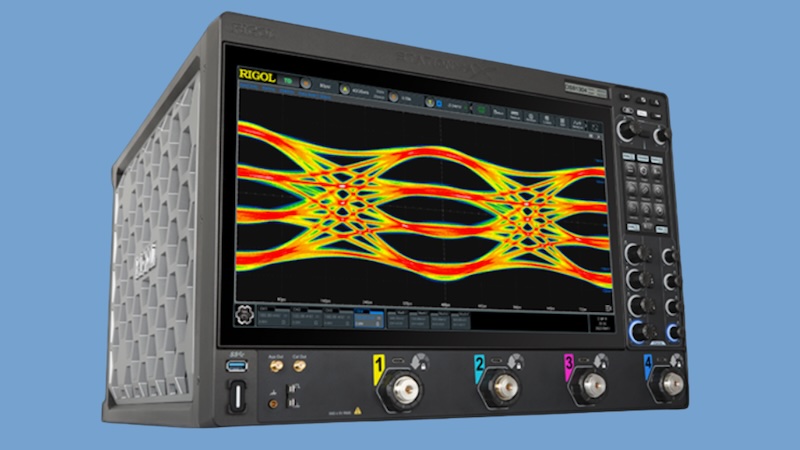
Sporting analog bandwidths of up to 13 GHz and a 40GSa/s maximum real-time sampling rate, the DS80000 series allows for detailed analysis of anomalies. Image used courtesy of Rigol.
The oscilloscope is equipped with a deep memory architecture to support the high sample rate. It offers a maximum memory depth of 4 Gpts, allowing for the capture of long-duration signals with fine detail. This is particularly useful for debugging complex systems where a single event may be preceded or followed by other critical, but time-separated, phenomena. The waveform capture rate is rated at 250,000 wfms/s, which helps find rare signal anomalies.
Complex Diagraming and Analysis in a User-Friendly Interface
The DS80000 series is not just a high-performance signal viewer but a comprehensive analysis tool. It includes a variety of advanced functions to assist engineers in validating complex designs. This includes optional real-time eye diagram and jitter analysis capabilities.
This functionality is essential for assessing signal integrity, timing margins, and compliance with industry standards for high-speed serial communications. The jitter analysis function can separate total jitter (TJ) into its random (RJ) and deterministic (DJ) components, including periodic jitter (PJ) and duty cycle distortion (DCD).
Additionally, the instrument supports a wide range of optional protocol compliance analysis tests, which are crucial for verifying high-speed interfaces. The provided data sheet lists options for USB2.0, 100Base-T, and 1000Base-T Ethernet, among others. A wide array of serial bus decoding options is also available for debugging, covering standards like RS232/UART, I2C, SPI, CAN, and FlexRay. The oscilloscope also incorporates an N-in-1 design, including a digital voltmeter and an 8-digit frequency counter as standard features.
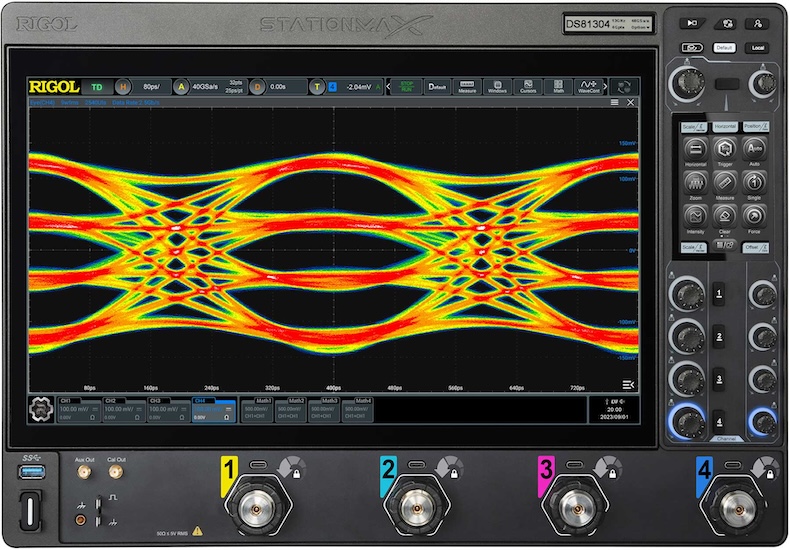
The DS80000 series is one of the most advanced on the market, but maintains Rigol’s reputation for having many user-friendly features. Image used courtesy of Rigol.
The user interface of the DS80000 series is built around a 15.6-inch high-definition capacitive multi-touch screen that can be electronically tilted with a single button. This primary display is complemented by a smaller secondary display for a user-defined shortcut menu, which supports quick-responsive touch operation with vibration feedback. The instrument is also controlled with standard SCPI command sets and offers various interfaces, including USB, LAN, and HDMI, for a variety of test setups.
Summary
Overall, the DS80000 series is presented as a robust tool for engineers working on high-speed components and systems. Its combination of high bandwidth, deep memory, and specialized analysis software provides a complete platform for signal integrity, jitter, and protocol compliance validation, helping to streamline the debugging and verification process for modern digital designs.


