
Ambiq Introduces Ultra-Low Power Wireless SoC for Edge AI Applications
Ambiq’s new Apollo510B system-on-chip (SoC) features a 48 MHz network coprocessor and Bluetooth Low Energy 5.4 radio for wireless, low-power connectivity in wearable technology, industrial automation, and beyond.
The increasing demand for intelligent, battery-powered devices at the network edge is driving the need for microcontrollers that can execute complex AI and machine learning workloads with minimal power consumption. The Apollo510B System-on-Chip (SoC) is Ambiq’s newest release into this market, integrating a high-performance Arm Cortex-M55 processor with wireless connectivity and extensive peripheral support.

Ambiq’s Apollo510B wireless system-on-chip (SoC) is built for edge AI applications, including wearable technology and asset tracking. Image used courtesy of Ambiq
Apollo510B Wireless System-on-Chip (SoC)
At the core of the Apollo510B SoC is the Arm Cortex-M55 processor, which can operate at a clock frequency of up to 250 MHz. This processor leverages Arm’s Helium technology, a vector processing extension for M-profile CPUs. According to Ambiq, the combination of the Cortex-M55 and its power-optimized technology platform delivers up to 30 times better energy efficiency for AI applications and up to 16 times faster performance compared to previous Cortex-M4 devices.
The Apollo510B’s memory architecture is designed to support these processing demands, featuring a multi-tiered approach. It includes 64 KB of instruction cache and 64 KB of data cache, in addition to 3.75 MB of system RAM and 4 MB of embedded non-volatile memory. This memory configuration is intended to enable the execution of complex algorithms and neural networks on-device.

Ambiq’s Apollo510B wireless SoC features a 48 MHz network coprocessor and Bluetooth Low Energy 5.4. Image used courtesy of Ambiq
Wireless Connectivity and Peripheral Support
For wireless connectivity, the Apollo510B integrates a 48 MHz network coprocessor and a Bluetooth Low Energy (BLE) 5.4 radio. The inclusion of a dedicated coprocessor is intended to offload wireless communication tasks from the main processor with the goal of improving overall system efficiency.
The SoC offers a comprehensive range of peripherals, providing interfaces for various sensors and external components. These include:
- A 12-bit ADC with 11 selectable input channels and a sampling rate of up to 1.7 MS/s.
- SPI, I²C, and UART interfaces for general-purpose communication.
- A USB 2.0 device controller for high-speed data transfer.
- SDIO and eMMC interfaces for external memory expansion.
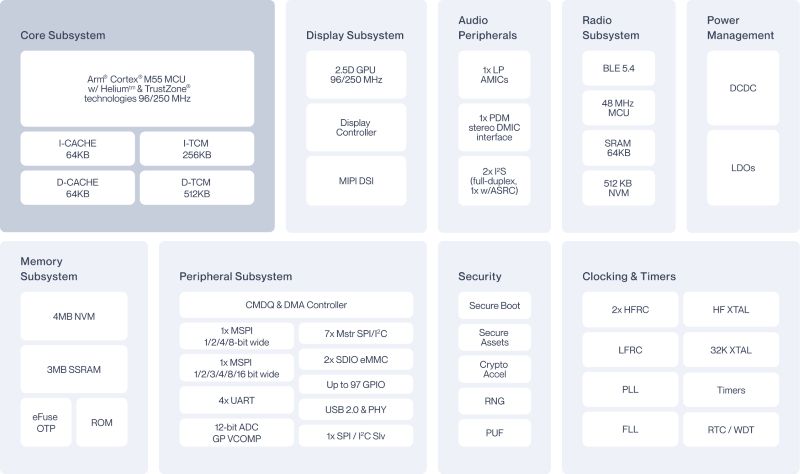
Block diagram showing specifications for the Apollo 510B SoC, including serial peripherals. Image used courtesy of Ambiq
Powerful Graphics, Advanced Security
For applications requiring a user interface, the Apollo510B includes a graphiqSPOT 2.0 graphics engine. This hardware features a 2D/2.5D GPU with vector graphics acceleration, as well as hardware-accelerated anti-aliasing and alpha blending to support more visually demanding applications. The display interfaces support MIPI DSI 1.2 and QuadSPI, enabling resolutions up to 640 x 480 at 60 FPS.
For security, Ambiq’s secureSPOT 3.0 and Arm TrustZone technologies are integrated onto the Apollo510B. This suite of security features includes secure boot, a physical unclonable function (PUF)-based identity, and secure over-the-air updates to protect the integrity of the device and its data.
Edge AI Applications
In summary, the Ambiq Apollo510B is a SoC designed to enable energy-efficient, high-performance edge computing by combining an Arm Cortex-M55 core with a suite of integrated peripherals, a dedicated Bluetooth radio, and advanced security and graphics engines. Ambiq has designed the Apollo510B for a range of applications that demand both intelligence and low power, including smartwatches, smart home devices, body-worn and ambient AI systems, patient health monitoring, and industrial edge computing.


