
AMD Announces Ryzen AI Embedded P100 and X100 Series Processors
The new processors combine Zen 5 CPU cores, AMD RDNA 3.5 GPU, and AMD XDNA 2 NPU to power AI-driven automotive and industrial applications at the edge.
AMD has launched its Ryzen AI Embedded processor family, introducing the P100 and X100 series designed specifically for edge AI applications in automotive, industrial, and autonomous systems.
The processors combine AMD’s Zen 5 CPU architecture with an RDNA 3.5 GPU and XDNA 2 NPU, enabling concurrent handling of deterministic control tasks, real-time graphics rendering, and AI inference workloads. This heterogeneous approach addresses the growing requirement for edge devices to process AI models locally while maintaining strict timing constraints for safety-critical functions.
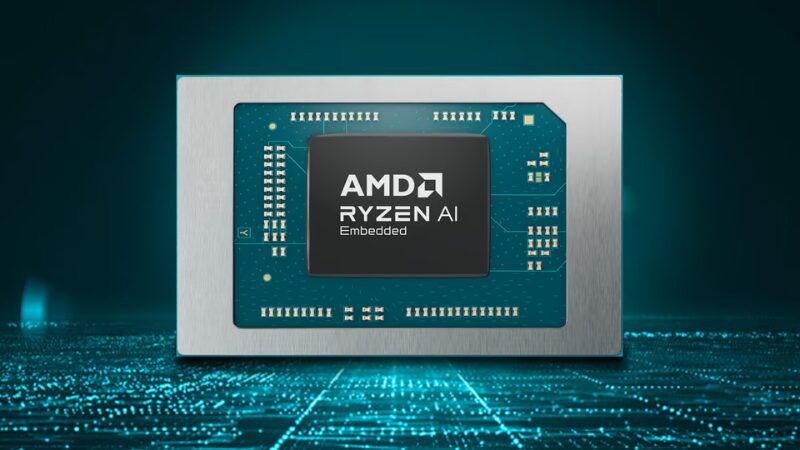
AMD has released the Ryzen AI Embedded P100 and X100 series processors for AI-driven applications. Image used courtesy of AMD
AMD Ryzen AI Embedded Processors
The P100 series processors feature up to six Zen 5 CPU cores operating at frequencies reaching 4.5 GHz, delivering what AMD characterizes as a 2.2x performance improvement over the previous Ryzen Embedded V2000 generation in both single-threaded and multi-threaded workloads. The processors include 8 MB of shared L3 cache and support DDR5-5600 or LPDDR5X-8000 memory with ECC capability.
The P100’s graphics processing leverages the RDNA 3.5 architecture with up to two work group processors, capable of driving four 4K displays at 120 frames per second or two 8K displays at the same refresh rate. AMD reports an estimated 35% increase in rendering performance over the V2A46 processor, as measured by GFXBench 5.0.0 Vulkan benchmarks. The integrated video codec engine handles encoding and decoding operations independently of the CPU, reducing latency for streaming applications.
The XDNA 2 NPU delivers up to 50 TOPS of AI inference performance, a threefold increase over the 16 TOPS of the Ryzen Embedded 8000 series. The architecture supports vision transformers, compact LLMs, and convolutional neural networks commonly deployed in automotive and industrial vision systems.
The AMD Ryzen AI Embedded P100 series is available in 4- and 6-core variants. Video used courtesy of AMD
Software Stack and Thermal Design
AMD has built its software environment on the open-source Xen hypervisor, which isolates multiple operating system domains. This architecture enables simultaneous execution of Yocto or Ubuntu for human-machine interfaces, FreeRTOS for real-time control loops, and Android or Windows for application-level functions. The hypervisor ensures temporal and spatial partitioning between domains, a requirement for ASIL-B capable systems in automotive applications.
The P100 series operates across a 15-54 W TDP range with junction temperatures from -40°C to 105°C in industrial variants. Automotive-grade versions carry AEC-Q100 qualification and support extended temperature ranges with additional reliability features, including LPDDR5X reliability, availability, and serviceability extensions. The processors include two 10 Gigabit Ethernet ports with time-sensitive networking support for deterministic communication in vehicle networks.
Enhancing Automotive and Industrial Systems
The initial P100 launch targets digital cockpit and industrial automation applications, with 8-core and 12-core variants scheduled to begin sampling in the first quarter of 2026. The higher-performance X100 series, featuring up to 16 cores and increased AI performance for autonomous systems and robotics, is expected to sample in the first half of 2026. AMD offers extended longevity programs providing up to 10 years of product availability for industrial and automotive deployments.


