
Bourns Releases Digital Current Sensors for Precise Current Flow Measurement
The SSD-1000A sensor series offers CANbus and RS-485 serial interface variants for high-accuracy measurement in a wide current range of 100 A to 1000 A.
The increasing prevalence of high-voltage, high-current DC systems, particularly within renewable energy infrastructure, electric vehicle charging equipment, and industrial motor drives, necessitates accurate, rapid current measurement. Historically, this has involved analog shunt measurement followed by complex signal conditioning and analog-to-digital conversion (ADC) before interfacing with a digital controller. This process introduces potential sources of noise, temperature drift, and complexity in system integration.
To address these integration challenges, Bourns has released the SSD-1000A series of DC digital current sensors that integrate the entire measurement and communication chain into a single module. The design is built on a precision shunt-based measurement architecture, which provides a fundamentally linear and stable current-sensing element compared to other magnetic-field technologies.
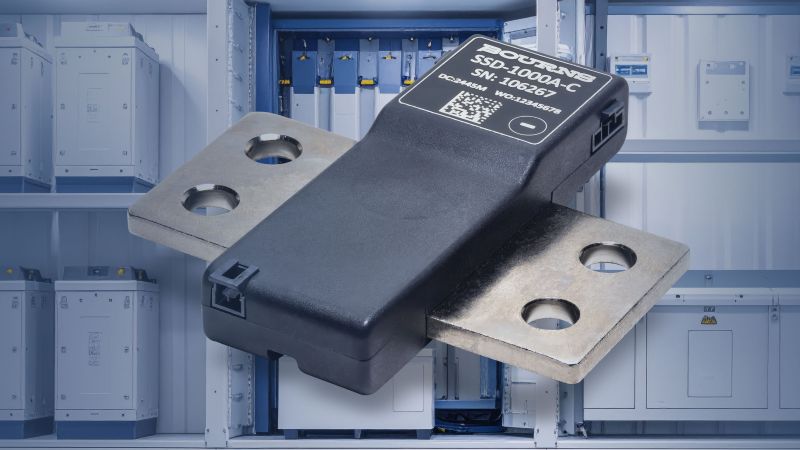
The SSD-1000A series of digital sensors is built for high-accuracy current flow measurement. Image used courtesy of Bourns
SSD-1000A Digital Current Sensor Series
The SSD-1000A series of digital current sensors is rated for a current range of 100 A to 1000 A, allowing for high-amperage monitoring and bidirectional current flow measurement common in battery charging/discharging applications. At the core of the module is an internal 24-bit ADC and a 16-bit MCU responsible for signal processing, scaling, and digital communication protocol handling.
CANbus and RS-485 Variants
The most notable feature of the SSD-1000A sensor series is the direct integration of industry-standard digital communication physical layers, eliminating the need for external transceiver circuits and streamlining system-level design. The series is offered in two main variants: the customizable CANbus model and the RS-485 serial interface model.
The SSD-CANbus variant incorporates the CANbus physical layer. CANbus offers a robust, differential signaling approach well-suited for noisy industrial and automotive environments. It supports reliable data rates up to 1 Mbps, facilitating real-time data exchange in distributed control systems.
The SSD-RS485 variant features the RS-485 physical layer, widely used in industrial automation. It enables long-distance data transmission over twisted-pair cables and is configurable for the Modbus RTU protocol.
Both sensor models operate from a single supply voltage in the range of 5.0 V DC to 60 V DC. To further simplify bus connection and configuration, an internal 120 Ω termination resistor is available as an optional feature.
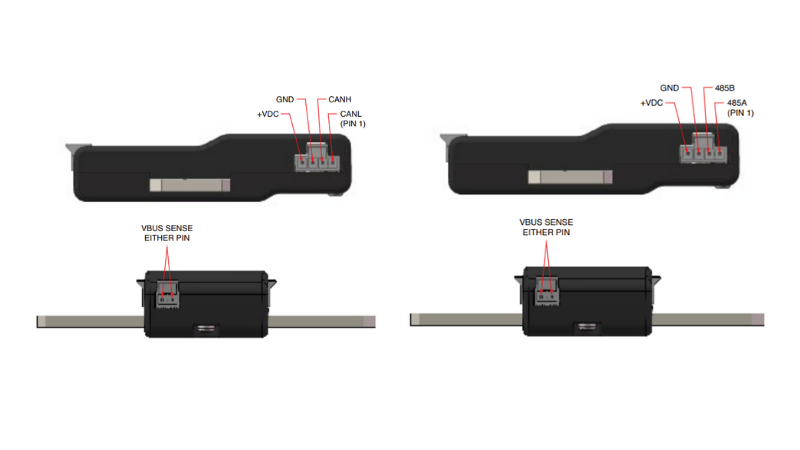
Connectors for the SSD-CANBUS (left) and SSD-RS485 (right). Image used courtesy of Bourns
Environmental Robustness and Isolation
The series’ operating temperature range spans from −40 °C to 115 °C, a specification that accommodates demanding thermal environments common in outdoor and heavy-duty applications. Safety and noise immunity are critical, particularly when measuring high currents. The devices provide high input-to-output electrical isolation, ensuring that the high-power measurement circuitry is safely separated from the low-voltage control electronics, preventing dangerous voltage transfer and mitigating the risk of ground loop interference.
Precise Current Measurement
In summary, the SSD-1000A series provides a compact, integrated current sensing solution that pairs the linearity of shunt technology with high-speed digital communication protocols. These sensors are designed to simplify the architecture of high-power monitoring systems.
Primary applications for this technology include battery management systems, electric vehicle supply equipment for charging, solar and wind power inverters, motor drives, and distributed industrial control and automation systems where high current accuracy and fast fault detection are mandatory.


