
Introducing Diodes’ I2C/SPI-Bus-to-Dual-Channel UART Bridge Controller
The new low-power I2C/SPI-bus-to-dual-channel UART bridge controller is designed to improve interconnectivity in automotive applications like telematics and advanced driver-assistance systems.
Diodes Incorporated has introduced the PI7C9X762Q, a new automotive-compliant I2C/SPI-bus-to-dual-channel UART bridge. This high-performance device is designed to improve the robustness and reliability of connectivity within modern automotive systems, particularly in electric vehicles (EVs). The new bridge IC offers a solution for designers looking to integrate multiple communication protocols efficiently while minimizing power consumption.
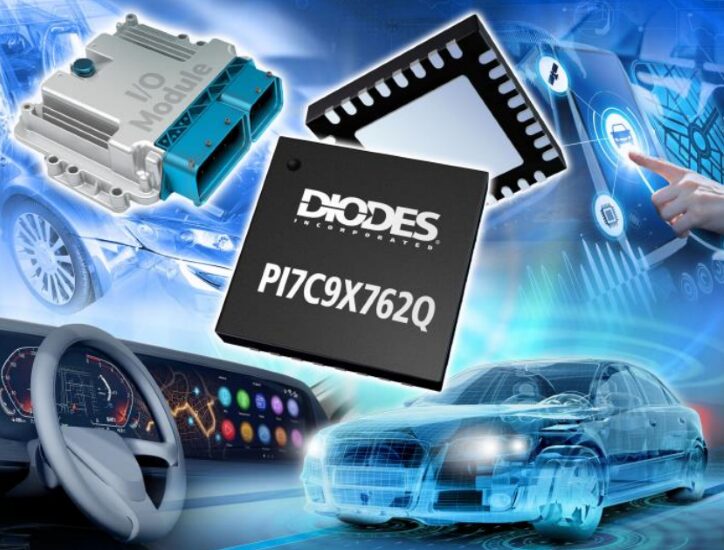
The PI7C9X762Q is an I2C-bus/SPI to UART bridge controller built for use in automotive applications, including telematics and advanced driver-assistance systems. Image used courtesy of Diodes Incorporated
Automotive I2C-Bus/SPI to UART Bridge Controller
The PI7C9X762Q functions as a protocol conversion bridge, enabling communication between a host processor on an I2C or SPI bus and external devices using a standard UART interface. This is a common requirement in complex automotive and industrial systems where a central microcontroller needs to communicate with various peripheral components, such as sensors, modules, and displays, that may use different communication protocols. The device supports full bidirectional protocol conversion, ensuring seamless data flow in both directions.
One of the key features of the PI7C9X762Q is its support for high-speed data transfer. The device can handle SPI clock speeds of up to 33 Mbps, essential for applications requiring rapid data exchange. It also includes 64 bytes of transmit (TX) and receive (RX) first-in, first-out (FIFO) buffers. These FIFOs temporarily store data, reducing the need for constant polling by the host processor and improving system efficiency. The presence of 64 bytes of FIFO helps to manage bursts of data and prevents data loss during high-volume communication.
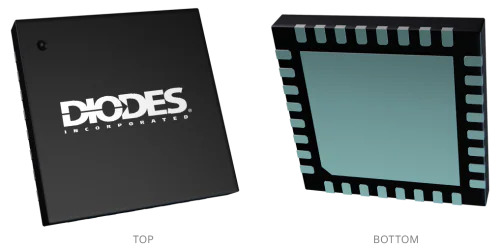
The PI7C9X762Q is available in a compact, 5 mm x 5 mm 32-contact TQFN32 package. Image used courtesy of Diodes Incorporated
Software Development
The IC also includes several features aimed at simplifying the design and software development process. It supports programmable character formatting, allowing engineers to configure the data frames to match the requirements of the connected UART devices. The internal register set is backward-compatible with other UARTs on the market, which can significantly reduce the effort required for software development when migrating or upgrading a system. The device also includes auto-hardware and software flow control mechanisms, which are critical for managing data flow and preventing buffer overflows, thus ensuring reliable communication.
Compact Automotive Compliance
The PI7C9X762Q is packaged in a compact 32-contact TQFN package of just 5 mm x 5 mm. This small footprint makes it suitable for space-constrained applications. Additionally, the device is automotive-compliant, meaning it meets the stringent quality and reliability standards required for use in vehicles. This includes robustness against a wide range of operating temperatures and electromagnetic interference (EMI).
The low-power consumption of the PI7C9X762Q, both during active operation and in a low-power sleep mode, is a significant advantage for EV designs, where power efficiency is a critical design consideration. The IC also features a software reset function and supports fractional baud rates, providing additional flexibility for system integration. For industrial and commercial applications, Diodes Incorporated also offers a standard compliance version of the device, the PI7C9X762.
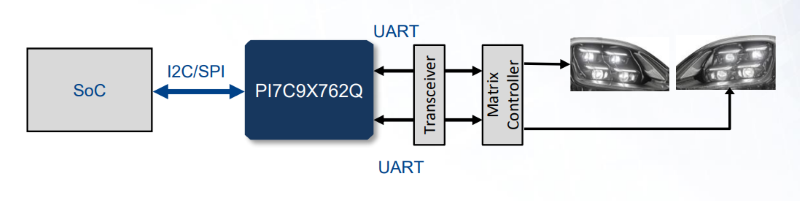
An application of the PI7C9X762Q being used in automotive matrix headlights. Image used courtesy of Diodes Incorporated
Connectivity in Automotive Systems
The new PI7C9X762Q from Diodes Incorporated is a high-performance, low-power I2C/SPI-bus-to-dual-channel UART bridge controller designed to enhance communication within electronic systems. Its key features include high-speed data transfer, 64-byte TX/RX FIFOs, and a compact footprint.
The device’s automotive-compliant design and low power consumption make it particularly well-suited for use in electric vehicle systems, including smart cockpits, central controllers, advanced driver-assistance systems (ADAS), and telematics. Its ability to provide robust and reliable connectivity between different protocols simplifies the design process for engineers and helps ensure data communication integrity in demanding environments.


