Espressif Integrates Tri-Band Wi-Fi 6E and Dual-Mode Bluetooth Into Single SoC
The ESP32-E22 SoC operates across the 2.4 GHz, 5 GHz, and 6 GHz Wi-Fi bands and supports Classic Bluetooth and Bluetooth LE 5.4 for advanced wireless connectivity in industrial and consumer markets.
Espressif Systems has launched the ESP32-E22, marking the company’s entry into Wi-Fi 6E with a device positioned as a radio co-processor for host-based system architectures. Unlike Espressif’s standalone SoCs, the ESP32-E22 handles the complete wireless protocol stack while allowing a separate application processor to manage system logic. The device supports 2.4 GHz, 5 GHz, and 6 GHz operation, giving designers access to the less congested spectrum above 5.925 GHz for the first time in the ESP32 product line.
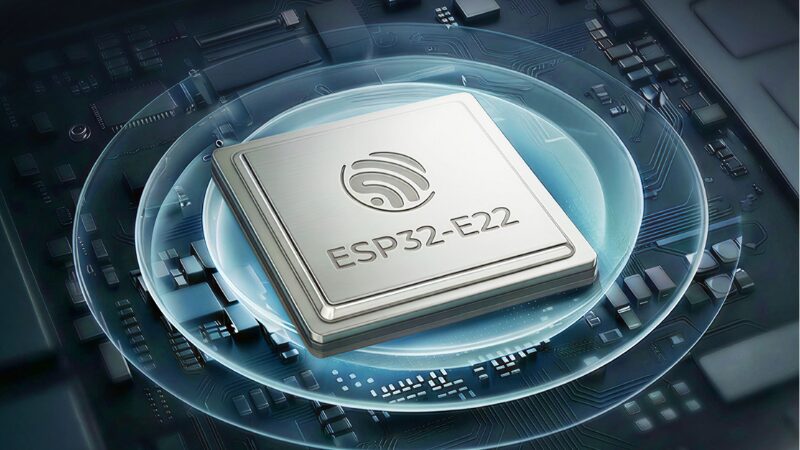
Espressif’s ESP32-E22 Wi-Fi 6E SoC for wireless industrial and consumer devices. Image used courtesy of Espressif Systems
Wi-Fi 6E Connectivity Co-Processor
Espressif’s ESP32-E22 Wi-Fi 6E SoC implements a radio co-processor model in which the device manages Wi-Fi and Bluetooth protocol stacks internally, without exposing these tasks to the host processor. System designers connect ESP32-E22 to application processors through PCIe 2.1 or SDIO 3.0 interfaces, depending on throughput requirements and existing system constraints. This architecture separates wireless subsystem development from application software, potentially simplifying certification processes and allowing independent updates to each domain.
The SoC’s dual-core RISC-V processor operates at 500 MHz and executes Espressif’s internally developed Wi-Fi 6E protocol stack. This in-house development approach gives Espressif direct control over stack optimization and long-term maintenance rather than relying on third-party IP licensing. The processor supports 1024-QAM modulation, enabling theoretical data rates of up to 2.4 Gbps under optimal conditions with 160 MHz channels in the 6 GHz band.
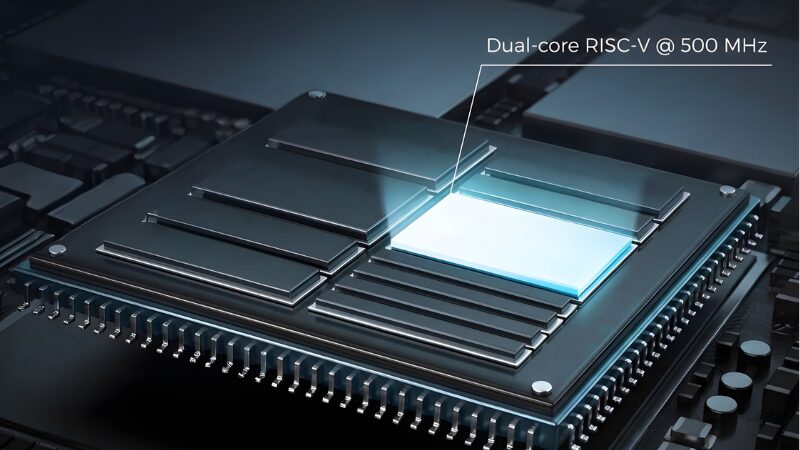
Espressif has built the ESP32-E22 on its in-house dual-core 500 MHz RISC-V processor. Image used courtesy of Espressif Systems
Wi-Fi 6E and Bluetooth Integration
Wi-Fi 6E extends the 802.11ax standard into the 6 GHz frequency range, providing access to up to seven 160 MHz channels that are relatively free of legacy device interference. The ESP32-E22 implements 2×2 MU-MIMO, beamforming, and orthogonal frequency-division multiple access to improve performance in environments with multiple concurrent users.
The Bluetooth subsystem supports both Bluetooth Classic and Bluetooth LE 5.4, allowing connectivity with audio accessories, peripherals, and low-energy sensor networks through a single radio. Coexistence algorithms coordinate operation when Wi-Fi and Bluetooth radios operate simultaneously, managing interference and scheduling to maintain reliable performance for both protocols. This becomes particularly relevant in applications requiring concurrent video streaming over Wi-Fi while maintaining Bluetooth audio links.
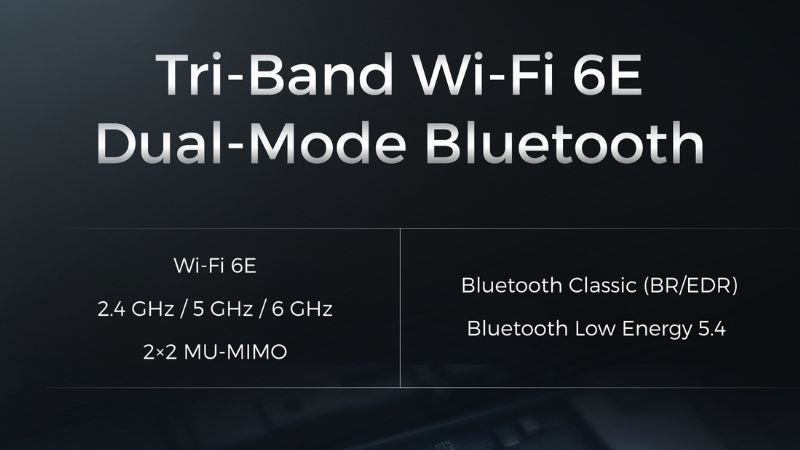
Espressif integrates tri-band Wi-Fi 6E and dual-mode Bluetooth into a single SoC. Image used courtesy of Espressif Systems
Flexible Wireless Connectivity
The combination of tri-band Wi-Fi 6E and dual-mode Bluetooth positions the ESP32-E22 for applications requiring high wireless throughput without burdening the main processor. Video streaming devices benefit from the 6 GHz band’s clean spectrum and high bandwidth, particularly in apartment buildings or office environments where 2.4 GHz and 5 GHz channels are heavily congested. Smart home hubs can leverage the device to manage multiple concurrent connections while maintaining low latency for control commands.
Industrial automation systems benefit from reliable, high-speed wireless links for machine vision and control applications. AR and VR accessories require low-latency wireless connections to maintain acceptable user experiences, making the combination of Wi-Fi 6E and efficient protocol handling relevant for these emerging categories.
Engineering samples are now available through Espressif’s customer support channels. The ESP32-E22 expands Espressif’s product range beyond its established standalone SoC offerings into the co-processor segment, targeting designs where system architects prefer separating wireless subsystems from application processing while gaining access to the 6 GHz spectrum.