
Forlinx FET1126Bx-S: Rockchip RV1126 Edge AI SoM for Vision Systems
A 40×40 mm industrial SoM with quad-core Cortex-A53, 3 TOPS NPU, 4K video, dual cameras, and long-term supply, paired with a feature-rich OK1126Bx-S carrier board.
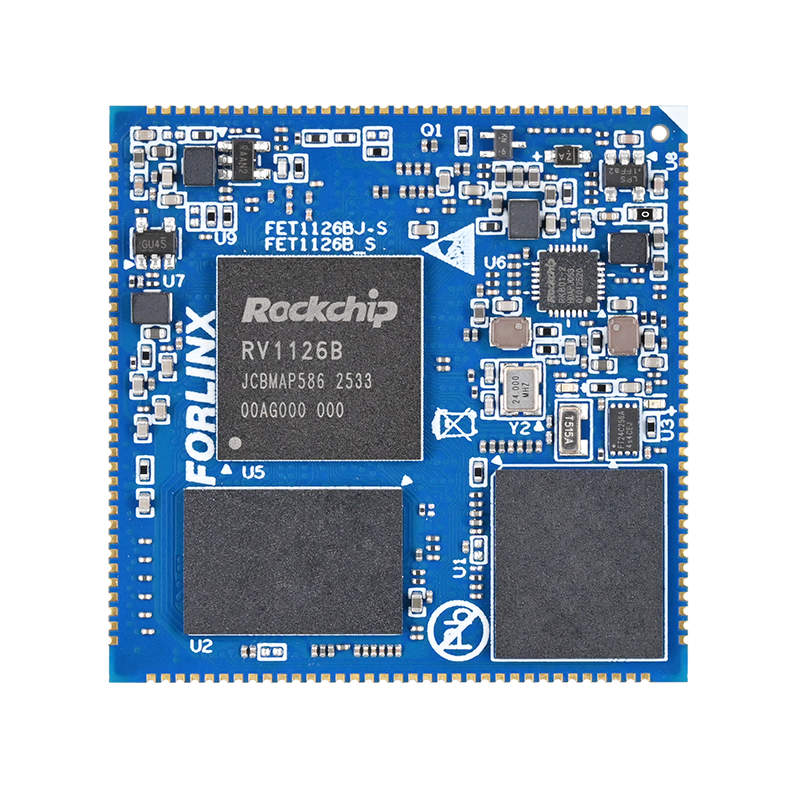
FET1126Bx-S Industrial SoM
Forlinx Embedded Technology recently announced the official release of the FET1126Bx-S (Rockchip RV1126B/RV1126BJ) Industrial System on Module (SoM). This compact module (40 mm × 40 mm), specifically designed for edge-side AI computing, provides a high-performance, affordable solution for intelligent recognition and real-time video analysis in demanding industrial environments. Forlinx Embedded Laboratory has rigorously tested it for industrial-grade stability, guaranteeing dependable performance and a 10- to 15-year lifespan for steady long-term supply.
The Rockchip RV1126B (commercial) or RV1126BJ (industrial) SoC is the basis for the development and design of the FET1126Bx-S low-power industrial System on Module (SoM). This newer RV1126B/BJ SoC comes with a noteworthy architectural upgrade with a 64-bit quad-core Arm Cortex-A53 processor and a more powerful 3.0 TOPS NPU. FET1126Bx-S features quad-core Arm Cortex-A53 central processing unit (CPU) up to 1.6 GHz commercial and 1.3 GHz industrial, H.265/H.264 4K hardware decoding, 12 megabits per second image signal processor (ISP), dual network ports, and 2x mobile industry processor interface camera serial interface (MIPI-CSI). For evaluation, the company also offers the OK1126Bx-S carrier board/development board, which has a 40-pin GPIO header compatible with Raspberry Pi.

Forlinx FET1126Bx-S Industrial SoM Front and Back
Forlinx FET1126Bx-S Specifications:
- Core Processing:
- SoC: Rockchip RV1126B (commercial grade) or RV1126BJ (industrial grade)
- CPU Architecture: Quad Arm Cortex-A53
- Clock speed up to 1.6 GHz (commercial) or 1.3 GHz (industrial)
- Cache configuration: 32 KB L1 instruction cache + 32 KB L1 data cache per core, with a shared 512 KB L2 cache
- Graphics: Integrated 2D graphics accelerator
- AI Engine: Dedicated Rockchip NPU
- Performance up to 3 TOPS (INT8)
- Compatible with TensorFlow, TensorFlow Lite, Caffe, PyTorch, ONNX, Android NN, and other common AI frameworks
- Video, ISP and Multimedia:
- Hardware Video Decoder: H.264 / H.265 up to 4K (3840 x 2160) at 30 fps
- Hardware Video Encoder: H.264 / H.265 / JPEG up to 12 Mbps at 30 fps
- JPEG Decoder: Supports image resolutions ranging from 48×48 to 65520×65520
- Image Signal Processor (ISP):
- VICAP input: RX raw8/raw10/raw12/raw14/raw16
- 12 MP at 30 fps standard pipeline
- AI-ISP: 8 MP at 30 fps
- Maximum supported resolution: 4096 x 4096
- Memory and Storage:
- System Memory: LPDDR4 RAM, configurable as 1 GB / 2 GB / 4 GB
- On-board eMMC:
- Commercial version: fixed 64 GB
- Industrial version: 8 GB / 16 GB / 32 GB options
- Removable Storage: SD Card interface (SDIO 3.0)
- Display Output:
- MIPI-DSI: 4-lane interface, up to 1.5 Gbps per lane, suitable for FHD panels
- Parallel Digital Video:
- BT.656 for SD
- BT.1120 for HD/FHD displays with embedded synchronization
- RGB Interface: 24-bit parallel RGB, up to 1920 x 1080 @ 60 Hz
- Maximum Display Resolution: 1920 x 1080 @ 60 fps
- Camera:
- MIPI-CSI Inputs:
- Up to 2 camera interfaces
- Dual 4-lane MIPI D-PHY v1.2 (up to 2.5 Gbps per lane)
- Supports MIPI-CSI, LVDS, and Sub-LVDS
- Virtual channel capability
- Parallel Camera Input (DVP):
- Pixel clock up to 150 MHz
- Compatible with BT.601, BT.656, and BT.1120 standards
- MIPI-CSI Inputs:
- Audio:
- Up to 3x Serial Audio Interface (SAI) (master or slave mode)
- 2x differential microphone inputs
- 2x differential Delta-Sigma Modulator (DSM) audio outputs
- Networking:
- Configurable Ethernet Support:
- 1x RGMII interface or
- 1x 10/100 Mbps Ethernet with integrated PHY
- Configurable Ethernet Support:
- USB:
- 1x USB 2.0 Host
- 1x USB OTG supporting USB 2.0 / USB 3.0 dual-role operation
- Expansion
- GPIO: Up to 118 programmable pins (excluding module-internal usage)
- UART: Up to 8 ports, data rate up to 4 Mbps; UART1–UART7 support automatic flow control
- CAN Bus: Up to 2x CAN 2.0A/B
- SPI:
- Up to 2 SPI master/slave controllers
- FSPI supported for boot (1-bit / 2-bit / 4-bit modes)
- SD / SDIO:
- 1× SD card interface
- Up to 2× SDIO 3.0 plus 1× SDIO (3.3 V)
- I²C: Up to 5 controllers, 7-bit / 10-bit addressing, speeds up to 1 Mbps
- PWM: Up to 27 independent PWM channels
- ADC: Up to 24 analog inputs, 13-bit resolution, 2 MSPS
- DSMC Interface:
- FPGA host interface
- 4 chip-select signals
- Supports 8-wire and 16-wire serial modes
- Power Supply:
- Input Voltage: 5 V DC
- Typical Power Consumption:
- Idle / standby (no load condition): 0.505 W
- Camera active: 0.9 W
- Camera + 7″ MIPI display + video playback: 1.34 W
- Full CPU load: 1.51 W
- Maximum stress (CPU, RAM, eMMC): 1.97 W
- Mechanical and Form Factor:
- Module Size: 40 mm × 40 mm
- Connector Pins: 237
- 140 stamp-hole pins (1.0 mm pitch)
- 97 LGA pads (1.27 mm pitch)
- Environmental Specifications:
- Commercial Grade (RV1126B): −20 °C to +85 °C
- Industrial Grade (RV1126BJ): −40 °C to +85 °C
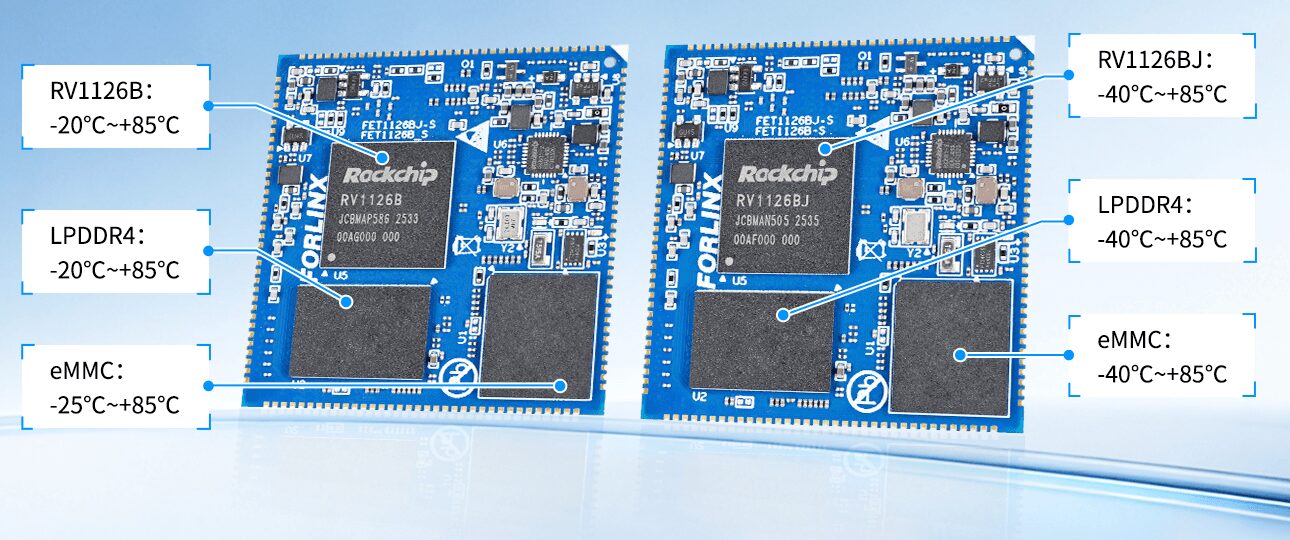
Forlinx FET1126Bx-S Industrial SoM Environmental Specifications
The company has also developed the OK1126Bx-S carrier board, a compact baseboard for Forlinx RV1126 series SoMs, designed to support edge AI and vision applications. The board integrates essential interfaces including MIPI-CSI camera connectors, display output, Gigabit Ethernet, USB, CAN FD, UART, SPI, I2C, and GPIOs—making it well suited for smart cameras and industrial AI-based systems. It simplifies development by providing a stable power supply, convenient debugging support, and easy peripheral expansion.

OK1126Bx-S carrier board
Forlinx OK1126Bx-S Carrier Board Specifications:
- SoM: Forlinx FET1126Bx-S as specified above
- Storage:
- MicroSD card slot, supports high-speed operation up to SDR104
- FSPI interface available for booting from external flash memory
- Display:
- LCD interface via pin headers, supports capacitive touch and backlight brightness control
- 4-lane MIPI DSI interface, supports capacitive touch and backlight brightness control
- Camera: 2x MIPI CSI via FPC connectors (4-lane + 4-lane)
- Audio:
- Speaker output via onboard power amplifier (Drives an external 4 Ω / 3.3 W speaker)
- Up to 2x microphones input (Includes one onboard microphone)
- Networking:
- Ethernet (Note: Only one Ethernet port can be active at any time due to a single MAC):
- 100 Mbps Ethernet via RJ45
- Gigabit Ethernet via RJ45
- Wireless: Dual-band Wi-Fi 5 (802.11ac) operating on 2.4 GHz and 5 GHz and Bluetooth 4.2 via FN-LINK 6221ASRC module with single antenna configuration
- Ethernet (Note: Only one Ethernet port can be active at any time due to a single MAC):
- USB:
- USB 3.0 Host Type-A port
- USB 2.0 Host Type-A port
- USB Type-C port used for flashing and debugging
- Expansion:
- 40-pin Raspberry Pi-compatible GPIO header with 2× CAN, 2x I2C, 1x SPI, 1x UART
- 7x ADC channels accessible via an onboard 8-pin header
- Debugging: Integrated USB-to-serial interface accessible through the USB Type-C port
- Misc:
- RTC supported via external CR2032 coin-cell battery (onboard connector)
- Hardware toggle switch for boot configuration
- Dedicated push buttons for power, reset, and firmware update
- Power:
- Supply: 12 V DC via barrel jack
- Typical Power Consumption (including SoM):
- Idle / Standby (no load): 1.27 W
- Camera operation: 2.26 W
- Camera + 7-inch MIPI display + video playback: 4.66 W
- Maximum CPU load: 2.24 W
- Dimensions: 120 mm x 75mm

Forlinx OK1126Bx-S Carrier Board Specifications
Software-wise, the FET1126Bx-S is compatible with Linux 6.1 and can be flashed using a MicroSD card or USB OTG. User and build instructions, factory images, kernel source code, drivers, test programs, file systems, flashing tools, development environments, and examples of AI algorithms are all included in the Linux BSP. Kernel source code, drivers, development tools, sample applications, and examples of AI algorithms are all included in Forlinx’s software package. Additionally, the platform facilitates the deployment of models from frameworks like TensorFlow and PyTorch using Rockchip’s RKNN toolchain. All the necessary information can be found on the Forlinx Documentation Main Page.
Pricing details for their SoM and development boards are not listed on the Forlinx product page, and the FET1126Bx-S SoM and OK1126Bx-S carrier board are no exception. A handful of additional information could potentially be uncovered from the product page.
Images used courtesy of Forlinx


