
GigaDevice Enters EEPROM Market with Rugged GD24CL Series
A new non-volatile memory family offers four million cycles and hardware ECC for high-reliability data storage in demanding industrial and IoT environments.
GigaDevice has expanded its non-volatile memory portfolio by introducing its first EEPROM product family, the GD24CL series. Aimed at meeting requirements for stable, long-term configuration storage, these devices are designed for systems operating in challenging environments such as data centers, networking, and industrial automation.
Enhanced Endurance and Data Integrity
The core focus of the GD24CL series is operational longevity and robustness during frequent data modification cycles. The devices offer a rated endurance of up to 4 million program/erase cycles, providing a significant margin over standard alternatives for applications requiring constant parameter updates. Alongside this endurance, the series guarantees up to 100 years of data retention. To further safeguard information against potential corruption, the family integrates hardware-level Error Correction Code (ECC) functionality. The hardware implementation functions directly within the device to maintain data integrity over a wide operating temperature range spanning from -40°C to 125°C.
To protect against system malfunctions or unauthorized alterations, GigaDevice incorporates hardware protection mechanisms. A dedicated write-protect pin allows designers to enforce hardware-level write prevention during anomalous events or software faults. For permanent data safeguarding, the devices also feature a write-lockable Security Page. Once this page is locked, the stored core data becomes unalterable, establishing a permanent barrier against tampering.
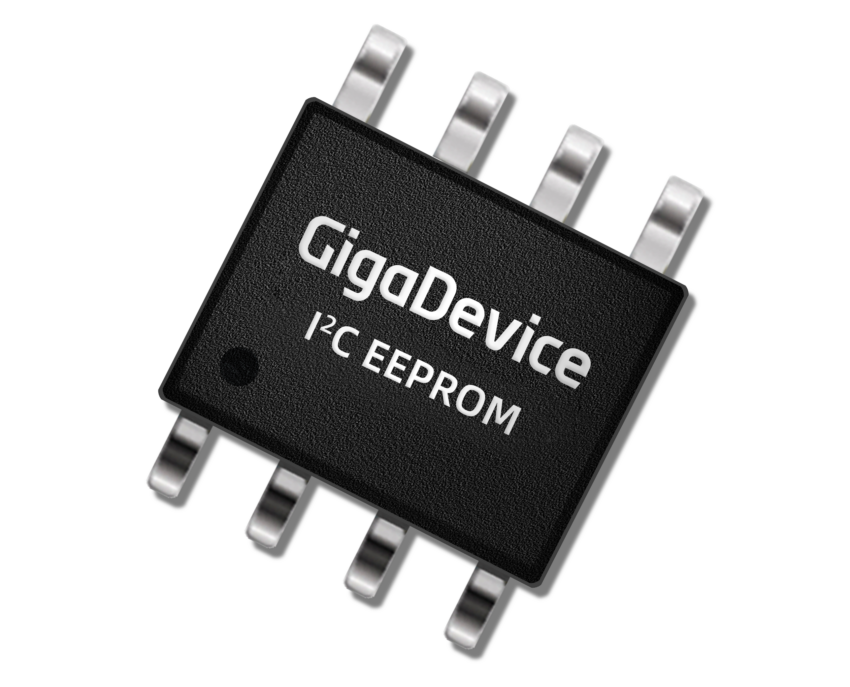 Designed for harsh environments, the new I²C EEPROM features internal hardware ECC and a 4-million cycle endurance rating to prevent configuration data corruption. Image used courtesy of GigaDevice
Flexible Interface and Low-Power Operation
Communication with host systems occurs via a simple low-pin-count I²C bus interface. The series supports three distinct clock frequency options of 100kHz, 400kHz, and 1MHz, accommodating both legacy low-speed sensors and higher-throughput industrial control buses. Efficiency is further supported by full byte-level random read and write capabilities, allowing designers to perform granular parameter modifications without rewriting entire pages, thereby improving overall system-level write efficiency.
Power consumption is structured around power-sensitive and remote tracking requirements. Operating across a wide voltage spectrum of 1.7V to 5.5V, the components exhibit a standby current of 1µA. Active read current remains at 1 mA, while active write current peaks at 1.5 mA. To aid compact design efforts, the family comes in multiple form factors, including SOP8, TSSOP8, and a 2×3 mm UDFN8 package.
The initial product sampling is the 256Kb variant, designated as the GD24CL256B, with capacities across the broader family planned to range from 32Kb to 1Mb. It is interesting to see GigaDevice expand beyond its traditional Flash memory and 32-bit microcontrollers into the EEPROM market. This hardware-level ECC and high-cycle endurance make the series well-suited for industrial IoT terminals, green data centers, and critical industrial control infrastructure, where unexpected data loss or parameter corruption could compromise entire systems.


